Hugh Jackman delivers his slicey swan song as Wolverine in Logan, the R-rated for-realsies conclusion to the arc of Marvel’s famous X-Man. This week’s gallery pays tribute to the Marvel movies that existed before and now compete with the Marvel Cinematic Universe — read on for the best & worst Marvel movies (outside the MCU)!
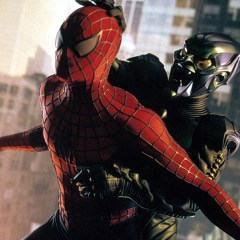
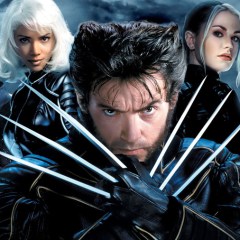
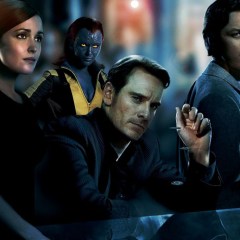
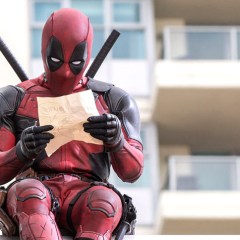
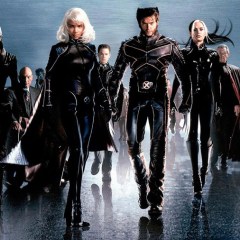


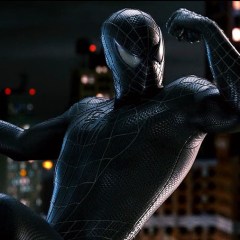
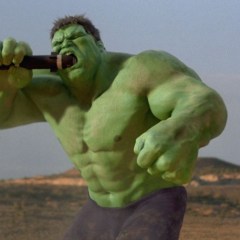
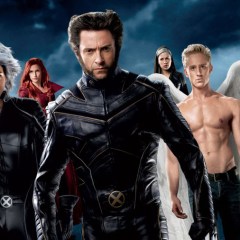

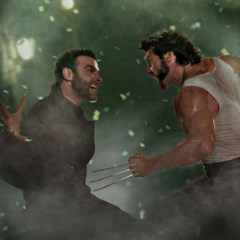

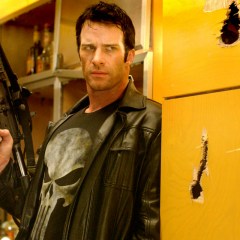
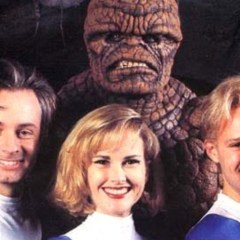
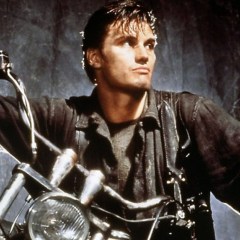
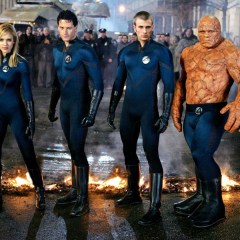
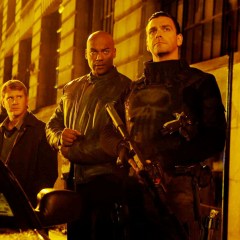
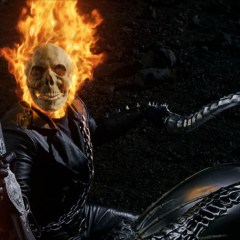
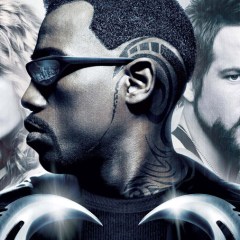
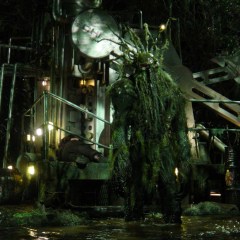
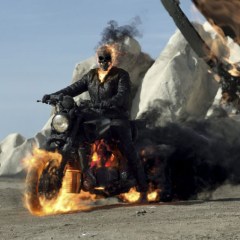
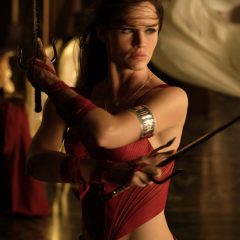

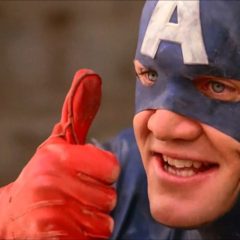
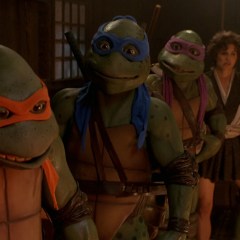
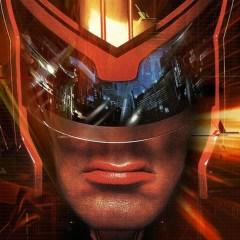
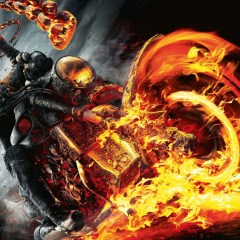
There has yet to be a Fresh-rated entry in the Teenage Mutant Ninja Turtles movie franchise (whose latest installment, Out of the Shadows, is out Friday), not that it matters much considering how deep “Ninja Rap” runs in our nostalgia veins. The Turtles, in fact, are in fine company as comic adaptations have walked a long, ignominious road in Hollywood, inspiring this week’s gallery: the 24 worst-reviewed comic book movies by Tomatometer!

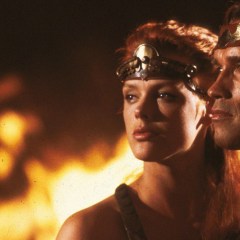
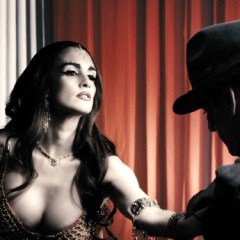
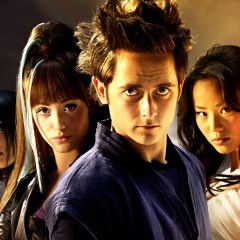



Happy Valentine’s Day weekend, kinky film fans! Hearts, flowers and candy are nice if you like that sort of thing, but for those of a more…adventurous persuasion, your average rom-com simply won’t suffice for February 14 viewing. But never fear — your pals here at Rotten Tomatoes have taken it upon ourselves to put together a list of boundary-pushing film releases from the past, organized according to the taboos they busted. Remember that safe word, because it’s time for Total Recall!
Clocking in at under a minute, this 1896 short was commissioned by Thomas Edison for director William Heise, and features little more than a pair of actors (May Irwin and John Rice) recreating their smooch from the stage musical The Widow Jones. It’d be the stuff of little-seen YouTube uploads today, but at the time, the sight of people kissing on screen was nothing short of scandalous — as one review seethed, “The spectacle of the prolonged pasturing on each other’s lips was beastly enough in life size on the stage but magnified to gargantuan proportions and repeated three times over it is absolutely disgusting.” It all seems awfully quaint now, but it just goes to show you how social mores change over time.
We’ve already established that audiences were scandalized by the sight of actors smooching in 1896’s The Kiss, and they were driven to distraction all over again roughly 15 years later by something almost as innocuous: the infamous “gaucho dance” depicted in Urban Gad’s The Abyss. The scene, which finds our protagonist Magda Vang (Asta Nielsen) seducing a potential conquest she’s lassoed to a chair, is exceedingly tame by today’s standards — but by the same token, there’s no mistaking Magda’s aim with that dance, and the notion that a young lady could possibly be so unabashedly forward on the silver screen was enough to send U.S. censors’ scissors into prudish conniptions. Already a leading lady of the stage when The Abyss was filmed, Nielsen enjoyed international stardom afterward (and married Gad, too).
People who refuse to watch films with subtitles out of a misguided belief that they’re boring are cheating themselves in lots of ways — and anyway, lots of movies are well worth reading on the screen. Take Ingmar Bergman’s Persona, a career high point from the Swedish master that bedeviled censors with controversial content both visual (a quick glimpse of an erect penis) and aural (a monologue detailing one character’s adulterous outing with several underage boys and her subsequent abortion). Persona‘s pleasures run deeper than the merely prurient, however; as Richard Brody pointed out for the New Yorker, “Bergman blends a theatrical subjectivity with a tactile visual intimacy, with his characters, the objects close at hand, and the superb coastal landscape.”
Like In the Realm of the Senses, Melvin Van Peebles’ Sweet Sweetback’s Baadasssss Song featured scenes of unsimulated sex — but Van Peebles decided to kick cinematic sand in another taboo’s eyes while he was at it, hiring his 13-year-old son Mario to stand in as Sweetback’s youthful proxy for a flashback scene depicting the character losing his virginity (to a prostitute, natch). A landmark for black filmmaking with or without its most provocative moments, Sweetback set off the Blaxploitation trend while earning approval from critics like the Chicago Reader’s Dave Kehr, who called it “A shrewd and powerful mix of commercial ingredients and ideological intent.”
Perhaps convinced he hadn’t elevated enough blood pressures with the nude male wrestling match he depicted in Women in Love, director Ken Russell kicked things up a notch with The Devils, which centers on the religious hysteria fomented in a 17th-century French town where the Church is convinced demonic tomfoolery is transpiring. As it turns out, they have a few things to worry about, including a nun orgy and a randy Vanessa Redgrave, who brings Our Lord and Savior down from the cross so she can have her way with Him. While a number of critics resented Russell’s over-the-top lurid approach, The Devils resonated with plenty of others, including Ken Hanke of the Mountain Xpress, who deemed it “Quite frankly one of the greatest films ever made. Period. No qualifiers are necessary.”
An erotic drama about a widower’s anonymous affair starring one of the most famous actors in the world, 1972’s Last Tango in Paris might have catapulted director Bernardo Bertolucci to infamy even if he hadn’t worked overtime to come up with the most deliberately transgressive sex scenes possible — including the infamous tête-à-tête that unravels after Marlon Brando tells Maria Schneider to “go get the butter.” Neither Brando nor Schneider were happy with Bertolucci after making Paris; in fact, Schneider held a grudge against the director for the rest of her life. No apologies were necessary for most critics, however — and some of them even saw past all the steamy goings-on, including Jamie Russell of the BBC, who argued that it’s “actually a dark, torrid masterpiece about love and grief.”
Nicolas Roeg’s Don’t Look Now — a 1973 adaptation of the Daphne du Maurier short story about a pair of grieving parents (Donald Sutherland and Julie Christie) haunted by memories (and possibly more) of their dead daughter — is probably one of the least sexy films on this list. For the bulk of its running time, it’s a stylishly creepy meditation on grief with a dash of supernatural horror tossed in — but then there’s that one scene where Sutherland and Christie are getting ready to go out for the evening, and they opt for a nude interlude in which Sutherland… orders an appetizer. So realistic that rumors persisted for decades the on-screen coitus was unsimulated, it earned Don’t Look Now an X rating in the U.S., but it certainly didn’t damage the movie’s standing with critics. “It’s a ghost story; it’s a meditation on time, memory and the poignancy of married love,” wrote Peter Bradshaw for the Guardian. “And it’s a masterpiece.”
Onscreen sex can seem awfully realistic, but we take it as a given that it’s simulated — except in the rare instances when the stars are actually in flagrante delicto. For example, there’s Nagisa Oshima’s In the Realm of the Senses, an overall forcefully provocative drama about the increasingly sordid affair between a former prostitute (Eiko Matsuda) and the owner of the hotel where she works as a maid (Tatsuya Fuji). Also noteworthy for its (definitely no pun intended) climactic scene in which Fuji suffers a fate familiar to anyone who’s watched Lars von Trier’s Antichrist, Senses raised eyebrows for its depictions of unsimulated sexual activity (and later shook booties with the Chaz Jankel song “Ai No Corrida,” inspired by the movie’s Japanese title) — and wowed critics like Empire’s David Parkinson, who called it “An undeniably powerful, stylish and impressive piece of work.”
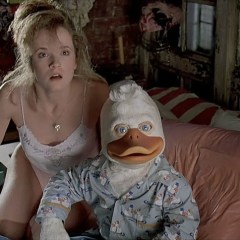
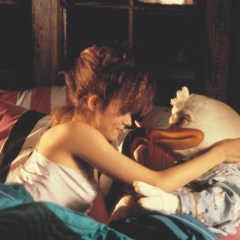
Sometimes, what works on the page just doesn’t seem right on the screen. Take, for example, the infamous Howard the Duck, which took Marvel’s beloved off-kilter cult comic — rife with counter-culture humor and endowed with a richly subversive point of view — and turned it into a cruddy would-be comedy in which a creepy-looking duck tries to get it on with Lea Thompson. Neither smart nor funny enough for adult audiences, and too clumsily dark and ribald for kids, Howard went down in history as one of cinema’s biggest duds — as well as the one and only time a screenwriter attempted a duck-woman pairing. That contribution to history aside, this turkey has few friends in the critical sphere aside from the Orlando Sentinel’s Jay Boyar, who argued, “It’s hard to fault the tongue-in-bill high spirits of a movie like Howard the Duck.”
Religious folk tend to get a little testy when Jesus is depicted as fallible in any fundamental way, and the conservative community reacted to the news of Martin Scorsese’s The Last Temptation of Christ by marshalling the moral majority long before a single frame of the film had even been screened. Their concerns were met with a movie that, while ultimately more or less faithful to the rough contours of the crucifixion story, added a few narrative wrinkles that disturbed less accommodating viewers — including a brief scene that depicted Christ (Willem Dafoe) consummating his marriage to Mary Magdalene (Barbara Hershey). Controversy aside, the end result resonated with many critics, including Carol Cling for the Las Vegas Review-Journal, who wrote that it was “Stunning and heartfelt; Scorsese at the height of his power and artistry.”
All things considered, Paul Verhoeven’s Basic Instinct is little more than a slickly assembled, eminently well-cast upgrade from your average late ’80s/early ’90s late-night softcore thriller. But even a little dramatic heft can go an awfully long way when a filmmaker is offering some extra T&A — and Instinct packed some extra taboo-busting firepower in the form of its most famous scene, during which femme fatale Sharon Stone toys with her interlocutors during police questioning by languidly crossing her legs and giving the cops (not to mention all the folks in the audience) a glimpse of what her mama gave her. Often imitated, never duplicated (not even in the long-delayed, ill-advised sequel), Instinct‘s enthusiastically trashy box office triumph inspired a slew of similarly wardrobe-challenged dramas in the years to come, although few if any inspired the level of modest critical acclaim expressed in Basic reviews like the one written by Antagony & Ecstasy’s Tim Brayton, who mused, “Through all this, there remains that calm center of nasty, brilliant social insight.”
Before E.L. James built a publishing empire out of Anastasia and Christian’s sadomasochistic exploits, the film world had its own celebrity dominating/submissive couple: E. Edward Grey (James Spader) and Lee Holloway (Maggie Gyllenhaal), whose decidedly unorthodox love affair is chronicled in Steven Shainberg’s 2002 film Secretary. Expanded and adapted from author Mary Gaitskill’s short story Bad Behavior, it earned a small mountain of acclaim (including a Sundance Special Jury Prize) while raising countless eyebrows with its depiction of a relationship that, loosely speaking, begins with the new confidence awakened in an emotionally troubled young woman after her boss gives her a spanking in the office. But under the surface, wrote Karen Montgomery for Cinerina, “It’s an interesting exploration of people finding and accepting themselves and then finding the puzzle piece that fits this new shape.”
Lest you ever doubt the depth and breadth of Chloe Sevigny’s acting talent, simply remind yourself that she found a way to rebound from the salacious stir that erupted around her appearance in Vincent Gallo’s The Brown Bunny. Booed at Cannes (and deemed the worst film in the history of the festival by Roger Ebert), it’s probably chiefly remembered for a sequence in which Sevigny performs an apparently unsimulated oral sex act on Gallo — and while Bunny does have its share of defenders, it hasn’t aged as well as Sevigny, who’s gone on to earn widespread respect for her work in projects like Zodiac and the HBO drama Big Love.
Okay, so maybe puppet intercourse isn’t really anyone’s idea of a taboo, but we’d be remiss if we left off the unforgettable sex scene between Gary Johnston (Trey Parker) and Lisa Jones (Kristen Miller) in Team America: World Police, which found South Park creators Parker and Matt Stone sending up bombastic action movie clichés with the puerile glee of the world’s most brilliantly subversive fifth-grade boys. With puppets for stars, Parker and Stone were freed to make this scene almost as filthy as they wanted, and they took advantage with a wildly over the top few minutes that somehow still manages to feel more lifelike than the boudoir romp from Top Gun. “The puppets are extremely impressive,” observed Matthew Turner for ViewLondon, “and the fact that the strings are constantly visible is used to brilliant comedic effect, particularly during one of the film’s crudest scenes.”
A campfire, the Wyoming stars, bonding over the satisfaction of a hard day’s work… what could be more romantic, right? And yet some viewers were still scandalized by Brokeback Mountain, Ang Lee’s 2005 adaptation of the Annie Proulx short story about a pair of ranch hands (Heath Ledger and Jake Gyllenhaal) whose sheep-herding gig blooms into a secret affair that changes the lives of both men and their families — and not necessarily in a good way. Brokeback met a far cheerier fate at the box office, where it earned nearly $200 million while reaping scads of positive reviews on its way to netting three Academy Awards (including Best Director for Lee) against eight nominations. “If you have the patience to sit through a slow-moving romance and you lack the vanity to be put off by explicit cowboy on cowboy relations,” suggested Brian Marder of Hollywood.com, “you’ll greatly appreciate the light at the end of Brokeback Mountain, a work of art that’s more than just a movie.”
Finally, here’s the earliest example of on-screen censorship, as displayed in Thomas Edison’s 1897 short, Fatima:
Enter Marvel Movie Madness, wherein Rotten Tomatoes watches all of the significant Marvel movies ever made. Full Marvel Movie Madness list here. Tune in! We give you our thoughts, and you give us yours.
Part 21: Howard the Duck (1986, 16% @ 32 reviews)
Directed by Willard Huyck, starring Lea Thompson, Jeffrey Jones, Tim Robbins, Ed Gale
Luke: Well, I guess everyone’s going to violently disagree here, so I’ll come right out with it. This is the kind of movie that reminds me why I never trust critics’ opinions on anything. If you think Howard the Duck is one of the worst things ever made, then frankly you either haven’t seen enough movies or have no sense of humor. I mean, sure, the script grimly bastardizes Steve Gerber’s comic character in favor of a silly sci-fi adventure — an ideal Howard adaptation probably should have been animated and directed by, I don’t know, Ralph Bakshi or Terry Zwigoff, to capture the character’s caustic existentialism. But whatever; how many big-budget PG blockbusters marketed under the marquee of George Lucas have been this f***ing weird? What I like about Howard is the uncomfortable friction between source material and family-friendly adventure intent — no matter how they tried to dampen them, traces of Gerber’s rude, ill-mannered anti-hero remain. Yeah, the duck puns are inoffensively lame, but consider that in the first five minutes we get a boozing, cigar-chomping misanthrope in the lead and a totally unwarranted frontal flash of duck breasts (upholding the classic gratuitous ’80s shot tradition), before soon discovering that Howard rocks a mini duck condom in his wallet, gets a job cleaning the jizz from the tanks at a sleazy sex spa, and then all-but gets it on with Lea Thompson in one seriously strange bedroom scene. What would little kids reared on the Lucas brand name of Star Wars and the previous tame Ewok movies have wondered?
On top of that, Jeffrey Jones is completely gross and hilarious as the evil scientist possessed by an ill-tempered intergalactic demon — “I no longer neeeeeeeeeeed humaaaaaaaaaaan fooooooooooooood,” he wheezes, sweating like a Mr. Rooney from Hell — in a performance that essentially set the standard for Vincent D’Onofrio’s similar turn in Men In Black a decade later (and Jones’ ILM stop-motion alien incarnation at the end is pretty damn freaky-great, too). And if Howard’s puppet/animatronic form looked dodgy to 1986 audiences, he looks relatively charming and real compared to the sorts of crappy CG characters that would later replace him. It’s all a matter of time and perspective. Oh yeah, and Tim Robbins is dorky-funny, the music’s by John freakin’ Barry (and Thomas Dolby, doing synth-pop punk songs for all-girl band Cherry Bomb), while Lea Thompson’s Sistine Chapel of crimped Cyndi Lauper hair is a work of pop-girl art. She and the duck make quite the cute couple. And there’s nothing wrong with that at all. I’m guessing that, had this movie not been released under the aegis of Lucas (when the knives were obviously drawn at that point) and instead been made by a unknown entity, it might have gone down as an offbeat cult item instead of the critical whipping post it (unfarily) is.
Jeff: While I can’t share your (apparently considerable) enthusiasm for Howard the Duck, Luke, I have to admit that this movie is nowhere near as bad as its reputation. I watched it in the theater as a 12-year-old Marvel fanatic, as the front half of a double bill with Flight of the Navigator, and I hadn’t seen it since; I remembered it as being pretty lame, but not the worst thing I’d ever seen, and it more or less lived up (or down) to my memories.
As a showcase for what ILM could do circa 1986, Howard isn’t bad, and Jeffrey Jones’ performance is a wondrous work of majestic, ham-scented art. But generally, it’s just kind of harmlessly silly — the kind of movie where you can’t have a bar fight without a person (or an anthropomorphic duck — whatever) being sent sliding down the bar, and where street toughs giggle and trade punny quips instead of doing anything really menacing.
The big problem with Howard — for me, anyway — is that it’s so disconnected from the clever, subversive spirit of the books. As you pointed out, Luke, we do get to see flashes of the “real” Howard, but they’re sort of randomly scattered throughout the movie, and the way he’s written really doesn’t have much of anything to do with who he is in the comics.
So why bother adapting Howard the Duck if you aren’t going to do it in a way that fans of the character will recognize or appreciate? It isn’t like Ghost Rider, where you can piss off the fans and still have enough flaming action to draw blockbuster crowds. Here, you’re just left with a talking, cigar-smoking (and really pretty unpleasant-looking) duck. I don’t think it’s one of the worst movies of all time, but it’s definitely a bizarre disappointment.
Tim: I couldn’t disagree with you guys more: Howard the Duck is worse than its reputation suggests. I’ve been known to revisit critical duds from time to time, and usually I can find something to admire (or, in the case of Heaven’s Gate, a whole lot to admire). But sorry, nothing doing with Howard the Duck; it’s just awful. It’s too sophomoric and silly for adults, and too sleazy for kids. It takes a ridiculous scenario and makes the very least of it; it’s the kind of movie where everyone acts as wacky as possible to cover up the fact that they have to sell an incredibly unfunny script. There’s so much off-putting stuff here, from the groan-worthy one-liners to the dull action to the the sheer repulsiveness of Howard. Seriously, this movie left me slack-jawed. I’ve read time and again that the original comics were subversive and smart, but there’s hardly a glimmer of that here — the whole thing feels like a smuttier Mac and Me, or some other dispiriting 1980s relic.
Jeff: I can’t argue any of the points you’re making about the movie — especially about the wacky actin’ — but in this particular case, they didn’t bother me as much as they bothered you. Maybe it’s because so much of the Marvel stuff we’ve watched for this series so far has been slickly crass, or at best, mind-numbingly competent; although Howard the Duck is certainly a failure, at least it’s an unusual one. I didn’t come away from it feeling sad and unclean the way I did after watching, say, Fantastic Four: Rise of the Silver Surfer or The Punisher.
Luke: Ah, Tim, you issued all the praise I needed to say right here: “the whole thing feels like a smuttier Mac and Me.”
Tim: I agree with you in theory, Jeff — there are plenty of unsuccessful movies that I enjoy for their sheer weirdness. But said weirdness should feel organic, and unfortunately, I don’t get that vibe here — it just feels like a big-budget movie that went seriously amuck.
C.S. Lewis was no dummy. His Narnia books might have had all the necessary ingredients for success with the younger set — sweeping drama, larger-than-life action, and the fate of the world hanging in the balance, to name a few — but he must have known his ace in the hole was the fact that one of his main characters was a talking lion who wasn’t afraid to tear things up when the bad guys got out of hand. (Why do you think “The Lion” got top billing in that first book? Duh.) Now that the second film in Disney/Walden’s big-budget reimagining of the Narnia series, The Chronicles of Narnia: Prince Caspian, is heading to theaters, we here at RT thought it would be the perfect time to revisit some of our favorite theatrical talking animals.
Our parameters were fairly loose — the movies had to be live-action, and the animals had to, you know, talk — which enabled us to make our selections from across the animal kingdom without regard for Tomatometer, as you’ll soon see. Prepare to relive your fondest (and not-so-fondest) memories of chatty fauna in Hollywood — and, of course, to hit the comments section to take issue with our selections. It’s Total Recall!
 more info… |
10. Paulie
Given the level of animosity he seems to inspire wherever he goes, you’d think a movie where a character voiced by Jay Mohr spends most of his time locked up in a cage and squawking for pet food would be a big hit — but unfortunately for Mohr, you’d be wrong. At 63 percent on the Tomatometer, Paulie is one of Mohr’s better-reviewed films — and okay, it stands out largely because it’s lumped in alongside titles like Are We There Yet? and The Adventures of Pluto Nash, but still, Mohr is at his most consistently charming here, as an unusually loquacious parrot whose search for his original owner (Hallie Kate Eisenberg, in her screen debut) sends him on a series of incredible adventures. Plus, you get Buddy Hackett in his final role. What’s not to like? Video |
 more info… |
9. Oh! Heavenly Dog
In one of the great cinematic pairings of the ’80s, box-office heavyweights Chevy Chase and Benji teamed up here for a crime caper about a private eye (Chase) whose death leaves him stranded between afterlife destinations, giving him a chance to return to Earth in the form of a stray dog (um, Benji) so he can punch his ticket to heaven by solving his own murder. Chase received top billing, but this is really a Benji movie, as evidenced by the involvement of director Joe Camp, who had already helmed a pair of features and a TV movie with the canine star. Both Benji and Chase would go on to make better movies, but none of them would include love scenes between Jane Seymour and a dog.
|
 more info… |
8. The Shaggy Dog
For their first live-action feature-length comedy, Disney took an unused television pilot and turned it into one of the most successful films of 1959 (good Lord, it even outgrossed Ben-Hur). Tommy Kirk, fresh out of Old Yeller and on the brink of starring in seemingly every single live-action feature Disney made between 1960-65, takes the spotlight here as Wilby Daniels, the goggle-eyed teenage na�f who, thanks to a surprisingly intricate plot too complicated to go into here, winds up shuttling unpredictably back and forth between dog and human form. Though not exactly a critical favorite, The Shaggy Dog stands at a respectable 69 percent on the Tomatometer — and was, perhaps most importantly, responsible for Fred MacMurray’s late-period reincarnation as the go-to guy for films in need of cardigan-rockin’ dads.
|
 more info… |
7. Charlotte’s Web
“Modern-day remake of beloved children’s classic” is a phrase that, nine times out of 10, is synonymous with cinematic disaster — but the 2006 film version of E.B. White’s Charlotte’s Web proved to be the exception to the rule, soaring to 78 percent on the Tomatometer and racking up over $80 million at the box office. Of course, casting the voice talents of Robert Redford, Julia Roberts, Steve Buscemi, John Cleese, and Oprah Winfrey (as a horse, spider, rat, sheep, and goose, respectively) never hurts — but White’s timeless tribute to pan-species friendship has been resonating with readers young and old for over 50 years. Tell the story faithfully — as director Gary Winick and screenwriters Susannah Grant and Karey Kirkpatrick did here — and the audience will follow. Some pig, indeed. Video |
 more info… |
6. Stuart Little
Michael J. Fox as an adorable talking mouse and Nathan Lane as a jealous cat named Snowbell. How’s that for perfect casting? And it gets better — M. Night Shyamalan and David O. Russell were just two of the writers involved in bringing E.B. White’s 1945 classic Stuart Little (66 percent) to the big screen, and the human cast includes Geena Davis, Hugh Laurie, and Jonathan “The Human Head Weighs Eight Pounds” Lipnicki. It isn’t hard to see how the budget topped $100 million — or why Columbia earned it back, and then some. As White’s plucky protagonist and his arch-enemy, Fox and Lane helped make the film a hit with parents as well as kids — and helped make kid-friendly voicework appealing to actors with bigger box-office clout than, say, Jay Mohr. Video |
 more info… |
5. Francis
Before there was Jason, before there was Freddy, there was Francis the Talking Mule. Novelist David Stern’s creation was the inspiration for an incredible seven films, starting with 1950’s Francis (and ending, unfortunately, with 1956’s Francis in the Haunted House, which featured none of the actors from the first six installments). The plot — as with Jason and Freddy — was always basically the same, dropping soldier Peter Stirling (Donald O’Connor) into a ridiculous situation where he had to be bailed out by his sarcastic, braying friend (voiced by Chill Wills). Stirling’s penchant for ill-advised honesty when it came to Francis’ special talents invariably landed him under some sort of psychiatric observation, until the movie’s final act, when everyone realized he’d been telling the truth all along. Until the next movie, of course. Video |
 more info… |
4. Joe’s Apartment
Skits and short films rarely benefit from being turned into feature-length films — just ask Lorne Michaels — but as soon as MTV started airing brief clips of talking, singing, dancing cockroaches in the early ’90s, a Joe’s Apartment movie was a foregone conclusion. The film’s 12 percent Tomatometer speaks for itself, but this earnest tale of cockroaches with hearts of gold is still the only place to hear Billy West, Dave Chappelle, and Jim Turner voicing lifelike bugs, and it offers a tantalizing glimpse of the career Jerry O’Connell was building for himself before he wrote the First Daughter screenplay and became the world’s foremost Tom Cruise impersonator. Video |
 more info… |
3. The Wizard of Oz
All right, so maybe this is fudging a little — but what kind of talking animals list would be complete without a nod to Bert Lahr’s turn as the Cowardly Lion in The Wizard of Oz? Victor Fleming’s adaptation of the L. Frank Baum classic boasts a 100 percent Tomatometer rating for many reasons, not the least of which is Lahr’s iconic performance. In Baum’s book, the Lion gets his courage from a bottle, but Fleming and company understandably shied away from that idea; instead, his film counterpart finds it inside himself, and is rewarded with a shiny new medal. Lahr went on to acquire some hardware of his own, winning a Tony Award for his performance in the 1964 musical Foxy, but to most of us, he’ll always be best remembered as the guy who sang “If I Were the King of the Forest.” Video |
 more info… |
2. The Chronicles of Narnia: The Lion, the Witch, and the Wardrobe
C.S. Lewis’ Narnia books sat around for over five decades before someone started making blockbuster live-action epics out of them. The missing ingredients? CGI technology — and the gravitas-drenched voice of Liam Neeson as Aslan, the titular lion. Announced as having been awarded the role just five months before the film’s release — and only after director Andrew Adamson bumped his original choice for Aslan’s voice, Brian Cox. Neeson, of course, was perfect for the role, and although he can’t take all the credit for The Lion, the Witch, and the Wardrobe‘s 76 percent Tomatometer rating (or its nearly $300 million gross), his involvement certainly didn’t hurt. Neeson has described Aslan’s role in the upcoming Prince Caspian as more “parental” — here’s hoping the movie still makes room for him to lay some smack down. Video |
 more info… |
1. Babe
Yes, it’s true: A film about a talking pig who enters a sheepdog competition really was nominated for a Best Picture Academy Award. It was nominated for seven Oscars, actually — and came away with one, for Best Visual Effects. This George Miller-adapted fable (taken from the Dick King-Smith book) built a lot of buzz thanks to its then-state-of-the-art visuals, but it earned its 98 percent Tomatometer rating based on the story’s big heart, and a terrific cast that included the voices of Christine Cavanaugh (as Babe) and Hugo Weaving (as Rex the sheepdog) — not to mention James Cromwell, whose laid-back turn as Farmer Hoggett earned him a Best Actor nomination and boiled his long, distinguished career down into five words: “That’ll do, pig. That’ll do.” Video |
 more info… |
Dishonorable Mention – Howard the Duck
A Lucasfilm release based on one of Marvel Comics’ most beloved second-string characters — a wisecracking, cigar-chomping alien duck. A cast including Lea Thompson and Tim Robbins. A soundtrack featuring Thomas Dolby, Stevie Wonder, and Joe Walsh. What could go wrong? The answer, of course, is “everything” — thanks largely to a nigh-incomprehensible mess of a plot that virtually ignored the comics, Howard the Duck went down in history as an enormous flop, earning the almost universal enmity of critics (look at that 19 percent Tomatometer rating!) and making back less than half of its $40 million budget back during its American theatrical run. Howard the Duck has never even been released on DVD here in the States — and in a marketplace that has room for a 10th anniversary deluxe edition of Tommy Boy, that’s really saying something. Video |
Fans of the joyously insane Will Ferrell have no doubt been looking forward to "Talladega Nights" for quite some time, and they’ll be happy to know that there’s an all-new trailer up for the upcoming comedy. (Truth be told, much of the new trailer consists of material from the old teaser…) Plus the official site is live as well, so go have some fun.
"Opening August 4, "Talladega Nights" tells the story of NASCAR stock car racing sensation Ricky Bobby (Will Ferrell) whose "win at all costs" approach has made him a national hero. He and his loyal racing partner, childhood friend Cal Naughton Jr. (John C. Reilly), are a fearless duo — dubbed "Thunder" and "Lightning" by their fans for their ability to finish so many races in the #1 and #2 positions, with Cal always in second place. When a flamboyant French Formula One driver, Jean Girard (Sacha Baron Cohen), challenges the "Thunder" and "Lightning" for the supremacy of NASCAR, Ricky Bobby must face his own demons and fight Girard for the right to be known as racing’s top driver. Gary Cole, Michael Clarke Duncan, Leslie Bibb and Jane Lynch also star."
Directed by "Anchorman" helmer Adam McKay, "Talladega Nights: The Ballad of Ricky Bobby" opens on August 4th.
Thanks to CS.net for el synopsis de la plot.