Taylor Swift: The Eras Tour undoubtedly had a monster weekend, but did we read too much into the pre-release hype or were we misled in any way? We are not burying the lede in any way here. This is the most successful concert film of all time. It is a historical release for a theater-based distribution arm. It could still very well outgross every other film on the calendar the rest of 2023. But the numbers did change wildly this weekend, and it is still anyone’s guess just how high it climbs.
Consider the headlines we have seen since the announcement of Taylor Swift: The Eras Tour’s release. Films moved off the release date. It had the highest single-day pre-sales in the history of Fandango — and that was after just three hours. As of last week, advance sales were reported at more than $100 million, leading speculation that this weekend’s haul could be over $125 million or even challenging Barbie’s year-leading $162 million start. Well, perhaps some of those sales were for the weekdays or another weekend because the estimated haul for The Eras Tour this weekend is coming in at $96 million.
Absolutely nothing to sneeze at. But that is also with $2.8 million tacked on after it was announced on Wednesday that the film would begin its shows on Thursday night instead of the planned 6 p.m. launch on Friday with its $19.89 adult tickets and $13.13 children and seniors price. Its $39 million Friday take (plus Thursday — though some are reporting as $37.8 million) amounted to the second-biggest opening day ever in October, behind only Joker’s $39.3 million. Ultimately it fell just short of that film’s $96.2 million start to have the biggest October opening ever. (In fact, it’s the fourth-best opening for any film opening between August 1–November 1.) Any disappointment that it was not somehow bigger is a result of rampant speculation envisioning a truly one-of-a-kind event that we have never seen before.
David Gordon Green’s The Exorcist: Believer dropped back to second, falling 58 percent to $11 million in weekend two. That brings its 10-day total to $44.9 million. Back in 2008, Saw V had $45.4 million at the end of its second weekend, which added up to $9.7 million. That puts Exorcist on a path somewhere north of $57 million, but not much more than $60 million–$65 million for its landing. An additional $40 million internationally currently means this film directly will make its money back and a little then some, but it’s going to take a lot more profitable Exorcists to cover the $400 million investment for the franchise rights.
Speaking of franchises, Saw X fell only 31 percent in its third weekend. That is the lowest drop any film in the series during the first six weekends of their release. Saw II fell 37.7 percent in its fifth weekend making $2.4 million on its way to a franchise best of over $87 million. Saw X made $5.4 million; the fourth best third weekend for a Saw film bringing its 17-day total to $41.1 million. That puts the film smack dab between the numbers for Ouija and Sinister which, respectively, had third weekends of $5.8 million and $4.99 million and 17-day totals of $43.3 million and $39.4 million. That would put Saw X with a finish somewhere between $48.1 million–$50.7 million. Throw in another $25-plus million on the international front, and that is a solid finish for the $13 million production.
The kids have their own franchise going with Paw Patrol: The Mighty Movie. It dropped back to third this week with $7 million bringing its 17-day total to $49.8 million. The closest family film in October to achieve these numbers is Alexander and the Terrible, Horrible, No Good, Very Bad Day, which had grossed $45.7 million at this point after a $7.1 million third weekend. It finished with over $66 million, so somewhere in the vicinity of $70 million for the animated doggies is now very possible. Meanwhile, non-franchise starter The Creator fell to $4.3 million for a total of $32.4 million. That is less than a million ahead of where Ron Howard’s Inferno was in 2016, which did not even reach $35 million. At only $79 million worldwide, this is another loser for 20th Century Studios.
That company’s other film in the top 10, Kenneth Branagh’s A Haunting In Venice has reached $35 million, but not by much. After another $2 million this weekend its total is at $38.9 million domestic and over $105 million worldwide. Not enough to make this more than a trilogy. That may be forthcoming for The Conjuring spinoff series, as The Nun II continues to flourish with $1.7 million. The film is over $257 million worldwide and it joins M3GAN, Evil Dead Rise, Insidious: The Red Door, Scream VI, and Talk To Me as some of the most profitable films of the year.
Sony’s The Equalizer 3 isn’t quite yet there in profit, despite raising its domestic total to over $90 million this weekend. Added to another $86-plus million internationally, the film still needs around $10 million to get out of the red, but that could be made up in home-video sales. Thankfully, it releases on 4K Blu-ray on November 14 before Best Buy gets out of the physical media business for good. Duck Dynasty origin story The Blind also comes out on DVD on that same day, and it has brought its total up to $13.9 million.
That is higher than Sony’s platformed-into-wide-release Dumb Money. The story of GameStop’s Wall Street whirlwind spent two weeks in limited release before finally launching into over 2,800 theaters and reaching $12.5 million to date. Dumb Money is only the second expansion-based release of the year to gross that much, with Wes Anderson’s Asteroid City being the other. In 2022, only the phenomenon of Everything Everywhere All at Once successfully expanded well beyond that number before the November/December awards season. As we approach that season this year, Neon opened Palme d’Or winner Anatomy of a Fall this weekend into five theaters, where it grossed $125,000. Their opening of last week’s The Royal Hotel has grossed $644,000 total, and even A24’s limited launch of Dicks: The Musical, which had a top 10 per-theater-average for the year, fell big. Upping its release from eight to 15 theaters still resulted in a 57-percent drop to $94,000, bringing its total to $354,000.
 98%
TAYLOR SWIFT | THE ERAS TOUR
(2023)
98%
TAYLOR SWIFT | THE ERAS TOUR
(2023)
 22%
The Exorcist: Believer
(2023)
22%
The Exorcist: Believer
(2023)
 72%
PAW Patrol: The Mighty Movie
(2023)
72%
PAW Patrol: The Mighty Movie
(2023)
81%
Saw X
(2023)
67%
The Creator
(2023)
76%
A Haunting in Venice
(2023)
 - -
The Blind
(2023)
- -
The Blind
(2023)
51%
The Nun II
(2023)
76%
The Equalizer 3
(2023)
84%
Dumb Money
(2023)
Erik Childress can be heard each week evaluating box office on Business First AM with Angela Miles and his Movie Madness Podcast.
[box office figures via Box Office Mojo]
Thumbnail image by AMC Theaters
On an Apple device? Follow Rotten Tomatoes on Apple News.
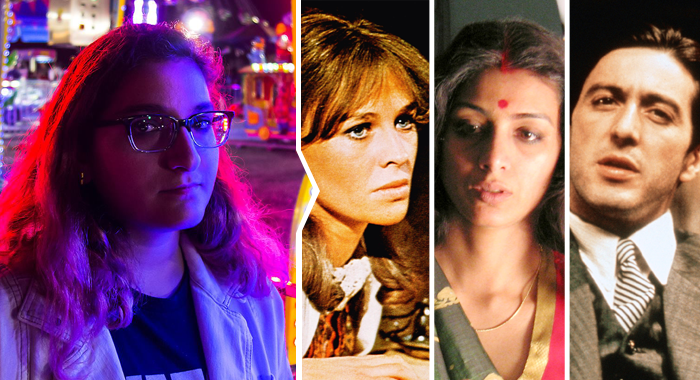
(Photo by Metro-Goldwyn-Meyer, courtesy Everett Collection; 20th Century Fox (all rights reserved), courtesy Everett Collection; Paramount Pictures, courtesy Everett Collection)
“Know Your Critic” is a column in which we interview Tomatometer-approved critics about their screening and reviewing habits, pet peeves, and personal favorites.
Known just as well for her criticism as for her feminist and cultural essays, Roxana Hadadi provides incisive takes wherever she publishes. Whether she’s covering a new release or writing a retrospective, Hadadi’s voice is recognizable because of the way she undertakes her intellectual projects: She consistently wields sharp language and provides compelling evidence, convincing her readers (or listeners, when she appears on podcasts) to approach titles in new and insightful ways.
Hadadi’s advice for new and aspiring critics is both practical and philosophical. “In general, my advice is go out, and see and experience the world,” she said in an interview with Rotten Tomatoes. “The advice that everybody gives is to write all the time, which I think is good advice because something that’s very important for young critics is instilling the discipline of ‘I have to write a piece, it has to have a draft, I have to have an outline of what I want to say.’ ”
“My advice is to find yourself and find who you are. Then I think it’s a little bit easier to write about the things that you’re consuming because it’s easier to find your emotional reaction to them,” Hadadi said. “Then you can use your criticisms of the technical qualities of a film to understand: What is the movie intending to do? What does it do for me? How does it exist in the medium, or in pop culture, or the world at large?”
Roxana Hadadi is a pop culture critic. Beginning December 6, she’ll be TV Critic at Vulture/New York Magazine. Her work can be found at Pajiba.com, The AV Club, Crooked Marquee, RogerEbert.com, and Polygon. Find her on Twitter: @roxana_hadadi.
What makes a good movie?
A good movie for me is one that makes you feel something, whether that is anger, or sadness, or happiness, or melancholy, or joy. I think if something gets a pure emotional response from you, then it is a success. I don’t necessarily know if that always makes a movie good or enjoyable, but I think it makes it worthwhile.
What’s your favorite Rotten thing?
The answer is always John Carter. Yes, I love this movie. I’ll be honest, a lot of it is because I love how Taylor Kitsch looks in this movie. I’m sorry, he is very attractive and I am but a simple woman.
But truly, the answer that I really give as to why I love this movie is that it is daring to be very weird for a Disney film, and sort of sexy and sort of subversive. I think that as much as the story is a typical “white male savior comes to an alien place and figures out a way to help save it,’ I think the movie is very aware that that is the story that is being told. I think it works against Taylor Kitsch’s character in proving that he is not, for lack of a better term, completely hot s–t. He is surrounded by other characters that temper him.
Along those lines, I also really like Sucker Punch, which is very much derided as a Zack Snyder film. It’s one of those movies that a lot of people think it is misogynistic because it is a movie about misogyny. I revisited it earlier this year because I wrote a piece about it for The Guardian. It was very interesting to have my own long-held negative assumptions about that movie challenged because, while you’re watching it, there is a lot of the typical Zack Snyder slow-mo action sequences, too-short skirts sort of thing. But I thought that it was very deliberate in making clear that a way to work through trauma and pain is through imagining yourself as a hero and as a survivor rather than as a victim. I really respected the movie for that, which surprised me.
Those two are definitely the ones when people say, “Wow, this movie sucked,” I get very defensive.
What is the hardest review you’ve ever written?
The Report was a very difficult review to write because I had to separate my feelings of “everybody should watch this movie because thematically, I think the content is important.” I had to separate that from, “Does the movie succeed on the technical qualities of a film? Does it build tension? Does it communicate information? Is the acting good across the board?”
All of those things that I think a movie needs to do to be, like you said, a “good movie,” I have to assess those things outside of my personal feeling as to whether the content was important. I think those kinds of reviews are hard because you have to parse through, “well, do I agree with what this movie is saying about the world or whatever, and that’s why I’m saying that it’s good and why you should watch it.” You have to do an internal analysis of your own motivations in writing. That can be really difficult.
I think that’s – to get pretentious – the purpose of art. It’s to make you think about the world that you’re in and what your place is within it. I think the hard reviews are the ones that really challenge you in that space.

(Photo by 20th Century Fox)
What is your favorite classic film?
This is very much a tie between two David Lean films. It is either Lawrence of Arabia or Doctor Zhivago, which are both films that I grew up with. Those are some of my parents’ favorites. I think that I probably first watched them on a Saturday afternoon on PBS. I just think that for me, the scope of those films signifies everything that movies can be. They can build this entirely different world, and transport you to a different time and a different place.
What is your favorite movie from your childhood?
I think these are the movies that made me who I am. Between these and the Godfather films, they’re very much the core of a certain aspect of my identity. But my favorite movie when I was a kid-kid was Hook, which is another one that I think probably has a Rotten score, but that I just love with every aspect of my being. I’ve told this story on the internet before, but my parents went away for a weekend. We rented Hook, and I broke the family VCR by watching it and re-watching it so often. They didn’t love me for that one.
What, besides Hook, is the movie or show that you have watched more than any other?
A movie or show that I have watched more than any other. I think the movie is probably The Godfather, because it was a family tradition for us that we would watch The Godfather and get Chinese food for certain holidays. I called it “Kung-Pao and Corleone.”
Have you ever seen yourself on screen? If so, what did you relate to about that character or story?
I don’t know if I have fully ever seen myself on screen just because I think that is a difficult ask when you are an Iranian-American woman. Let’s be frank: Hollywood does not tell Middle Eastern stories. The data proves that to be true. So, it’s been very difficult to get a sense of exactly me and exactly my identity on screen.
But I think movies that have reflected portions of my experience have been The Big Sick, Hala, some episodes of Ramy. Probably the one that has reflected it most is Mira Nair‘s The Namesake, which I won’t talk about too much because it’ll make me cry. I think that movie is astonishing. The source material is amazing. Jhumpa Lahiri’s novel is beautiful. It is about a married couple who relocates from India to the US and starts a new life here. Then it follows their children, in particular their son.
I saw it in college, and it was during a time when I was struggling with becoming my own person versus who my parents expected or wanted me to be. There’s a lot of that similar sort of conflict in the film. It’s very much a commentary on cultural shift and generational shift, and growing into somebody who appreciates your parents in a way that you probably didn’t when you were an asshole teenager, which I very much did not. So, definitely The Namesake. It is about an Indian-American man, it is not about an Iranian-American woman, but I think a lot of the cultural beats are the same.
Is there an actor, a director, or a screenwriter whose work you always love?
Director-wise, the answer is pretty much always Marty Scorsese. I just consistently respect his ability to show you a character who you think is a villain and challenge you to find their humanity. I am just consistently floored by that, and by at least what I perceive to be his deep belief that every person, no matter the bad decisions that they make, might be deserving of your empathy. That’s something that I find very challenging to do in my normal day to day life, but it’s something that I really gravitate to in film – the suspension of disbelief. Normally, I’m a very pessimistic person. I find that Marty Scorsese’s films don’t necessarily make me feel optimistic about the future, but they help me step inside perspectives and identities that I hadn’t considered before.
My screenwriter answer is probably either Asghar Farhadi or Sofia Coppola. Both of them for me do very interesting work in grasping domestic life. Farhadi, because he is an Iranian director working often within the contemporary modern Iranian space. Being Iranian-American, I really gravitate to the very detailed nuanced ways that he shows just our culture on screen. He does a very good job finding the divide between your public persona and your intimate life in a very specifically Iranian way.
Sofia Coppola I feel like does the same thing in terms of femininity and what it is to be a girl, or what it is to be a woman, and what are the perils of that? What are the ways in which people trap you within their expectations? What are the ways that you have to navigate that or break free of that? Interestingly, I am very much an “eat the rich person,” and Sofia Coppola’s movies are very often about the white rich.
But again, just in terms of suspending disbelief, sometimes she gets to the core of something that I’m feeling from a not-white, not-rich perspective. I’m just really moved by the commonalities that she finds in the female experience.
Is there someone in your life who’s not a critic but whose opinion you admire?
For older films and for the classics that I grew up with, the answer is very much my parents. They were big movie fans, and they really shaped that in me by just always being down to watch a movie and to have me sit with them. Their real love for the medium I think brushed off on me. They didn’t really expect it. They were surprised when I started writing about movies, but it was something that they became proud of over time. I would always talk to them about the movies that they’d watch growing up in Iran, and what they started watching when they came here.
Then more recently, my partner has a very thoughtful consideration of genre films, in particular sci-fi. I think sci-fi is a genre that I gravitate to, but that I am not incredibly intelligent when it comes to talking about the history of the genre, or how certain themes came to pass or develop. He has a really strong grasp of that and has pointed me in a lot of really good directions in terms of novels and theory to read. That has been really helpful, just in helping me expand. I think that’s what you have to do as a writer. You have to grow, you have to expand, and you have to absorb the world around you. I think both my parents and my partner have helped me do that.
Roxana Hadadi is a pop culture critic. Beginning December 6, she’ll be TV Critic at Vulture/New York Magazine. Her work can be found at Pajiba.com, The AV Club, Crooked Marquee, RogerEbert.com, and Polygon. Find her on Twitter: @roxana_hadadi.
On an Apple device? Follow Rotten Tomatoes on Apple News.

(Photo by Phillip Caruso/©Unversal, ©Warner Brothers/courtesy Everett Collection)
Twenty-five years ago, Robert De Niro enjoyed a particularly stellar year that would change his career forever. In November, he reunited with his frequent collaborator Martin Scorsese for Casino, a companion piece of sorts to their 1990 masterpiece Goodfellas. Just a few weeks later, he shared the screen with fellow acting titan Al Pacino for the first time in Heat, Michael Mann’s cops-and-robbers epic.
Yet at the time, this one-two punch wasn’t necessarily regarded as a triumph. Sky-high expectations for a de facto Goodfellas follow-up and a Pacino/De Niro team-up meant that both movies garnered a lot of reviews that were more respectable than ecstatic, and months later these two awards hopefuls received a grand total of one Oscar nomination between them — for Sharon Stone’s career-best performance in Casino.
Criticisms leveled at both movies at the time zeroed in on the crime-picture familiarity that now makes them feel like classics. Some came down especially hard on the idea that Pacino, Pesci, and particularly De Niro were repeating themselves. De Niro had delivered gentler, change-of-pace performances not much earlier in movies like 1990’s Awakenings and 1993’s Mad Dog and Glory, and the close proximity of Heat to Casino wound up calling attention to his characters’ similarities across the two films: Owen Gleiberman of Entertainment Weekly described him as “a scowling cipher, a forbidding synthesis of dictator and monk,” then a few weeks later noted that in Heat, “as in Casino, he’s playing an ice-minded humanoid.”
It’s true that both movies find De Niro acting in a chillier register than his work in, say, Taxi Driver or The Godfather Part II (to say nothing of the genuinely sweet Mad Dog and Glory). Sam “Ace” Rothstein, the mob-affiliated casino boss he plays in the Scorsese picture, and Neil McCauley, the career criminal he plays in Heat, do their respective jobs with ruthless professionalism. McCauley offers the spiel that lends Heat its title, explaining that anyone serious about the heist business needs to be able to drop all attachments “in 30 seconds flat if you feel the heat around the corner.” Ace, in the meantime, is the kind of exacting control freak who demands one of his buffet chefs put an equal amount of blueberries in each muffin. If Neil and Ace are less immediately magnetic than even some of De Niro’s more villainous characters — the scene in Heat where he must rebuff the vaguely inexplicable interests of Amy Brenneman is one of cinema’s least romantic meet-cutes — the tension in both movies comes when the De Niro character’s detachment is challenged.
That’s visible in the famous Heat diner scene, the mid-movie sit-down when McCauley meets with cop Vincent Hanna (Pacino) over coffee. As the conversation continues, Mann catches more of each actor’s reactions, cutting to them when they’re listening, not just when they’re speaking. So much of the scene’s drama happens in the actors’ eyes, as De Niro portrays McCauley, briefly freed from the responsibilities of organizing a major heist, making thoughtful considerations as he answers Hanna’s questions about his motivations. The scene probably wouldn’t be as effective without De Niro’s unforgiving exterior, and it certainly wouldn’t be as chills-inducing with other actors.
In Casino, the steely enforcer lets his guard down in an early scene where he proposes marriage to Ginger (Sharon Stone), negotiating and equivocating about how their “mutual respect” can lay the groundwork for a good partnership, even though she doesn’t love him, and says so upfront. It’s more subtle than either pleading or outright strong-arming and, as such, both heartbreaking and a little pathetic.

(Photo by ©Universal courtesy Everett Collection)
It’s no shock that De Niro is actually great in both of his 1995 movies, though it is a little surprising that even after their reputations grew, he still managed to be underestimated. The images Casino and Heat projected of the actor as a serious, driven professional were especially appropriate for that stage of his career — a stage that these two movies helped bring to a close. His filmography is too long and varied to categorize every performance, but Heat and Casino are arguably his last two big-ticket leading-man parts in the crime genre that made him famous. Over the next few years, he would do a lot of character and supporting parts (Sleepers, Cop Land, Jackie Brown, Great Expectations) and some self-conscious riffs on his past roles (The Fan revisits both Taxi Driver and Cape Fear; Analyze This parodies his mafia parts; Meet the Parents depends on his tough-guy image). Later, he would do more comedies, often about aging and/or families, sometimes to great effect (Silver Linings Playbook; The Intern), sometimes less so (The Big Wedding; The Family).
Many of these later-period movies are about bringing De Niro back down to earth, even when they’re not directly kidding his on-screen history (and a lot of them do, beyond even his two comedy franchises). Sometimes this can be read as undermining his legacy, sticking him in unserious paycheck-friendly gigs like Dirty Grandpa or Grudge Match when he “should” be doing more projects with titans like Scorsese, who took a 24-year break from casting De Niro after Casino, or big-name auteurs like Mann. While it’s true that De Niro has appeared in his share of movies that aren’t especially worthy of his talent, it often seems that he’s both willing to work and remarkably free of ego in the work itself.

(Photo by ©Lionsgate)
His characters in Casino and Heat are quite the opposite; they wouldn’t be caught dead doing jobs that could be perceived as beneath them. (McCauley’s promise to Hanna in the coffee-shop scene makes this more or less literal.) They’re men of discipline, yes, and certainly McCauley displays less hubris than Ace, who at one point broadcasts his own television show to settle scores with the Las Vegas gaming commission. But they’re both larger than life — not because of particularly gregarious personalities, but because they loom outside what Heat refers to as a “regular-type life.” De Niro can get away with moments of unemotional minimalism because of his own towering work before these movies, especially the volcanic outbursts of Goodfellas, Taxi Driver, The Untouchables, and Raging Bull, among others. In 1995, at least, his reputation preceded him.
Neither of De Niro’s 1995 movies were received as a farewell to the iconography and prestige involved with being the legendary Robert De Niro, and knowing his work ethic, they probably weren’t intended that way, either. But 25 years later, they play like De Niro has honed his most familiar tics into a sleek, efficient weapon. Heat and Casino both prepare him for middle age, and this doesn’t just mean his comic roles and character-actor parts. Look at an underseen later-period De Niro movie like Stone: It generates plenty of intensity as his parole officer character faces off against a prisoner played by Edward Norton, but this is a life-sized De Niro, his anger and violence repressed, his disappointments flattened out.
This extends to his recent reunion with Scorsese, The Irishman, where he plays a hitman as an unquestioning working stiff. The film is powered by the idea that maybe those classic gangster movies were even sadder and less glamorous than viewers entirely realized at the time — something else that both Heat and Casino were preparing for back in 1995, when they were met with good-but-not-great receptions. Neil McCauley orchestrates a precise and ambitious heist, falls in love, and the LAPD still catches up to him; Ace Rothstein ends his long, detailed, decades-spanning story about Vegas with a shrug as he returns to bookmaking. Maybe a lot of those beloved De Niro icons were secretly workhorses all along.
Casino was released on November 22, 1995. Heat was released on December 15, 1995.
On an Apple device? Follow Rotten Tomatoes on Apple News.
This week’s TV Talk roundup looks at some bad news about one reboot (The Last Airbender creators are no longer involved with Netflix’s live-action adaptation) and some good news about another (Will Smith and Jada Pinkett Smith are attempting to get a series made out of Morgan Cooper’s viral video that reimagines The Fresh Prince of Bel-Air as a drama). There’s also new late-night shows coming to Peacock courtesy of some familiar faces, a Netflix comedy special starring Trump impersonator Sarah Cooper, and a TV titan dies at 97.

(Photo by Nickelodeon)
Michael Dante DiMartino and Bryan Konietzko, the creators of the much-loved Nickelodeon animated series Avatar: The Last Airbender, have announced that they have severed involvement with Netflix in regards to a live-action adaptation of the show. Konietzko shared the news in an Instagram post while DiMartino offered more details on his website by saying that “in a joint announcement for the series [in 2018], Netflix said that it was committed to honoring our vision for this retelling and to supporting us on creating the series. And we expressed how excited we were for the opportunity to be at the helm. Unfortunately, things did not go as we had hoped.”
A live-action film adaptation of The Last Airbender was written and directed by M. Night Shyamalan. It was released in 2010 and was savaged by critics. It has a 5% Tomatometer score.
More from Netflix this week:

(Photo by Mindy Tucker)
Trump-skewering TikTok star Sarah Cooper will have her own Netflix special this fall. It’s directed by Natasha Lyonne, who executive produces along with Maya Rudolph.

(Photo by Michael Tullberg/Getty Images)
Get ready for some more tracking shots on streamers. Martin Scorsese’s Sikelia Productions has signed a multi-year first-look deal with Apple TV+, which will include film and television productions. The channel is currently working with the acclaimed director on Killers of the Flower Moon, a film starring Scorsese regulars Leonardo DiCaprio and Robert De Niro. (DiCaprio’s Appian Way, which is co-run by Jennifer Davisson, also has a deal with Apple TV+).
More from Apple TV+ this week:

(Photo by NBC)
NBCUniversal’s new streaming service Peacock is getting into the topical late-night show game with two upcoming shows.
The first, which stars Late Night with Seth Meyers breakout Amber Ruffin and is called The Amber Ruffin Show, will launch in September and currently has a nine-episode order. Ruffin is executive producing the series along with Meyers, Mike Shoemaker, and fellow Late Night writer and frequent on-screen commentator, Jenny Hagel.
Ruffin told journalists attending the show’s all-virtual Television Critics Association summer press tour that “the show will be a half-hour, late-night show and it’ll mostly feel like a late-night show except there will never be a guest. Well, as of now, we will not have guests. You never know who’s gonna stop by. New York’s a big city. But I guess we will write as much as we can all week and then the four things we like the most, that’s what we’ll do.”
But fans of Late Night who have come to enjoy Ruffin (and Hagel’s) commentary in segments like “Jokes Seth Can’t Tell” should not worry, as she will still be involved with that show.
Peacock’s other new after-hours series involves bringing back a late-night veteran: Larry Wilmore. The Daily Show and Nightly Show alum will host a still-untitled weekly series that the press release promises will see him having “real discussions with high profile people from all different backgrounds including sports, politics and entertainment.”
“The show is basically about where we’re going to have that kind of ‘conversation’ that we’ve been saying that we want to have,” Wilmore told journalists attending his virtual panel. “So we’re going to have some interesting people in the show, and we’re also going to cover the election. I felt like I got cheated the last time during the last election [because The Nightly Show’s last episode aired August 18, 2016]. So it’ll be fun to cover that, and just weigh-in on the important issues in the culture right now.”
He also said that the show isn’t going to steer away from topical, yet sensitive, issues like race, explains that “we’re definitely going to cover race, but we’re not going to be … obsessed with it.”
The series has an 11-episode order so far and also launches in September.
More from Peacock this week:
 Greg Peters/©Universal courtesy Everett Collection

(Photo by Clockwise from top left: Angela Bassett Courtesy / D'Andre Michael; Joe Morton Courtesy / Benjo Arwas; Oprah Winfrey Courtesy / Harpo Inc., Ruven Afanador; Courtney B. Vance Courtesy / Matthew Jordan Smith; Susan Kelechi Watson Courtesy / Kate Szatmari; Tariq “Black Thought” Trotter Courtesy / Dario Calmese)
Angela Bassett, Joe Morton, Phylicia Rashad, Tariq “Black Thought” Trotter, Courtney B. Vance, Pauletta Washington, Susan Kelechi Watson, and Alicia Garza, Oprah Winfrey will star in the HBO special event Between the World and Me, based on the New York Times bestseller of the same name by author and journalist Ta-Nehisi Coates.
The special will combine elements of the novel’s original 2018 Apollo Theater stage adaptation, will again be directed by award-winning director and Apollo Theater Executive Producer Kamilah Forbes, and will include readings from Coates’ book. The HBO production will also incorporate documentary footage from the actors’ home lives, archival footage, and animation. Currently in production under COVID-19 guidelines, the special debuts this fall on HBO and will also be available to stream on HBO Max.
Media tycoon Sumner Redstone, who, with his family, was the majority voting shareholder of ViacomCBS — and, before that, the executive chairman of both CBS and Viacom — has died at age 97. In his obituary on the mogul, CNN media critic Brian Lowry writes about Redstone’s infamous cantankerous personality — “I have no intention of ever retiring, or of dying,” Redstone once said in an interview — as well as his long, public battle to control his legacy and his feuds with members of his family.
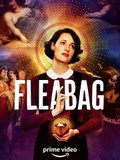
The Broadcast Film Critics Association (BFCA) and the Broadcast Television Journalists Association (BTJA) announced the winners for the 25th annual Critics Choice Awards on Sunday, January 12, and there were a few surprises. Not only did we get a tie for the Best Director award on the film side, but neither of the honorees actually came out with a Best Picture win, which went to Quentin Tarantino’s Once Upon a Time In Hollywood. On the TV side, Fleabag nabbed Best Comedy Series, Best Actress in a Comedy Series, and Best Supporting Actor in a Comedy Series to lead all winners, while HBO’s Watchmen took home a couple of the big acting awards, and Netflix’s When They See Us won Best Limited Series and Best Actor in a Limited Series. See below for the full list of winners.
BEST PICTURE
BEST ACTOR
Failed to fetch Celebrity data from given ID.
BEST ACTRESS
BEST SUPPORTING ACTOR
BEST SUPPORTING ACTRESS
Failed to fetch Celebrity data from given ID.
BEST YOUNG ACTOR/ACTRESS
Failed to fetch Celebrity data from given ID.
BEST ACTING ENSEMBLE
BEST DIRECTOR
BEST ORIGINAL SCREENPLAY
BEST ADAPTED SCREENPLAY
BEST CINEMATOGRAPHY
BEST PRODUCTION DESIGN
BEST EDITING
BEST COSTUME DESIGN
BEST HAIR AND MAKEUP
BEST VISUAL EFFECTS
BEST ANIMATED FEATURE
BEST ACTION MOVIE
BEST COMEDY
BEST SCI-FI OR HORROR MOVIE
BEST FOREIGN LANGUAGE FILM
BEST SONG
BEST SCORE
BEST DRAMA SERIES
BEST ACTOR IN A DRAMA SERIES
BEST ACTRESS IN A DRAMA SERIES
Failed to fetch Celebrity data from given ID.
BEST SUPPORTING ACTOR IN A DRAMA SERIES
BEST SUPPORTING ACTRESS IN A DRAMA SERIES
BEST COMEDY SERIES
BEST ACTOR IN A COMEDY SERIES
Failed to fetch Celebrity data from given ID.
BEST ACTRESS IN A COMEDY SERIES
BEST SUPPORTING ACTOR IN A COMEDY SERIES
Failed to fetch Celebrity data from given ID.
Failed to fetch Celebrity data from given ID.
Failed to fetch Celebrity data from given ID.
BEST SUPPORTING ACTRESS IN A COMEDY SERIES
BEST LIMITED SERIES
BEST MOVIE MADE FOR TELEVISION
BEST ACTOR IN A LIMITED SERIES OR MOVIE MADE FOR TELEVISION
BEST ACTRESS IN A LIMITED SERIES OR MOVIE MADE FOR TELEVISION
BEST SUPPORTING ACTOR IN A LIMITED SERIES OR MOVIE MADE FOR TELEVISION
BEST SUPPORTING ACTRESS IN A LIMITED SERIES OR MOVIE MADE FOR TELEVISION
BEST ANIMATED SERIES
BEST TALK SHOW
BEST COMEDY SPECIAL
Like this? Subscribe to our newsletter and get more features, news, and guides in your inbox every week.
Are you as obsessed with awards as we are? Check out our Awards Leaderboard for 2019/2020.

(Photo by Netflix)
The long and arduous road to bring The Irishman to theaters spanned two decades and featured several dead ends and detours. It took Netflix stepping in at the last minute with a $250 million budget and multimillion-dollar ad campaign to distribute Martin Scorsese’s long-awaited gangster opus as he had hoped to see it. Though the streaming giant’s row with theater owners prevented a large-scale rollout, the film delighted audiences over the Thanksgiving break, and as the accolades continue to roll in on our Awards Leaderboard, we are now safely considering it a lock for a Best Picture Oscar nomination — and perhaps even a win.
Realizing a script by Steven Zaillian based on the controversial eponymous memoir, Scorsese has created his most epic work in the gangster genre with which he has become synonymous. The film chronicles Frank “The Irishman” Sheeran’s time as a member of the Teamsters’ Union and as a hitman for the Mob, as well as his friendship with various mafia figures from the early 1960s onward, including infamous Teamster boss Jimmy Hoffa. To bring the story to screen with actors Al Pacino, Joe Pesci, and Robert De Niro playing younger versions of themselves, the shoot had to employ cutting edge de-aging technology and groundbreaking visual effects and photography techniques. To achieve this, cinematographer Rodrigo Prieto and visual effects supervisor Pablo Helman utilized a by-any-means-necessary approach to the visuals, inventing new camera equipment and techniques to shoot the action without encumbering the actors’ performances or Scorsese’s vision. When we sat down with Prieto and Helman, they broke down their efforts, the new camera rig they fashioned, and why, when you work with Martin Scorsese, the last thing you want to tell him is “No, we can’t do that.”

(Photo by Netflix)
Pablo Helman: I’ve been involved with the project since 2015, so that’s been four years, and we were all discussing the whole process with Marty [Scorsese], and I was working with him on Silence. We were shooting in Taiwan, and I took the opportunity to get to know Marty in Taiwan, and we started talking about technology, and of course, he’s such a curious person. He always wants to know more about stuff. So we started talking about technology and making actors younger, and he told me that he had a project that he’s been trying to do for about nine years, and this was in 2015. He sent me the script overnight, and of course, when he says he is going to send you something overnight, then you read it overnight. So I read the script and in the morning I was in.
Rodrigo Prieto: I guess it would have been very soon after that when we had the conversation that started seeming like this was viable, and The Irishman could be, in fact, made. For me, I was just hearing about it, but not in a specific way. I was obviously so immersed in Silence, so it wasn’t really until after we were done with Silence that I really started hearing about The Irishman and the idea of shooting a test. But I wasn’t able to physically shoot the test myself, but I did participate in arranging for it. I got Reed Morano to shoot it; she’s a director and a DP and she’s wonderful. Of course, Pablo made the whole test happen. Then, later on, I saw the test while I was in the post-production phase of Silence.
Helman: For me, it’s just the same thing that Rodrigo did. Usually, I don’t get involved talking to the DP and the director together until later on, but this was so important. Also, as a visual effects supervisor, I don’t want to interfere with anything that Rodrigo is planning to do and he’s talking to Marty about, but I realized how intrusive what we were going to do was going to be, and I tried to stay away from any creative decisions that would influence how we were going to shoot the movie.

(Photo by Netflix)
Prieto: When we started our first discussions, the essential part of all this was the look that we were going for. As I’ve said before, we wanted the movie to have this feeling of memory, and I felt that it was important to photograph it with film emulsion, with film negative, because also I was doing the simulation of photography in Kodachrome for the ’50s, Ektachrome for the ’60s, and then in the ’70s, it was a different process. But it all was based on photochemical processes that we all have in our memories; photographs, photography — not digital photography, but photography either on the transparencies or on negatives. So we felt very strongly that we had to shoot this movie on film, but Pablo explained to me this rig that he was concocting that had to be digital, because all the shutters of the three cameras had to be synchronized. And then also he described how these, the main camera and the witness cameras, had all had to move in unison.
So we actually had to create a rig that could take three cameras, so it made it physically impossible for it to be film cameras. So then, for me, it became choosing a camera that would be able to map the colors and the lookup tables of the Kodachrome and Ektachrome and so on, onto a digital camera that would match the film camera, the way that the film negative was responding to those lookup tables. Then, in addition to that, I told Pablo, you have to make sure and you have to guarantee to me that you’ll be able to also match the texture, meaning the film grain. And since we worked very closely on Silence before, I really trusted Pablo. I knew that if he said he could do something, I knew that it was true. He was going to do it. So with that trust, I was okay. I said, all right, let’s split it. We’ll shoot on film, which everything that happened doesn’t need the three-headed monster for the visual effects. Then we’ll shoot the digital cameras for that, and we’ll make it all match, and indeed that’s what happened in the end.

(Photo by Netflix)
Prieto: I think every one of us that has worked with Marty has come to realize you really don’t say no to Marty. There is no limit in him as you know, and that’s part of the joy of working with him. But he has these amazing ideas and concepts, and it’s up to us to figure out how to make that actually come to fruition and technically achieve it and also artistically enhance it. That’s a beautiful thing.
Helman: I think in terms of film or digital or all these, I don’t think he has this predetermined notion that everything has to have a film texture. It’s more of an emotional thing for him. When I projected tests of something shot on film negative and something shot on digital, he feels more connected to the actors on what he’s seeing on film negative. So it’s more a feeling than a dogma. But then again, I know that he doesn’t have a compunction of shooting a whole movie on digital. It’s not something that he necessarily is married to one or the other. But I think that in the case of The Irishman, he agreed that the texture of film was an important part of this feeling of memory. I think it was pretty successful. Pablo was very impressed.
Prieto: One thing for me that was also important — and we talked a lot, Pablo and I, in pre-production — was that I wanted to be able to sit in the digital intermediate room doing the color grading as if I shot the whole movie on film negative, and the lighting on the face replacements on the DGI visual effects would be the same that I did on the set and would react the same way of when I tweaked it in the ice suite. And it did. It felt completely organic. Whenever I came up to the shots that were Pablo’s, as opposed to the ones that I had shot with a film camera, and then I came to the visual effects shots, it felt pretty seamless, and I think that was thanks to whatever magic Pablo did.

(Photo by Netflix)
Helman: Also, it’s a way for us to understand what it is that he’s after. You see, when he says something, he really means it, and it all goes to how he feels about something, so it’s part of our job.
Prieto: I think that there were other technical things that we talked about, because we were working with infrared technology and there was the lights and things that Rodrigo and I already talked about. We don’t involve him. It’s part of solving the problem.
From the beginning in Taiwan, Marty told me that Bob De Niro was not going to wear any markers. He was not going to wear any helmets or little cameras in front of him. He wanted to be on set with the lighting, so there wouldn’t be reshoots or shooting a scene in a different controlled environment that we call a mock-up studio or anything like that. He told me, “I want the technology completely away from the performances. I want to work the way I want to work with the actors. The actors want to work with the actors too, and I want that technology completely away.” The reason is the difference. You can see the difference in the performances. If the actors are not in the moment, in a different environment, not acting with their acting partners, the movie doesn’t happen, because a lot of what happens between two actors is a connection that translates through the camera into the audience. If you are in the middle as the technology and visual effects supervisor, it’s going to take it all in the movie, and we don’t want to do that.
Also, in cinematography, there’s a lot of preference in terms of the lights, the cameras, the marks on the floor — all these things that I try to make as minimal as possible. In fact, I try not to say things to the actors. I want them just to feel as free as possible. The “three-headed monster” camera rig became a concern in pre-production because we knew that Scorsese was going to want to be able to move the camera in whichever way he would desire. I didn’t want to say, “Marty, we really can’t do this shot you’re saying, because this camera’s too heavy or big.” Pablo and I worked together to make sure the camera team — and also with every rental and ILM — to design a rig that could work on any type of camera head, be it a fluid head or a remote head, a crane, or even on steady cam. We tested that several times and went back to the drawing board when initially we failed; particularly the remote head didn’t respond. It was not happy with the weight. We had to come up with different materials and different types of motors for the focus and all these things. It was actually quite fun in pre-production to work on this and figure it out.
Helman: On the set for me, it was important that my focus was the main camera and the lighting for that. The camera movement and the other witness cameras that were shooting infrared and actually lighting infrared would be Pablo’s world. There were camera technicians for those cameras, focus pullers. There was our whole team. Each camera had its own team, but I didn’t want to worry about that. I wanted to be able to deliver the schedule. So, that was another part that I’m grateful to Pablo, because indeed, he just made sure that he was getting the information he needed from those cameras, and I mostly forgot about it. There were instances where even the rig, we had to make it so that we could detach one of the witness cameras and place it in a different place — for example, putting it on top of the main camera — because I needed to be close to a wall or I was seeing the other camera in one of the shots. We tended to shoot a lot with two cameras simultaneously. So we then were able to remove the camera and put it in a different spot. It was modular, so we kind of created a monster that was relatively nice to us. It wasn’t so monstrous after all.
I think the whole idea was, from a technology point of view, to remove the burden from the actors. If you remove the burden from the actors, that burden doesn’t go away. It gets spread out throughout all these departments. The first department that hits is Rodrigo’s, because he’s got double the crew in the camera. So you have infrared, then it also spreads over the production design because you see the rig; it’s about 30 inches wide. The frame of a door in the United States is about 32 inches, so we have to make sure, and we knew we had like 117 locations, so we had to get the rig through the doors and all kinds of things. Also, because we’re working with infrared technology and really old cars from the ’50s and ’60s, the windshields on the cars have lead, and the lead doesn’t let the infrared light go through, and I can’t have that. So we had to take all the windshields off. All the windshields that you see are all CG. See how it spreads all over the place? It was a whole team working out the technology so that it was away from the actors and the director and they could do wherever they wanted.

(Photo by Netflix)
Helman: At some point, I had to say to Rodrigo, “This is what we need for this, but I don’t know how to take 20 pounds away from there, because I don’t know exactly what your department and you are going to need.” So it was a working together thing in a way that I hadn’t worked before, so maybe that is part of it? You have a team of people and you need to be careful with elbows and not elbow each other and those kinds of things.
Prieto: I’ll have to also credit my focus pillar, Trevor Loomis, and even a camera operator, Scott Sakamoto. They were instrumental in suggesting different types of motor and cables. Then the friends from area rental, figuring out a lighter plate on which to put the cameras. Both Pablo and I had requirements. For instance, what I was describing, I insisted on this possibility of removing pieces from both sides of the rig so we could have the camera in whatever corner needed to be. Pablo needed the witness cameras to be able to be adjustable because it depends on the distance of us to the actor’s face. You need it to be able to adjust these cameras. For all these things, there was a whole team of people making sure that it worked. I think everybody took it with enthusiasm, and there are these kinds of challenges that we all relish. I’m sure that if we do it again, we’d figure out some other ways that would be even more practical. That’s the way technology advances, right? But it’s all manmade in the end, especially in the beginning when you’re creating something new. You’re doing it by hand basically.
Helman: I have to credit everybody with being able to work together. That’s one of the skills that anybody has that could take them anywhere. If you have the skill to work with other people, you can do anything in your life. It was difficult at times, but it was great. It was great being flexible and being able to accept solutions from other departments.

(Photo by Netflix)
Helman: Throughout post-production, I kept sending images to Rodrigo. During the production, we talked about the fact the lighting is so important, not only for the movie, but obviously because of the content and all the decisions that Marty and Irwin made. Also because of the technology. The technology is such that works from the lighting setup. If I cannot match the lighting, I cannot finish my work. So it was really important that throughout we communicated and we sent pictures and just made sure that we were on the same wavelength.
Prieto: During the shoot, that was an important factor and also a challenge, time-wise. We did have to get the lighting information to Pablo to be sure that, in post-production, he had everything accurate. It wasn’t just by eye, seeing what I had done in this shot, saying, “OK, it looks like we used the three-quarter backlight here.” They actually were able to input into the computer the exact information besides intensity and color and texture of each one of the lighting units, plus the influence of this set itself onto the light that ultimately lights a face. It’s not only the lighting units, but it’s also the environment as well. We had to every time shoot a mirrored sphere in the place of where the actor’s face would have been. Also, we had to shoot a gray sphere and then color charts with all the different levels of black to white and the different colors and a lighter, which is a system where you put a camera where the face of the actor would be, and you’d do a 360-degree capture of everything that’s around the face of the actor. It’s bracketed as well, meaning that you get all different levels of exposure.
So all that information is fed into the computer, and it basically reproduces that on the actor’s face. I’m sure there’s some tweaking also going on to make sure it matches what the main camera saw before the faces were replaced. I must say, it was very accurate. Obviously we’re all a little bit neurotic about what we do, and we’re very specific about why I lit in a certain way with a certain unit, with a certain intensity. I recognize everything I did while I was doing the DI, and when I was doing it, it was very seamless. So I really don’t remember any instance whatsoever where I had to go back to Pablo and say, “This doesn’t look like the lighting I did. Can you redo it?” It really felt very accurate. I even saw the movie before the visual effects. I saw it all put together with the faces of the actors as they were when we shot them. Then I started doing the DI and felt no real difference in the lighting, and I think, as Pablo says, it’s crucial for the naturalism of the effects. They blend in perfectly with the lighting that was done on the set.
Helman: Yeah, and besides that, there is a scientific reason why that had to be so. It’s because the capturing of the performances has to do with comparing what we got on set with what I’m rendering on the computer. So if there’s a difference in lighting, the computer will pick it up, and it’s not going to do what it’s supposed to do. So there are all kinds of things that go with it that was complicated, but we were able to work them out.

(Photo by Netflix)
Helman: From the first test in 2015, that was the first time that we showed the test to Marty and to Bob De Niro, and he doesn’t say much. He was just looking. He had this little tiny smile on his face and he said, “you gave me 30 more years of my career,” which was great.
Prieto: That’s funny. I mean, after the movie, I didn’t hear any comments about the visual effects, but during the shooting, I do remember the first time each one of them saw the rig. They sort of raised their eyebrows like, “Wow, look at that.” It had all the cables and the monitors read. It was kind of a thing. But once that initial two-minute surprise had happened, then it was seamless. They completely forgot about the cameras. I do remember Pacino in particular. There’s a scene where he is talking with Tony Pro (Stephen Graham) in jail, and they’re sitting on a bench, and he’s eating his ice cream. Tony Pro comes in for his money, and we shot that with three angles simultaneously. So each one of them has to be a three-headed monster, so it was nine cameras shooting the scene at the same time. I do remember Pacino was like, “Whoa, what’s all this?” It was quite a thing. But, yes, as I said, initially he was surprised, but then totally forgot about it. We all hid behind our gear and made ourselves invisible.
Helman: The other thing that you have to think about is that this is a brand new thing. This is the first time that we’ve ever tried something like this. So from here on, things are going to get better. So the rigs are going to get very, very small. Technology is going to get faster. In visual effects, and I’m sure it’s everywhere in this business, we kind of stand on each other’s shoulders to get to where we need to be. So I can’t wait for everybody else in the industry to pick up where we left off and further this more, allowing performances to come through.
The Irishman is available to stream now on Netflix.
All images courtesy of Netflix.
Netflix released Martin Scorsese’s long-anticipated The Irishman into very select theaters this weekend ahead of the film’s digital release on the streaming platform November 27. And so the world is finally getting its first look at the epic three-and-a-half–hour gangster flick that reunites Scorsese favorites Robert De Niro and Joe Pesci and also features Al Pacino, starring in a Scorsese picture for the very first time. Critics are loving it so far: The movie is Certified Fresh at 97% on the Tomatometer, and the director and lead cast are all considered sure-things for nominations this awards season. But is this adaptation of I Heard You Paint Houses, the story of gangster Frank “The Irishman” Sheeran and his relationship with union leader Jimmy Hoffa, everything the buzz says it is? That’s the question Mark Ellis is asking critics Scott Mantz and Angie Han (Mashable) in this Irishman deep dive. The panel tackles all the big questions about Netflix’s big Oscar play: Is it Scorsese’s best movie? Who stands out in the cast? Does the movie completely sideline its female cast? And, of course, we ask if this movie will land the legendary director his second Best Picture statuette?
The Irishman is in select theaters now and available on Netflix November 27, 2019.
95%
Will The Irishman Bring Oscar Glory to Netflix?
Can a de-aged De Niro bring home an Oscar for ‘The Irishman’? We explore what brought Scorsese’s passion project to Netflix.
Posted by The Rotten Tomatoes Channel on Thursday, August 1, 2019
Martin Scorsese’s latest feature film, The Irishman, has been talked about for years, enduring financial, developmental, and technological bumps along the way, but with the release of the teaser trailer this morning, we finally get our first look at what it’ll look like, when it’ll come out (sort of), and who’s involved, but let’s be honest, this trailer had you at “hello.”
So, let’s break down what we know — and don’t know — about Martin Scorsese’s Netflix-produced film The Irishman. [Updated on 7/31/19.]

Jimmy Hoffa in 1961
Based on I Heard You Paint Houses, the biography of Frank “The Irishman” Sheeran by Charles Brandt, The Irishman tells the story of mafia hitman Sheeran and his relationship to, and possible murder of, Teamsters Union leader Jimmy Hoffa. The disappearance (but let’s just call it murder) of Jimmy Hoffa is one of the most notorious organized crime stories of the 20th century, and more than 40 years later, the case still remains unsolved.
Hoffa’s connections to organized crime began in the 1930s when he was a union activist in New York, and it was here that the young Hoffa first gained an audience with mafia dons Russell Bufalino and Angelo Bruno. After years of moving up in the Teamsters Union, all while making shady backdoor deals with the East Coast mafia, Hoffa became president of the Teamsters from 1957 until 1971 and turned it into one of the most powerful in the world.
But, on July 30, 1975, just four years after stepping down as Teamsters president, Hoffa vanished without a trace. The unsolved disappearance has led to countless theories of what happened, including ones that posit Hoffa was either buried underneath Giants Stadium in the Meadowlands, compacted in a car and sold as scrap metal and shipped to Japan, or buried under a suburban Detroit driveway. The one commonality is that they all agree the mafia had him taken out.
The teaser trailer released today seems to have higher ambitions than just exploring Hoffa’s rise, fall, and presumed death, however. With frequent allusions to John F. Kennedy and the role of “big business and the government,” it seems like The Irishman will tackle the connections between a tangled web of organized crime, crooked unions, and American politics in the 20th century.

(Photo by Universal courtesy Everett Collection)
We first got a glimpse of the type of talent in this movie in the initial teaser (even though it was only their names), but now we finally get to see some of the greatest actors in film history and one of the most beloved and revered directors of all time doing their thing.
We all know the work Scorsese, De Niro, Keitel, and Pesci have done together, including Mean Streets, Taxi Driver, Raging Bull, Goodfellas, and Casino, but adding Pacino to that crew is the pistachios on the cannoli.
In the upcoming film, Pacino plays Union leader Hoffa and De Niro plays his friend and alleged killer Sheeran, while Keitel and Pesci play bosses of rival East Coast crime families.
But the talent doesn’t stop there, as The Irishman’s roster is both top heavy and deep. In addition to these heavy hitters, the film will also feature Oscar winner Anna Paquin, two-time Emmy winner Bobby Cannavale, two-time Emmy nominee Jesse Plemons, and Emmy-winner Ray Romano.
In case you weren’t keeping count, that cast features actors who have been nominated for a combined 19 Oscars, 35 Golden Globes, and 27 Emmys, and have collectively taken home five Oscars, five Golden Globes, and seven Emmys. And that’s just in front of the camera.
Between Scorsese, screenwriter Steven Zaillian, editor Thelma Shoonmaker, and cinematographer Rodrigo Prieto, the talent behind the camera has combined for 25 Academy Award noms and four wins.
So, with all that talent and excitement, how has it taken so long for this film to get made?

(Photo by Andrew Cooper/Paramount courtesy Everett Collection)
This film has been a passion project for director Martin Scorsese for years, with news coming about the potential film as far back as 2008. (That same article refers to Scorsese’s adaptation of Shutter Island as an upcoming release, just to give a sense of how long ago 2008 was.)
Since then, the film has floundered in development hell, and Scorsese moved on to directing other long-gestating passion projects like Hugo, The Wolf of Wall Street, and 2016’s Silence. But Scorsese kept coming back to the story of the most famous mob hit in history, and finally, in 2017, Paramount and Fábrica de Cine came together to co-finance the film and aim for a 2019 release.
So how did it end up on Netflix, you ask?

Yes, like all things, it comes down to cold, hard cash.
Initially targeted for a $100 million budget, the movie’s cost soon ballooned to nearly $200,000,000 after the production opted to use a CGI de-aging technique to make De Niro, Pacino, and co. appear younger while playing the younger versions of their characters.
Because of this price tag (and perhaps still feeling the burn left by Silence, which cost upwards of $50 million and took in less than $25 million at the box office), Fábrica de Cine and Paramount decided to back out of the project less than a year after agreeing to fund it.
Fábrica de Cine producer Gaston Pavlovich explained this difficult decision, saying “We quickly realized that Marty and De Niro really thought that the aging process was going to be a very important aspect of this film. The traditional model was not going to work with this new vision of the project… [we could not] risk that amount [of money] when all our data was telling us that it was not going to come back.”
Thankfully, Netflix stepped in, and the importance is not lost on Scorsese, who recently said, “People such as Netflix are taking risks. The Irishman is a risky film. No one else wanted to fund the pic for five to seven years. And of course we’re all getting older. Netflix took the risk.”
(Photo by Netflix)
Even so, the CGI de-aging comes with both budgetary and cinematic concerns. Previously used on Brad Pitt in Benjamin Button, Jeff Bridges in Tron: Legacy, and Robert Downey Jr. in Captain America: Civil War, the de-aging technology has advanced in recent years to appear more natural, but still remains costly. So costly, in fact, that until Samuel L. Jackson (and, perhaps less noticeably, Clark Gregg) was made to look 25 years younger in the recent Captain Marvel, it had only been used sparingly.
Editor Thelma Schoonmaker called it a “risk,” saying, “We’re youthifying the actors in the first half of the movie. And then the second half of the movie they play their own age. So that’s a big risk. We’re having that done by Industrial Light and Magic Island, ILM. That’s a big risk.”
While it might be cool to see young Pacino, young De Niro, young Pesci, and young Keitel in the same scene, it could also venture too close to the uncanny valley and take the viewers out of the film.
Schoonmaker has also expressed some trepidation over how the public is going to view seeing a 30-year-old Pacino, De Niro, et al. in a 2019 movie: “I haven’t gotten a whole scene where they’re young, and what I’m going to have to see, and what Marty’s going to have to see, is ‘How is it affecting the rest of the movie, when you see them young?’” In that same interview, the eminent editor said that, of the few people they’ve screened the movie for, “nobody minds. Nobody minds watching them play young, because they’re gripped.”
While we don’t see too much of the de-aged film legends in the teaser trailer, what we do see looks pretty good. On first impressions, the one shot of a young De Niro talking on the phone might be a little distracting, but this is just the first glimpse, so that’s a given. With what is sure to be stellar directing from Scorsese and brilliant acting from some silver screen legends, audiences likely won’t even notice that there’s a 40-something Robert De Niro in a 2019 movie.

(Photo by Paramount Pictures)
As one of Netflix’s main prestige productions for 2019, it was always expected that The Irishman would be released at the heart of awards season, and now we have confirmation.
It was recently announced that The Irishman will celebrate its world premiere as the Opening Night film for the 2019 New York Film Festival on September 27. Most likely, the film will be available for the general public a few weeks later in theaters and on your couch.
Previously, Scorsese has expressed his disdain for movie-watching on small screens, saying that when he was growing up, films “had to be shown in certain ways — people went to a movie, it wasn’t something you could choose or pick up, or walk out of the room. You actually made a commitment. It was a different experience.” He continued, “the ideal would be to see cinema in its proper context… It’s a problem of pure concentration.”
Robert de Niro agrees, saying at a recent film festival, “Movies have to be shown on a big screen.” It appears Netflix also shares this sentiment, as the teaser trailer announces that the film will be shown in “select theaters.”
Unfortunately, we still don’t really know when exactly The Irishman will be released. But we now know that it will have a splashy premiere at a prestigious film festival at the end of September, and will be shown in theaters and on the streaming service sometime this Fall.
The Irishman is currently set to release in select theaters an on Netflix during the Fall of 2019.
The NBR announced today the 2016 winners of the National Board of Review Awards, naming Manchester by the Sea the best film of 2016. NBR President Annie Schulhof said, “Manchester by the Sea is a masterful film which explores love, loss, and redemption in a deeply moving and completely original way. We are thrilled to award it our Best Film, as well as to honor Barry Jenkins’ singular directorial vision for Moonlight.” Additionally to being named the best film of 2016, Manchester by the Sea took home the awards for Best Actor (Casey Affleck), Best Original Screenplay and Breakthrough Performance (Lucas Hedges) for a total of four trophies. Barry Jenkins’s Moonlight, winner of the Gotham Independent Award for Best Feature the day before, won both the Best Director (Barry Jenkins) and the Supporting Actress (Naomie Harris) categories. Read through for the full list of winners, and their top 10 and top 5 lists.
The National Board of Review award winners are chosen by a group of film enthusiasts, filmmakers, professionals, academics and students of varying ages and backgrounds. Last year, Mad Max: Fury Road was named Best Film, while The Martian took home the awards for Best Director, Best Actor and Best Adapted Screenplay.
Best Film:
Manchester by the Sea (2016)
96%
Best Director: Barry Jenkins –
Moonlight (2016)
98%
Best Actor: Casey Affleck –
Manchester by the Sea (2016)
96%
Best Actress: Amy Adams –
Arrival (2016)
94%
Best Supporting Actor: Jeff Bridges –
Hell or High Water (2016)
97%
Best Supporting Actress: Naomie Harris –
Moonlight (2016)
98%
Best Original Screenplay: Kenneth Lonergan –
Manchester by the Sea (2016)
96%
Best Adapted Screenplay: Jay Cocks and Martin Scorsese –
Silence (2016)
83%
Best Animated Feature:
Kubo and the Two Strings (2016)
97%
Breakthrough Performance (Male): Lucas Hedges –
Manchester by the Sea (2016)
96%
Breakthrough Performance (Female): Royalty Hightower –
The Fits (2015)
96%
Best Directorial Debut: Trey Edward Shults –
Krisha (2015)
95%
Best Foreign Language Film:
The Salesman (2016)
96%
Best Documentary:
O.J.: Made in America (2016)
100%
Best Ensemble:
Hidden Figures (2016)
93%
Spotlight Award: Creative Collaboration of Peter Berg and Mark Wahlberg
NBR Freedom of Expression Award:
Cameraperson (2016)
100%
A gala hosted by Willie Geist will be held on January 4, 2017 at Cipriani 42nd Street in New York City to honor the winners.
Martin Scorsese’s massively influential true-life 1990 mob-drama Goodfellas opens in 1970, with its lead mobsters Henry Hill (Ray Liotta), Tommy Devito (Joe Pesci) and James “Jimmy The Gent” Conway (Robert De Niro) in a car on a dark, lonely road. At the wheel of the car, Hill looks exhausted but determined when he hears a weird noise outside. Did he hit a deer? Does he have a flat tire?
Hill drives to the side of the road and he and his partners get out and discover that the urgent pounding they’ve been hearing has been coming from the trunk, where a fat, terrified man wrapped in a sheet is oozing blood and guts. Hill opens the trunk before an enraged Tommy gets a machete and finishes the job of ripping open the soon-to-be-corpse with a massive blade while profanely cursing the man out for having the audacity to cling desperately to life when they really need him to be dead. In an almost literal act of overkill, the coolly pragmatic Jimmy pulls out his gun and shoots the oozing remains of the dying man repeatedly.
It is a scene of unabashed brutality, a moment devoid of sex, excitement, or glamour. This dead man might once have had a family and a partner, hopes and dreams; in this moment, however, he’s nothing more than an inconvenience that must be dealt with swiftly and without mercy. In this scenario, Hill is largely a bystander, albeit a bystander who opens the trunk so his partners and compatriots can put this pathetic mass of dying humanity out of his misery. Yet it is Henry who utters the film’s first punchline, which doubles as the first bit of narration. Grimly surveying the ongoing bloodbath his life and career have become, Hill confides, “As far back as I can remember, I always wanted to be a gangster.”
That, folks, is how you start a film. Scorsese begins his mob movie on a revisionist note. In the two-and-a-half-hours that follow, he seduces the viewer — with music, with beauty, with artistry, with fantasies of power and dominance. Yet this opening betrays the reality of what it really means to be a gangster. It’s butchery, brutality, and naked greed. It’s treating human life as inherently disposable and insignificant, and money and power as the only worthwhile aims.
This opening is also perfect in that Scorsese isn’t afraid to use dead bodies as punchlines and vicious murders as jokes. Goodfellas is a drama, but it’s also a pitch-black comedy of amorality that derives some of its biggest, guiltiest laughs from its characters’ complete lack of scruples. They treat murder as just another ho-hum component of the job, whereas cooking — and more importantly, ingredients for really decadent spaghetti sauce — is a matter of life-and-death importance.
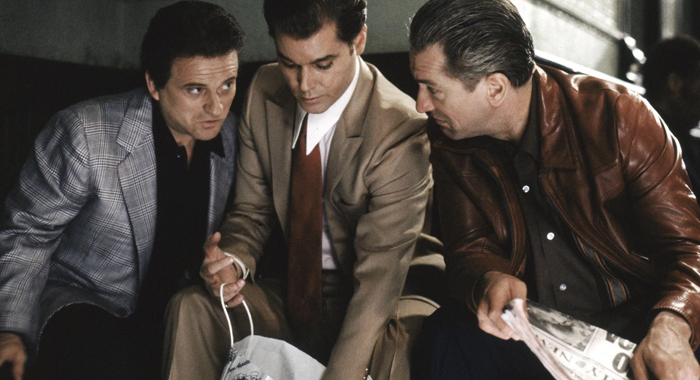 |
For the glib sociopaths of Goodfellas, violent death generally isn’t even the most important thing happening at any given moment. |
The exemplars of toxic masculinity in Goodfellas enjoy the finer things in life and don’t mind racking up the body count of a small war in order to acquire them. In flashback, we see the opening bloodbath of Hill’s childhood and witness his rise from ne’er-do-well half-Italian, half-Irish teenager to organized crime prodigy who starts off early doing jobs for the mob before steadily making his way up the ranks.
Few films use narration as extensively or as incisively as Goodfellas. As the famous opening conveys, narration can be an ironic counter-point to the action, but it’s also a great way to impart information. Goodfellas has a lot of information and exposition to unpack — it’s one of those movies that’s secretly (and almost unintentionally) educational, but it never feels like Scorsese is using narration to dump information on the audience.
No, the narration is a core element of the seduction. Goodfellas ushers us into a shadow society that’s like a sovereign nation within a nation, a secret United States where all of those metaphors about the savage nature of capitalism become brutally literal. It’s a world where “cutthroat competition” involves the actual cutting of throats, and “kill or be killed” is a maxim to be taken literally.
We see the world through Hill’s eyes and understand it through his voice. Scorsese plays with subjectivity continuously — the idea is to eliminate the gulf between what the protagonist experiences and what the audience experiences. Yet as he thrusts us inside Hill’s head — whether he’s being seduced by the lushness of the gangster lifestyle or seeing everything through the live-wire paranoia of a cocaine haze — Scorsese’s technique calls constant attention to the film’s style.
So while the intricately choreographed long-take sequences angrily demand to be acknowledged (and praised), a lot of the film’s most iconic moments consist of its characters simply doing shtick, busting each other’s balls in ways that make it hard to delineate between the faux comic aggression of friends giving each other a hard time and genuine rage that can — and in the case of Goodfellas, almost always does — explode into violence.
Think of the famous scene in which Hill tells Tommy that he’s funny, and the way the tone of the scene shifts instantly from rowdy, celebratory fun to painful tension when a suddenly enraged Tommy asks exactly how he’s funny, seemingly receiving an offhanded compliment as an unforgivable insult. The humor here is the comedy of awkwardness, of discomfort. That awkwardness doesn’t dissipate until Tommy drops the shtick and concedes that he was just busting his friend’s balls.
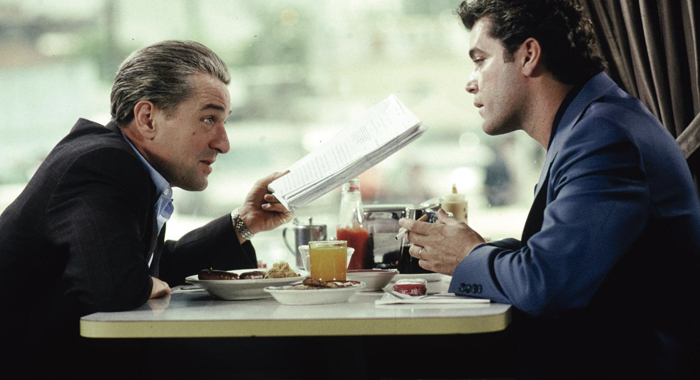 |
Goodfellas anticipated the dark comedy of Quentin Tarantino and the way he made giddy comic sport out of the weirdly banal ways bad guys go about the ugly business of killing people. |
Goodfellas spends a lot of time documenting its characters’ strange moral code. One of these rules is that, in the mob’s rigid hierarchy, guys at the top can get away with just about anything (especially if they’re “made”) while the people at the bottom are held to a far stricter standard. Hapless underling Spider (Michael Imperioli) learns this the deadly way when he makes the mistake of getting on Tommy’s bad side: because he isn’t a friend, or someone Tommy respects, he’s shot in the leg in a fit of rage, then just flat-out murdered.
For most of us, the prospect of death is frightening. For the glib sociopaths of Goodfellas, violent death generally isn’t even the most important thing happening at any given moment. The moment Tommy kills somebody, they cease to matter as anything other than a heap of meat to be hidden away before it becomes a problem. He lives forever in the present tense, which helps explain why he never seems to feel remotely guilty about the people he has killed.
Goodfellas anticipated the grisly blood-splattered dark comedy of Quentin Tarantino — particularly Pulp Fiction — and the way Tarantino made giddy comic sport out of the weirdly banal ways bad guys go about the ugly business of killing people. Like Tarantino’s first films, Goodfellas is in love with language, in love with behavior, and in love with conversation. It’s what Tarantino refers to as a “hangout movie,” a film populated with people and scenes so irresistible you want to revisit them over and over again, despite an almost complete dearth of sympathetic characters. There aren’t really any good guys in Goodfellas. Even the feds are jerks. There are only raging psychopaths like Tommy and people who are less evil, but still far short of even the most generous conceptions of “good.”
Hill doesn’t have a problem with the relentless violence of his job — it’s just business — and he doesn’t become alarmed until his colleagues begin to ignore the mob’s elaborate codes and start murdering people in ways that are indiscriminate, sloppy, and, worst of all, unprofessional. Hill can appreciate a good gangland assassination, but there’s just no excuse for subpar killing.
Goodfellas is a dark comedy of amorality, awkwardness, and blood-soaked slapstick, but for stretches, it’s also a culture-clash comedy. Hill falls in love with Karen (Lorraine Bracco), a nice Jewish girl who quickly devolves into a not-so-nice mobster wife. For part of the film, Karen takes over the narration to explain how jarring and bizarre it felt to be introduced to a weird world of mob wives filled with sad, angry women with spectacularly — almost impressively — terrible taste. We see these women as Karen sees them, as hideous gargoyles buried in pancake makeup and gaudy outfits. It’s disorienting and jarring initially, but it isn’t long until this ostensible outsider is living the lifestyle in all its tacky, vulgar, criminal quasi-glory. The mob taints and corrupts everything it touches in Goodfellas, and wives aren’t exempt — particularly if they want, on some level, to be corrupted.
Scorsese moves slowly and surely through the first two acts, unafraid to take his time, and the film’s pace reflects the ease of men who move through life knowing they are protected by the highest forms of power, at least where their neighborhood is concerned. In its final half hour, the pace accelerates to manic levels to reflect the mental deterioration of our protagonist, as he approaches a dispiriting endgame after a massive heist goes spectacularly awry and he starts abusing the coke he’s also selling.
Throughout Goodfellas, Hill acts as our guide to his secret world. The film’s humor, as well as its drama, comes from the gap between the amorality of the gangster lifestyle and the stodgy, staid morality of the audience, so there’s a sick joke in fate ultimately giving Hill a sentence worse than prison or death.
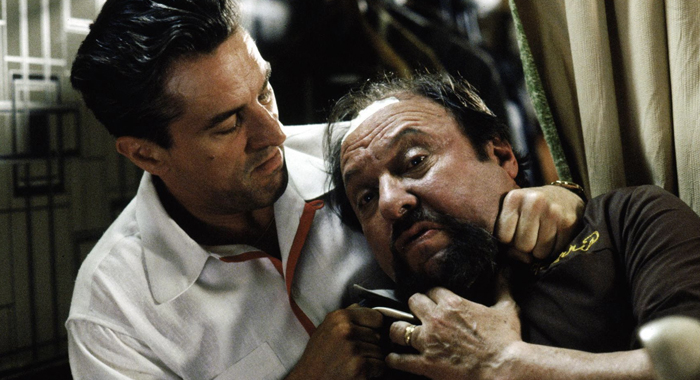 |
The film’s humor, as well as its drama, comes from the gap between the amorality of the gangster lifestyle and the stodgy, staid morality of the audience. |
Hill’s brutal punishment after betraying his closest peers and flagrantly disobeying the two iron-clad rules of mob life — “Never rat on your friends, and always keep your mouth shut” — is to become one of us, the sad suckers in the audience living vicariously through him. He’s cursed to live by the same tedious rules that we do. But it’s worse than that: Hill betrays what little he believes in by turning on the people he loves the most for the sake of saving his own ass. In a world where murder is nothing to get worked up about, being a snitch is the ultimate transgression. It’s even worse than making sub-standard spaghetti sauce. And that’s how Hill ends the movie: spilling the beans to the government the same way he’s been exposing the inner workings of the mob to the audience all throughout the film.
Even here, Hill sees things in show-business terms. “We were movie stars with muscle, we had it all just for the asking,” he concedes sadly, contemplating the world of power and access he’s leaving seemingly forever. At this point Hill breaks the fourth wall and walks off the witness stand where he’s testifying against his mentors, men he once revered as benevolent father figures, and he addresses the audience directly.
We then see Hill post-witness protection, as a self-described “average nobody” picking up the newspaper in his bathrobe like he was Dagwood Bumstead. On the soundtrack, meanwhile, Sid Vicious sneers his way through a feral version of “My Way” that’s less a cover than a bratty, aggressive, juvenile mockery — not just of Frank Sinatra’s egomaniacal anthem, but of the whole macho mindset that breeds men like Sinatra and Henry Hill. (Incidentally, Liotta would go on to play Sinatra in 1998’s The Rat Pack, a TV movie highlighted by Don Cheadlle’s brilliant take on Sammy Davis, Jr.)
It’s a cover rich in sarcasm, and its use here is similarly filled with irony. Hill hasn’t done it his way at all. No, he got caught, betrayed his longtime friends, and slunk away to avoid being killed by the same system he spent decades serving. But he isn’t quite as neutered as the ending makes it seem: we learn that Hill relapsed and went to jail again for narcotics, but has reportedly been clean since 1987. The upshot? Hill found his way out of the prison of everyday existence, but it led to time in actual prison. Considering how much he enjoyed a previous stint in the hoosegow, he might consider prison an upgrade over straight life as a non-criminal. Better to be a con than a schmuck.
The movie ends as it begins, with an ironic, satirical gut punch that’s still being felt across pop culture. It doesn’t seem like an exaggeration to posit Goodfellas as one of the 20 or so most influential American films of all time. It belongs to everyone at this point: still images have been turned into ubiquitous memes, and its characters have been appropriated wholesale by The Simpsons and Saturday Night Live, the latter of which cast Jim Breuer as Joe Pesci in a talk show sketch whose very slim gimmick involved Pesci acting exactly like his character in Goodfellas.
Yet none of these knock-offs and parodies are a fraction as funny or as revolutionary as the film itself. Goodfellas never gets old. It never stops being being new and bold and audacious. Twenty-six years and a whole sub-genre of ripoffs later, it’s still ahead of the curve. So while Goodfellas is funny in a very 1990s kind of way — it’s dark, cynical, hyper-violent, and obsessed with pop culture and storytelling and macho codes of honor — it’s funny in a way that’s ultimately timeless.
Nathan Rabin if a freelance writer, columnist, the first head writer of The A.V. Club and the author of four books, most recently Weird Al: The Book (with “Weird Al” Yankovic) and You Don’t Know Me But You Don’t Like Me.
Follow Nathan on Twitter: @NathanRabin

(Photo by Kevin Winter / Staff / Getty Images)
Oscar-nominated screenwriter Melissa Mathison, who penned the scripts for such classics as E.T. the Extra Terrestrial and The Black Stallion, died Wednesday in Los Angeles after a battle with cancer. She was 65.
Born in Los Angeles, to parents who were both writers, Mathison attended the University of California-Berkeley before leaving to work as Francis Ford Coppola’s assistant on The Godfather, Part II. After another stint as an assistant on Coppola’s Apocalypse Now — where she met future Husband Harrison Ford — she wrote the script for The Black Stallion (1979), a wide-eyed, deeply-felt family film that was produced by Coppola’s American Zoetrope studio. She would later write the script for Black Stallion cinematographer Caleb Deschanel’s The Escape Artist.)
However, it was Mathison’s script for E.T. – The Extra-Terrestrial (1982) that would prove to be her defining work as a screenwriter; she had said she was frustrated with the kinds of films that were typically made for children. E.T. earned Mathison an Oscar nomination for Best Original Screenplay; she and director Steven Spielberg would then collaborate on his segment of the 1983 omnibus film Twilight Zone: The Movie and the forthcoming fantasy adventure The BFG, which is slated for a 2016 release.
Mathison took time off in the mid-1980s to raise a family. She returned to the scene in 1997 with the script for Martin Scorsese’s Kundun, which was influenced by Mathison’s friendship with the Dalai Lama and her activism on behalf of Tibet. She is survived by two children from her marriage to Ford.
For Melissa Mathison’s complete filmography, click here.
This week in TV news, AMC greenlights a motorcycle-themed reality show with Norman Reedus, while Netflix gives a full-series order to YA project 13 Reasons Why with Selena Gomez. Plus, check out the happiest, fluffiest TV binge happening this weekend, and be on the lookout for HBO original series coming this winter — and figure out what that means for the next season of Game of Thrones! When is winter coming already?!

AMC announced Thursday its plans for a new non-scripted series, Ride With Norman Reedus, which stars The Walking Dead fan favorite (Daryl!) on the open road. In Ride, the actor and biker enthusiast will “explore local motorcycle culture and history and celebrate some of the best and brightest collectors, mechanics, and motorcycle craftsmen around the country.” Each episode will start in a different city and feature Reedus with a new riding companion — such as a fellow actor, musician, or bike fanatic — as they explore America’s motorcycle shops and collectors’ warehouses, as well as a few detours along the way (think tattoo parlors and roadside smokehouses). Ride With Norman Reedus, which will hit AMC in 2016 with six one-hour episodes, plans to showcase different motorcycles each week, adding to AMC’s existing unscripted programming: Comic Book Men and Talking Dead.

HBO set dates for three of its original series this week: Vinyl, Girls, and Togetherness. First up, Martin Scorsese‘s rock drama, Vinyl, starring Bobby Cannavale and written by Terence Winter of Boardwalk Empire fame, will premiere with a special two-hour episode on Valentine’s Day at 9 p.m. The following Sunday, Feb. 21, Vinyl will be the opening act for the season-five premiere of Girls, starring Lena Dunham, Allison Williams, and Adam Driver, and the season-two premiere of Togetherness with Mark Duplass and Amanda Peet. Over at Vulture, writer E. Alex Jung has calculated that these February dates mean a later start than usual for the next season of Game of Thrones. “As HBO only programs two hours of shows on Sunday nights,” Jung wrote, “it means that the sixth season of Game of Thrones likely wouldn’t return until May 1 at the earliest.”

Credit: Jamie McCarthy / Getty Images
Pop idol Selena Gomez will executive-produce a 13-episode adaptation of the young adult novel 13 Reasons Why for Netflix, according to Variety. In the 2007 book of the same name from Jay Asher, a boy named Clay receives a shoebox from his late crush, Hannah Baker, after she commits suicide. The contents of the box are cassettes that Clay is to distribute to 12 of his classmates — each of whom Hannah blames for taking her own life. Gomez reportedly took the project to Anonymous Content after reading the book, along with her mother Mandy Teefey, who will also executive-produce the project. Pulitzer Prize-winning playwright Brian Yorkey, who penned the pilot, is attached to write the full series.

Based on Bernard Cornwell’s bestselling series of books, “The Saxon Stories,” The Last Kingdom premieres this Saturday on BBC America.
See a pivotal scene from the premiere episode, in which a boy, Young Uhtred (Tom Taylor), watches his father Lord Uhtred (Matthew Macfadyen) die in battle at the hand of an infamous Danish warlord — an event that will set the course for Uhtred’s entire life.
“That’s rock and roll. It’s fast; it’s dirty; it smashes you over the head.”
So says a super-amped up Bobby Cannavale, as fictional record producer Richie Finestra in Vinyl, HBO’s new ’70s-set punk drama from Martin Scorsese and Terence Winter. Check out the latest trailer here:
Vinyl premieres January 2016 on HBO and also stars Olivia Wilde, Ray Romano, Ato Essandoh, Max Casella, P.J. Byrne, J.C. MacKenzie, Birgitte Hjort Sørensen, Juno Temple, Jack Quaid, James Jagger, and Paul Ben-Victor. Will you be watching?
This week’s Ketchup covers ten top stories from the last seven days in the realm of film development news, all of those stories we hear about upcoming movies. Included in the mix this time around are stories about the TV adaptations Absolutely Fabulous, Baywatch, and Deadwood, and new movies for Leonardo DiCaprio, Zac Efron, and Tom Hardy.

Jared Leto has been attracting a lot of attention this year for his depiction of The Joker in next year’s Suicide Squad, but Leto isn’t the only star who will soon be portraying The Joker on the big screen. Zach Galifianakis (The Hangover) is now in talks with Warner Bros to provide the voice of The Joker in their LEGO Movie spinoff The LEGO Batman Movie. Likewise, it won’t be Ben Affleck who provides the voice of Batman, but rather, it will be Will Arnett, who also played Batman in The LEGO Movie. Michael Cera has also recently been cast to provide the voice of Batman’s sidekick, Robin. The LEGO Batman Movie will be directed by Chris McKay, who also worked as an animation supervisor on last year’s The LEGO Movie. Warner Bros has scheduled The LEGO Batman Movie for release on February 10, 2017. The LEGO Batman Movie is just one part of Warner Bros’ continuing plans for their LEGO franchise, which includes The LEGO Ninjago Movie (9/22/17) (and a possible Ninjago sequel), The LEGO Movie Sequel (5/18/18), and The Billion Brick Race, which will be codirected by Jason Segel.

Director Martin Scorsese has collaborated with Robert De Niro for eight movies now, but Leonardo DiCaprio, who has been in five Scorsese films, is definitely getting close to at least tying De Niro’s record. This week, it was announced that Scorsese and DiCaprio are reuniting for what will be their sixth film working together. That film is the long-in-development adaptation of the Erik Larson non-fiction book, The Devil in the White City: Murder, Magic, and Madness at the Fair That Changed America. There was recently a studio auction for the rights to this package, and the winner was Paramount Pictures, which is in need of hot properties (as the studio is currently #5 in market share). Leonardo DiCaprio will play one of the most prolific serial killers in American history, Doctor H.H. Holmes, who is believed to have killed anywhere from 27 to over 200 people during Chicago’s World Fair of 1893. Holmes constructed “The World’s Fair Hotel,” which he was secretly using to lure his victims to their deaths, in “a haunt that had a gas chamber, crematorium and a dissecting table where Holmes would murder his victims and strip their skeletons to sell for medical and scientific study.” The Devil in the White City is being adapted by screenwriter Billy Ray (Captain Phillips, The Hunger Games).

When HBO announced in 2008 that they were pulling the plug on the Emmy-winning series Deadwood after three seasons, it left many of the show’s fans frustrated. Based upon the true stories of the 1870s frontier town in South Dakota, Deadwood was left at the end of the third season in narrative midstream, with some of the town’s historically significant true stories (Custer’s Last Stand, for example) yet to be included. There was talk at the time that HBO might produce a movie or two for their channel to wrap up the remaining stories, but the years passed, and nothing happened. Fans of Al Swearengen (Ian McShane’s foul-mouthed pimp/businessman) were excited to hear, therefore, the news that HBO has begun “very preliminary discussions” about how to bring Deadwood back as a feature film. If HBO does finally give Deadwood its shot at a feature film, it will join such previous HBO adaptations as Sex and the City (and its sequel), Sacha Baron Cohen’s Brüno, and this year’s Entourage. There has also been talk over the years about a possible movie based upon HBO’s Rome.

HBO isn’t the only TV channel that’s continuing to adapt their shows into being movies. This week saw the debut of the trailer for Dad’s Army, based on the popular BBC comedy series. And also this week, Fox Searchlight started negotiations with the BBC about boarding their plans for a feature film based upon the popular and long-running comedy series Absolutely Fabulous. That series about two middle-aged female friends (played by Jennifer Saunders and Joanna Lumley) premiered in 1992, ran for three years, and was then revived for two more series in 2001, which was then followed by a few specials in 2011 and 2012. Jennifer Saunders and Joanna Lumley are both expected to return, along with series regularly like Julia Sawalha and Jane Horrocks, and various celebrity cameos.

As one of the most prominent military leaders of the Pacific Campaign of World War II, General Douglas MacArthur has been portrayed dozens of times in film and television. The actors to play General MacArthur have included Gregory Peck (1977’s MacArthur), Sir Laurence Olivier (Inchon), Charlton Heston (TV’s Korea: The Unknown War), and recently, Tommy Lee Jones (Emperor). The next actor to join those high ranks is likely to be Liam Neeson, who is now in talks to star as General MacArthur in the Korean War drama Operation Chromite. The South Korean war drama will depict the events of the Battle of Inchon in 1950, which led to the recapture of Seoul, and was a strategic reversal for the United Nations’ allied forces. Operation Chromite will be directed by South Korean director John H. Lee, whose credits include A Moment to Remember, Sayonara Itsuka, and 71: Into the Fire. The production is being timed so that Operation Chromite can be released in South Korea in time for June 25, 2016, which will mark the 66th anniversary of the star of the Korean War.

Following successful hits with both Mad Max: Fury Road and 2012’s The Dark Knight Rises, Tom Hardy is becoming something of a box office force to be reckoned with. This week, the news broke that Hardy is returning to the corporate family behind both of those films as the producer of a feature film based upon a Vertigo Comics title. Tom Hardy will produce, and likely star, in New Line Cinema’s adaptation of the long-running series 100 Bullets. Also seen by some writers as a strong candidate to be adapted as a TV series, 100 Bullets (which ran for 100 issues from 1999 to 2009) was about “an enigmatic man named Agent Graves as he presents different people, for reasons unknown, with a gun, the identity of the person who ruined their lives … and a hundred rounds of untraceable ammunition.” Tom Hardy is expected to be the studio’s choice to play Agent Graves. New Line Cinema is also developing the Vertigo Comics adaptation Sandman (with Joseph Gordon-Levitt) and the DC Comics superhero adventure Shazam.

With only 6.7% of the 2015 market share to date, Paramount Pictures (along with Sony) is one of the studios that is under the most pressure to make big plans for the future. One of the movies that Paramount appears to be betting big on is their long-in-development adaptation of the hit 1970s TV show Baywatch. Having already recruited Dwayne Johnson for one of the film’s leads, this week, Paramount Pictures found his lifeguarding partner in the form of Zac Efron (Neighbors, High School Musical). Baywatch will tell the story of “a by-the-book and very serious lifeguard (Johnson) who is forced to team up with a young rule-flouting hothead (Efron) in order to save their beach from environmental destruction at the hands of an oil tycoon.” Seth Gordon (Horrible Bosses, Identity Thief) will direct Baywatch from a script most recently drafted by Damian Shannon and Mark Swift. In addition to working on Freddy vs Jason and the 2009 reboot of Friday the 13th, Shannon and Swift are also working on Disney’s Aladdin prequel called Genies. Filming of Baywatch is expected to start in early 2016 for release sometime in 2017, with what Dwayne Johnson confirmed this week will be an intended R rating, in Johnson’s words, “Like me when I drink.”

One of the big news stories last week was the announcement of release dates for both Bad Boys 3 (2/17/17) and Bad Boys 4 (7/3/19). (That was followed by a suggestion this week that Will Smith may only produce, and not star, in the sequels .) That news came from Sony Pictures, the studio whose two 21 Jump Street movies (along with Fox’s The Heat) suggest that there’s still very much a market for “buddy cop comedies.” And that right there might be why this week we learned that New Line Cinema has attached Mark Wahlberg to star in their buddy cop comedy called Partners. Compared to Mr. and Mrs Smith, Partners will follow an LAPD detective (Wahlberg) who finds that the woman he just had a one night stand with is also an FBI agent, and his superior on a high profile case they must work on together. Partners was written by Evan Turner, who has worked on ABC’s sitcom The Goldbergs. New Line Cinema is currently looking for a director, and Mark Wahlberg’s female costar.

Back in May, we first learned that 20th Century Fox has plans to reboot their adaptation of Alan Moore’s League of Extraordinary Gentlement comic book franchise after the failed attempt back in 2003. Earlier today, a quote from the project’s producer, John Davis, quickly became widespread, with varied interpretations. Davis was quoted as saying, “Just by going back to the roots and making it authentic to what the fan base was really excited about. It’s female-centric, which I think is interesting. I love female characters, point-of-view characters in action movies. I thought Mad Max [Fury Road] was great.” Some sources are interpreting that quote to suggest that the League of Extraordinary Gentlemen characters (which include the Invisible Man, Mr. Hyde, and Allan Quatermain) will be reimagined to become female characters, or new female characters will be added (similar to next year’s reboot of Ghostbusters). What’s also possible or likely is that John Davis was just referring to the fact that three of the characters Alan Moore uses most frequently as his protagonists are all female: Mina Murray, Orlando (who alternates between male and female), and Nemo’s daughter, Captain Janni Dakkar. We’re classifying this story as a “Rotten Idea” for now, based mostly on the Rotten 17% Tomatometer score that critics gave to the last time 20th Century Fox adapted League of Extraordinary Gentlemen.

When Warner Bros released Looney Tunes: Back in Action in late 2003, it was considered a box office bomb. That movie’s financial failure presumably led to the 12 years absence of any live action/animated Looney Tunes movies. What the box office numbers don’t tell you, however, is that critically, Looney Tunes: Back in Action (59% Tomatometer) was actually better received than Space Jam (35% Tomatometer), the 1996 Looney Tunes basketball comedy (though both scores are Rotten overall). Regardless, there have been rumors the last few years that Warner Bros is developing a sequel to Space Jam (presumably because Space Jam earned $230 million globally despite the critical reception). The focus of those rumors has been on Cleveland Cavaliers superstar LeBron James, but until this week, there had been no confirmation (including even when his production company signed with WB last month). Avoiding the Hollywood trades and blogs that are usually the sources for such news, LeBron James instead went on NBC’s Today this morning to say this about Space Jam 2: “We hope so. We’re definitely missing Bugs and Daffy and Tasmanian Devil and every last one of them, so hopefully we can do some great things.” LeBron James made his feature film acting debut in last month’s Trainwreck, appearing alongside Amy Schumer. There’s no word yet what other NBA stars might join LeBron James in Space Jam 2.
Is Martin Scorsese America’s greatest living director? It’s open to debate, but most movie buffs would agree that he’s created a body of work that is astonishing in its consistency and depth. Scorsese’s films contain many grand themes – organized crime, male insecurity, spiritual and moral uncertainty – and they’re executed with a level of artistic panache and intimate detail that few can match. Scorsese has exerted a profound influence on many important directors, including Quentin Tarantino, Spike Lee, and John Woo. And with apologies to Lee and Woody Allen, Scorsese is perhaps the greatest cinematic chronicler of New York’s distinctive social landscape.
While he’s considered one of the most important filmmakers to emerge in the 1970s, the 2000s have found Scorsese enjoying yet another fertile period, one that culminated with The Departed, for which he was granted his first Best Director Oscar. With his latest, Shutter Island, hitting theaters Feb. 19, we’ve decided to take a closer look at some of Scorsese’s most important films. However, rather than rank them by Tomatometer, we chose the movies that we feel best define the man’s art and stylistic breadth.
So join us for a tour of Scorsese’s career — a journey that will take us from the Bronx to Vegas, from Tibet to Boston, with plenty of interesting scenery along the way.
 |
Release Date: October 14, 1973 – Scorsese initially considered entering the priesthood, but ultimately decided to enroll in New York University’s film school, where he directed a number of shorts before graduating in 1969. It was here that he met two of his most important collaborators: a young actor named Harvey Keitel, and Thelma Schoonmaker, who would become his longtime editor.
In 1967, Scorsese directed his first feature, Who’s That Knocking at My Door?, starring Keitel as a young Italian American wracked by Catholic guilt. The film had a palpable sense of place and a soundtrack heavy with contemporary rock, but was occasionally sidetracked by excessively arty touches. Scorsese’s second feature, the solid-if-unspectacular Bonnie and Clyde-aping Boxcar Bertha, was made under the tutelage of exploitation maestro Roger Corman. Fellow director John Cassavetes told Scorsese his next film should be more personal, and the result was Mean Streets, a powerful tale of urban sin and guilt that marked Scorsese’s arrival as an important cinematic voice.
Keitel stars as Charlie, a low-level Mafioso whose devout Catholicism and loyalty to an old friend, the violent and impulsive Johnny Boy (Robert DeNiro, in the first of his many great performances for Scorsese) fill him with conflict. His love life is no easier: he’s torn between Diane (Jeannie Bell), a stripper, and Johnny Boy’s epileptic sister Teresa (Amy Robinson), and his lustful feelings consume him with self-loathing. From Mean Streets‘ electrifying title sequence (featuring grainy super-8 home movies of the characters over Ronettes’ bittersweet plea “Be My Baby”) to its inevitably grim conclusion, the film provides a far darker, less glamorous tour of the gangster life than The Godfather — one filled with uneasy alliances, sudden, clumsy violence, and moral dread.
 |
Release Date: May 30, 1975 – Before Mean Streets‘ release, Scorsese was hired to direct Alice Doesn’t Live Here Anymore, a vehicle for actress Ellen Burstyn. It was his first Hollywood production, and though it’s atypical of the kind of movie Scorsese would become known for, Alice showcases the director’s skill for capturing the small details in the lives of people facing adversity. Alternating between fantasy and everyday life, this intelligent dramedy found Scorsese making the most overtly feminist film of his career.
Burstyn plays Alice Hyatt, a New Mexico housewife reeling from the death of her husband. She decides to sell her possessions and hit the road, with her young son in tow, to live out her dream of becoming a professional singer. She gets a job at a seedy lounge and finds a boyfriend in Ben (Harvey Keitel), but their relationship shatters when Ben’s violent temper emerges. She skips town again, taking a job as a waitress in Phoenix, where she bonds with her coworkers and begins an uncertain but strong romance with a lonely rancher named David (Kris Kristofferson). Burstyn’s powerful, risk-taking performance won her an Oscar for Best Actress, and the movie was adapted into a long-running sitcom, but Alice Doesn’t Live Here Anymore also proved that Scorsese was no one-trick pony; he could put his stamp on more conventional material.
 |
Release Date: February 8, 1976 – The nightmarish, endlessly compelling Taxi Driver confirmed Scorsese’s reputation as one of the foremost figures of the “Movie Brat” generation and provided Robert DeNiro with perhaps his most iconic movie role: Travis Bickle, a lonely, socially awkward, and dangerously volatile Vietnam vet turned late-night cabbie. DeNiro ad-libbed the movie’s most famous line (“You talkin’ to me?”), and Paul Schrader wrote the script (ominously, the Bickle character was partially based upon himself), but Scorsese pulled it all together, and the result is a haunted, unforgettable portrait of troubled masculinity and, by proxy, the urban malaise that plagued New York in the mid-1970s.
Bickle is an insomniac, and takes the graveyard shift driving a taxi around the city, frequently returning to Times Square. However, the more he sees during his nocturnal excursions, the more he seethes: he’s disgusted by the pimps, prostitutes, and junkies that regularly line the sidewalks of his route. One ray of light comes in the form of Betsy (Cybill Shepherd), a presidential campaign worker who’s intrigued by Travis. But after an ill-fated date to a porno flick, Travis begins to stalk Betsy — and the candidate as well. He also takes it upon himself to save Iris (Jodie Foster), a teenage prostitute, from her life on the streets — a life she seems unwilling to abandon. The movie builds to a feverish, brutal climax that finds Travis exploding with the violent rage that’s been simmering throughout the film, before ending with an oddly elliptical, dreamlike coda.
Taxi Driver won the Palme d’Or at the Cannes Film Festival and was nominated for a Best Picture Oscar; it also inspired John Hinckley, Jr. to attempt to assassinate President Reagan. In other words, it’s cinema at its most primal and provocative, a masterwork that continues to leave audiences both profoundly moved and deeply unsettled.
 |
Release Date: June 21, 1977 – Today, New York, New York is probably best remembered for Frank Sinatra’s unparalleled rendition of its title tune, but it stands as a monument to the kind of epic, ambitious, auteur filmmaking that became virtually extinct by the end of the 1970s. Following the success of Mean Streets and Taxi Driver, Scorsese grafted his gritty realism onto the glitzy superficiality of the classic MGM musicals that he loved. The result is uneven, but while it bombed at the box office and remains one of Scorsese’s least-loved works, New York, New York features several show-stopping numbers and a distinctive style that’s all its own.
Robert DeNiro stars as Jimmy Doyle, a roguish jazz saxophonist who develops an on-and-off relationship with an up-and-coming singer named Francine Evans (Liza Minnelli). Their relationship is troubled from the beginning — Jimmy is a difficult customer, too temperamental for the responsibilities of love or his career. After a long split, the two find each other again, and this time, they’re at the top of their respective games — Francine’s topping the charts, and Jimmy has become a respected musician and club owner. In attempting an old-school rags-to-riches tale against a glittery backdrop, Scorsese can’t help but flesh out his characters’ painful insecurities, all of which makes for a stylistically jagged but often fascinating picture.
 |
Release Date: December 19, 1980 – By the end of the 1970s, Scorsese’s career faced uncertain times. He directed the all-star rockumentary “The Last Waltz,” which chronicled the Band’s final gig, and the little-seen but queasily fascinating “American Boy,” a doc about Neil Diamond roadie and all-around sketchy character Steven Prince. But he had a bad drug habit, and Robert DeNiro, obsessed with bringing former middleweight champ Jake LaMotta’s autobiography to the screen, worked overtime to coax the director back into action. The result, Raging Bull, is considered by many to be Scorsese’s greatest achievement, a kinetic, on-edge portrait of a brutal, flawed man that never loses sight of its protagonist’s humanity.
The film charts the rise of LaMotta (DeNiro) through the middleweight ranks, aided and abetted by his brother Joey (Joe Pesci), who acts as his matchmaker and sparring partner. After throwing a fixed fight, LaMotta is granted a title shot by underworld fixers in the fight game, and also begins to court the teenaged Vicky (Cathy Moriarty), who he meets at a Bronx swimming pool. LaMotta is most expressive in the ring, delivering flurries of punches to his opponents; on the outside, though, LaMotta is fiercely possessive of Vicky, and his inability to control his emotions leads to a long, sad decline.
Filmed in tactile black-and-white, the movie is perhaps Scorsese’s most articulate meditation on male inadequacy, and its fight scenes are vivid and electric. Raging Bull was nominated for eight Oscars, and while winning two — Best Actor for DeNiro, and Thelma Schoonmaker for Best Editing — it failed to take home the Best Picture or Best Director awards, two honors that would elude Scorsese for years to come. Still, the director can take comfort in the film’s critical appraisal — the prestigious British magazine Sight and Sound called Raging Bull the best movie of the 1980s.
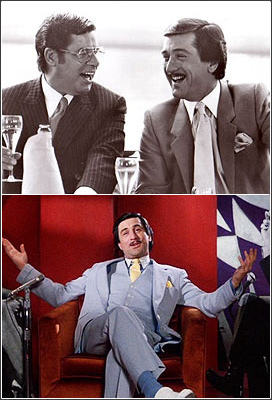 |
Release Date: February 18, 1983 – Simon Cowell should be thankful that the average deluded American Idol also-ran isn’t Rupert Pupkin. The single-minded fameball at the center of Scorsese’s pitch-black The King of Comedy is a type with whom we’ve become increasingly familiar in our tabloid-saturated times: Pupkin is needy, desperate, and willing to do anything to become famous. However, as played by Robert DeNiro, he’s a strangely sympathetic psychopath — and not an untalented one at that. Largely ignored and misunderstood upon its release, The King of Comedy today looks eerily prescient, and finds Scorsese dissecting our showbiz-fixated culture through the lens of the troubled loners that populated his previous films.
The lonely Pupkin amuses himself by seeking autographs and play-acting a late night talk show (he has a full set in his apartment, and banters with cardboard cutouts of the stars). One night, he has a chance meeting with one of his idols, chat host Jerry Langford (Jerry Lewis), who non-committally promises to check out Pupkin’s comedy act. Convinced he has his foot in the door, Pupkin shows up daily at Langford’s office until eventually he’s forcefully ejected. He then hatches a plot to kidnap Langford in a last-ditch effort to realize his dreams. With terrific performances from DeNiro, Lewis, and a borderline possessed Sandra Bernhard (who plays Pupkin’s accomplice), The King of Comedy is about as black as black comedies come, but it makes for riveting, prophetic entertainment. Most ironic line of dialogue, courtesy of Langford: “You don’t just walk onto a network show without experience.” Just you wait, buddy.
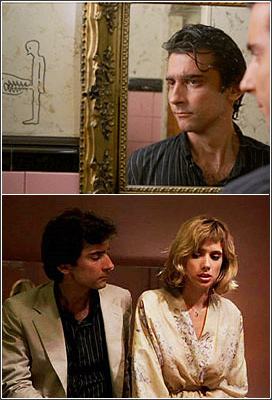 |
Release Date: September 13, 1985 – Like Taxi Driver, After Hours chronicles one man’s nightmarish, paranoid nocturnal journey throughout New York City. Unlike Taxi Driver, After Hours is a comedy — albeit an absurdist, Kafka-esque one. Scorsese had difficulty securing funding for some of his dream projects, so he decided to scale down for After Hours, adopting an underground, almost punk-rock aesthetic. The result was a different kind of Scorsese picture, an oddball movie that maintained the themes of his previous work while adjusting to the changing times.
Griffin Dunne stars as Paul, a corporate drone who meets an intriguing woman named Marcy (Rosanna Arquette) in a diner. He gets her number, and shortly thereafter she invites him to the apartment where she’s staying. But when Paul clumsily loses his money — and finds out that Marcy is more than he bargained for — he decides to head home. Subsequently, Paul is confronted with a bizarre series of circumstances — including subway fare increases, a bondage session, the loss of his keys, a suicide, Cheech and Chong, and a marauding mob that wrongly believes he’s a cat burglar — that prevent him from leaving Soho. Loaded with tension and wacky characters, this cult favorite found Scorsese making common cause with the burgeoning 1980s indie movement.
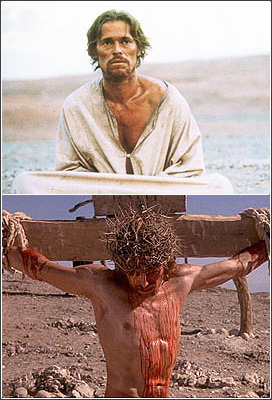 |
Release Date: August 12, 1988 – In the mid-1980s, Scorsese directed a pair of films that got him back in the mainstream’s good graces (The Color of Money, a sequel to The Hustler starring Tom Cruise and Paul Newman who won a Best Actor Oscar; and the long-form music video for Michael Jackson’s “Bad”). Next, he turned to a project of intense personal significance: an adaptation of Nikos Kazantzakis’ novel The Last Temptation of Christ.
It was Scorsese’s most controversial film to date; a scene in which Jesus (Willem Defoe), in a dream, forsakes the cross to marry Mary Magdalene (Barbara Hershey) drew thunderous protests from religious groups (unfortunately for Scorsese, the brouhaha did little for the film’s commercial prospects, as it bombed at the box office). However, The Last Temptation of Christ was hardly an empty provocation; while the film deviates from Scripture, it’s a sincere, deeply-felt attempt by Scorsese, a dedicated Catholic, to explore the mysteries inherent in Jesus’ tale – most notably, the grey area between his divinity and his humanity.
The Last Temptation of Christ touches on many of the greatest hits from the Gospels, from Jesus’ Sermon on the Mount to his Crucifixion. However, in drawing from the novel, Scorsese depicts Christ’s complex relationship with Judas (Harvey Keitel) and provides him with an inner monologue laced with uncertainty and distress over his supernatural visions. Each of the actors speak in their own accents, which lends an immediacy to the proceedings, and the on-location shoot in Morocco makes for a vibrant, mysterious stand-in for ancient Israel. The Last Temptation of Christ is austere, serious moviemaking, and though it isn’t always easy to watch, it’s a brilliant example of Scorsese’s ability make transcendent cinema out of inner tumult.
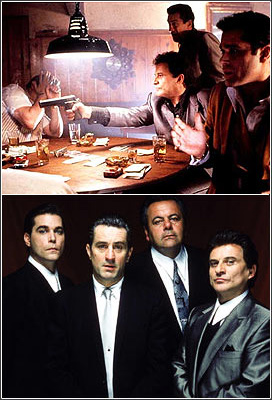 |
Release Date: September 19, 1990 – Raging Bull may be Scorsese’s most critically revered film, and The Departed was his biggest commercial success, but Goodfellas is probably his most cultishly adored picture. The tale of Henry Hill (Ray Liotta), an Irish-Italian mobster-turned snitch contains one of the most oft-quoted lines of dialogue in any Scorsese film, courtesy of Joe Pesci as the psychopathic Tommy DeVito: “I’m funny how? I mean, funny like I’m a clown? I amuse you?”
It’s easy to see why Goodfellas continues to resonate: It’s brilliantly acted, shockingly violent, unnervingly tense, and wickedly funny. It also contains one of Scorsese’s best soundtracks, utilizing the Rolling Stones’ “Gimme Shelter” and Derek and the Dominoes’ “Layla” to evocative effect. And once again, Scorsese is brilliant at capturing the distinctive milieus and daily rhythms of the underworld and bonds that form between those who live outside the law.
Hill is a Brooklyn kid who’s always dreamed of being a part of the Mafia. His wish comes true when he teams up with such local toughs as DeVito and Jimmy “The Gent” Conway (DeNiro) for a series of burglaries and hijackings. After attempting to recover money from an indebted gambler, many of the wiseguys are sent to prison, where Hill starts dealing drugs to support his family. Upon their release, the gang executes a spectacular heist of money and jewelry from JFK Airport, a crime that breaks the tight bonds of the gang. Hill convinces Conway and DeVito to join him in the drug trade, but soon, the wiseguys’ trust in one another has completely eroded. Based upon true events, Goodfellas feels absolutely authentic, not least because Scorsese is brilliant in depicting the inherent appeal of the gangster life — and its dark consequences.
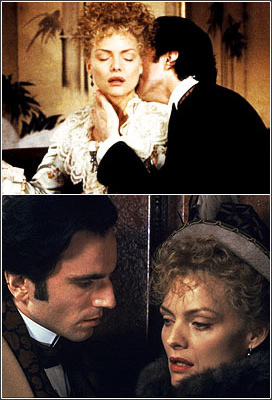 |
Release Date: October 1, 1993 – After a tense, assured remake of Cape Fear in 1991, Scosese did another U-turn. When it was released in 1993, The Age of Innocence seemed like a radical departure for the director; he took time out from chronicling New York’s gangsters and loners to craft a lush period piece about the city’s society life of the 1870s. However, like many of Scorsese’s other films, The Age of Innocence, based upon Edith Wharton’s novel, explores the social codes of a time and place that govern – and restrict – people’s behavior; Newland Archer (Daniel Day-Lewis) and Countess Ellen Olenska (Michelle Pfeiffer) are as bound by the conventions of their environs as Charlie and Johnny Boy were in Mean Streets. They may not have the outlets for emotional release afforded Scorsese’s other protagonists, but their passions run just as deep. The result is the director’s prettiest film, and a deeply poignant one.
Archer is an upstanding (but questioning) member of New York’s upper crust at a happy point in his life – he’s engaged to beautiful socialite May Welland (Winona Ryder). However, May’s cousin Ellen has just arrived in town, causing a scandal — she was unhappily married in Europe, and rumor has it she had an affair with a commoner. Seeking a divorce from her husband, she consults Archer, an attorney, for advice. Though he’s sympathetic to Ellen and feels she shouldn’t be shunned because of her marital status, Archer asks her to consider the social ramifications of her decision. What follows is a delicate dance between Archer and Ellen, who are powerfully attracted to one another; Archer sees possibilities for happiness with this new woman beyond his humdrum marriage.
Scorsese’s pacing is stately, but The Age of Innocence succeeds where many period-pieces fail, showing impeccable period décor as well as passion and, ultimately, bittersweet longing.
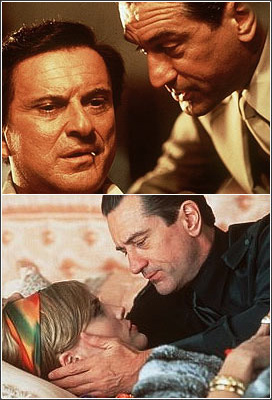 |
Release Date: November 22, 1995 – Upon its release in 1995, critics were somewhat disappointed by Casino. With the focused brilliance of GoodFellas fresh in their minds, many felt Casino was simply a well-crafted yarn that lacked the narrative focus to achieve its ambitious aims. However, seen 15 years later (and endless replays on cable), Casino has aged remarkably well; its telling of Vegas’ Genesis story is complicated, to be sure, but Scorsese deftly balances the historical details with the human drama, and he’s helped immeasurably by excellent performances from Robert DeNiro, Joe Pesci, and Sharon Stone (in arguably her greatest performance).
Casino is the story of how Las Vegas went from a sleepy desert outpost to a major tourist destination, told primarily through the eyes of Sam “Ace” Rothstein (DeNiro), a master sports handicapper recruited by the mob to manage the Tangiers Casino – and skim as much money as possible. Rothstein is a great success at generating illicit revenue, but his personal life takes a perilous turn when he marries former prostitute Ginger McKenna (Stone) and his old buddy, the violent, impulsive Nicky Santoro (Pesci) is brought in to provide muscle. Soon, Ace is besieged by the FBI, his closest associates, and, eventually, the mob itself.
Casino is filled with fly-on-the-wall details about how criminal organizations function – it’s a secret history of one of America’s most iconic cities, and a reminder of the criminality that helped build it. But it’s also a story about how human failings can derail even the most seemingly foolproof of plans.
 |
Release Date: December 25, 1997 – In The Sopranos, there’s a scene in which a young Mafioso sees Scorsese (played by Anthony Caso) entering a nightclub and shouts, “Marty! Kundun — I liked it!” Coming on the heels of the gangster epic Casino, Kundun took some by surprise, but this biography of the 14th Dalai Lama can be seen as a companion piece with The Last Temptation of Christ. Made in Morocco with a cast of non-professional actors, it’s a devout, patient, gorgeously-shot work — and if it doesn’t delve deeply enough into the inner workings of His Holiness, Kundun provides both a dramatic recreation of the conflict between Tibet and China, as well as a crash course in Buddhist principles and rituals.
Kundun begins in 1937, with a group of lamas searching for the latest incarnation of the Dalai Lama. They discover a two-year-old in a farming village near the Chinese border, and the boy is deemed a worthy successor after successfully selecting which items randomly laid on a table belonged to the previous Dalai Lama. The boy grows into his role, with intensive study of Buddhism and a preternatural grasp of political affairs. However, he’s tested when China annexes Tibet; after a few promising meetings with Mao Zedong, the Dalai Lama (played as an adult by Tenzin Thuthob Tsarong) realizes that Tibet’s way of life is under attack.
Featuring a moody, evocative score by Philip Glass, Kundun is one of Scorsese’s most visually ravishing pictures, and while it occasionally veers into standard biopic tropes, it’s a reverent, impassioned work. Kundun‘s sympathetic treatment of Tibet irked Chinese authorities, who permanently banned Scorsese and screenwriter Melissa Mathison from entering the country.
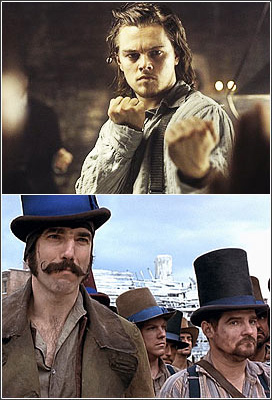 |
Release Date: December 20, 2002 – After the underrated Paul Schrader collaboration Bringing Out the Dead, Scorsese tackled a long-gestating dream project: Gangs of New York. Loosely based upon Herbert Asbury’s 1928 true crime book of the same name, Gangs was an attempt by one of cinema’s poets of organized crime to explore the roots of American gangsterism — and its inextricable ties with society and government. Set in Civil War-era Manhattan, the movie depicts a city teeming with hatred and violence — Gangs‘ Five Points setting is worlds away from the genteel folks living across town in The Age of Innocence. Costing more than $100 million and clocking in at nearly three hours, Gangs of New York can feel overstuffed, and it sometimes lacks historical context, but it’s always watchable, thanks to the impeccable production design and a gonzo performance from Daniel Day Lewis.
Leonardo DiCaprio (in his first performance for Scorsese) stars as Amsterdam, the son of Priest Vallon (Liam Neeson), an Irish immigrant gang leader. Vallon is killed in a gang war by Bill “The Butcher” Cutting (Lewis), who leads the virulently anti-immigrant Natives gang. Amsterdam is raised in a home for orphans, but upon his release as a young man, he returns to the Five Points section of New York, where Cutting rules with an iron fist. Amsterdam becomes Cutting’s right-hand man, while secretly planning to kill him. Meanwhile in the mayor’s office, Boss Tweed schemes to employ the gangs’ mutual antipathy to his political advantage. However, forced conscription of Irish immigrants into the Union army threatens to bring New York to a boil. Given that Scorsese had wanted to make this film for decades, his insistence on packing in as many events as possible is understandable, but it can make for a grueling experience. Still, Lewis is mesmerizing to watch, and rarely has a period piece captured an era with such acute attention to detail.
Gangs won Scorsese his first Golden Globe for Best Director, but he couldn’t repeat at the Oscars, losing Best Director and Best Picture to The Pianist and Chicago, respectively.
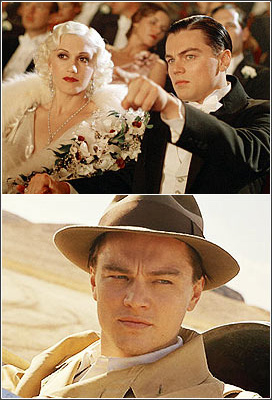 |
Release Date: December 25, 2004 – As the old saying goes, if you’re poor, you’re crazy, but if you’re rich, you’re eccentric. Few lived this maxim quite like Howard Hughes, who was a business tycoon, film producer, aviation pioneer, and germophobic loon. Scorsese’s handsome, sprawling biopic brings Hughes – or at least the idea of the man – to modern audiences. As history, The Aviator is often dubious (and it downplays some of Hughes’ less amusing idiosyncrasies — his enthusiastic, lifelong racism, for instance). However, Like Casino, The Aviator charts a historic moment before American business became more corporatized – when go-for-broke dreamers could change the status quo.
Leonardo DiCaprio plays Hughes as a cocksure, free-spending optimist; when we first meet him, he’s ignoring all sensible budgetary concerns to make Hell’s Angels the most spectacular picture possible. He also has a passion for fast airplanes and beautiful women, heedlessly breaking speed records, spearheading grand designs for flying machines, and courting Hollywood stars like Katherine Hepburn (Cate Blanchett). And as the owner of TWA, he’s locked in battle with Juan Trippe (Alec Baldwin) and Pan-Am for control of the airline industry. However, Hughes’ paranoia and obsessive-compulsive behavior contribute to his eroding social stature – by the end of the film, he’s sequestered himself in his private movie theater, terrified of germs and antagonists. Scorsese captures the glamour and ambitious spirit of Hughes’ era, and DiCaprio is outstanding at projecting a boyish recklessness that hardens into madness.
If The Aviator whitewashes certain aspects of Hughes’ life, it’s never less than watchable and breezily compelling. And though it didn’t win Best Picture, The Aviator took home five awards on 11 nominations.
 |
Release Date: October 6, 2006 – For years, Scorsese was to the Oscars what Susan Lucci was to the Daytime Emmys – a perennially deserving runner-up. When The Departed won both Best Picture and Best Director, some surmised that it was not simply because of the quality of the film – it was for the whole of Scorsese’s body of work. Still, if The Departed is a notch below GoodFellas or Raging Bull, it’s still a remarkable picture – an entertaining, complex cat-and-mouse tale that traded the mean streets of New York for South Boston without sacrificing Scorsese’s acute eye for regional detail.
A loose remake of the Hong Kong crime drama Infernal Affairs, The Departed is directed with matchless assurance from the man who wrote the rulebook on this kind of picture – and still finding new ways to expand the boundaries. (It should not pass without mention that Scorsese bookended The Departed with two fine rockumentaries: No Direction Home, a mammoth, insightful exploration of Bob Dylan’s early career that aired on PBS, and Shine a Light, an exhilarating live document of the still-spry Rolling Stones).
Irish Mafia head Frank Costello (Jack Nicholson) has a plan to stay one step ahead of the Boston authorities: utilizing Colin Sullivan (Matt Damon), who has just graduated from the Massachusetts State Police Academy, as his personal spy. However, the cops have a mole of their own: Billy Costigan (Leonardo DiCaprio), who quickly earns Costello’s trust. Before too long, it becomes apparent that both sides have people on the inside; as a result, Sullivan and Costigan work frantically to root out their counterpart. The Departed is filled with fine performances – Nicholson is at his grouchy, angry best here, and features juicy supporting roles for Mark Wahlberg, Martin Sheen, Vera Farmiga, and Alec Baldwin, to name just a few. But ultimately, The Departed is Scorsese’s triumph – a film with the grit and emotional weight that compares favorably to this cinematic master’s finest work.
Movies as we know them just wouldn’t be the same without Roger Corman. Sure, filmmakers like Francis Ford Coppola, Martin Scorsese, Jonathan Demme, James Cameron and Joe Dante probably would have found their way into the game eventually, but the fact remains that they all got their start under the tutelage of Corman and his low-budget genre factory — a tireless B-picture production line that also gave early breaks to unknown young actors like Robert De Niro, Sylvester Stallone and Jack Nicholson. Perhaps more significantly, Corman was one of the pioneers of the independent movie model, cranking out scores of exploitation and genre films (and distributing foreign titles by Truffaut, Bergman, Fellini and Kurosawa) that turned profits even as they flaunted the traditional studio system. (Not to be discounted: he also directed a handful of genuinely fine movies, like the Edgar Allan Poe adaptation The Masque of the Red Death.) This week, Corman is celebrated in Alex Stapleton’s documentary Corman’s World: Exploits of a Hollywood Rebel, a career-spanning look at his work that gathers together exultant testimonials from many of his most famous pupils. We caught up with Corman earlier this week for a chat about his career and his “graduates,” his thoughts on independent film, and how the Lucas/Spielberg blockbusters spelled doom for genre pictures. First, here are Corman’s five favorite films.
Battleship Potemkin (Sergei M. Eistenstein, 1925; 100% Tomatometer)
Well, if I were to pick my five favorites I would probably start with Battleship Potemkin, the great Russian silent film. To me, that is the greatest film ever made. It was probably the originator of a number of cutting techniques — the “Odessa steps” sequence, with the baby carriage rolling own the steps at the same time the troops are marching down the steps, is still one of the most powerful montage sequences I’ve ever seen.
If I went on to number two, there it becomes more difficult. I would say probably Lawrence of Arabia. I would say simply for the epic scope; the broad expanses and deserts, and then cutting in tight from these giant long shots to Lawrence and the other characters. And the power of Peter O’Toole’s performance as Lawrence.
Citizen Kane: So many people would pick that and there isn’t much I could say about it. The photography is extremely good. He was using a lot of low angles, he was using covered sets; and at that time, and still, very few art directors will put a ceiling on a set because it makes it very difficult to light, but he gave it a great feeling of realism. Also, it was a brilliant script. It’s well directed, well acted — Welles himself is brilliant as Kane — and it really stems from the script.
Did you ever meet Orson Welles?
Yes, I did meet Orson Welles. Orson and Peter Bogdanovich and I had dinner one night, and I met him a few other times. When I did The St. Valentine’s Massacre at Fox I wanted classical actors for Al Capone, the leader of the South Side gang, and Bugs Moran, the leader of the North Side gang. We cast Jason Robards for Bugs Moran and I wanted Orson Welles for Al Capone. The executives at the studio said they agreed with Jason, but they said, “Roger” — and I was fairly young at the time — “this is your first picture for a major studio, we have to tell you nobody can work with Orson Welles. He takes over the set and does anything he wants.” I told the story to Orson and Orson said, “[I’m] probably the most cooperative actor anybody ever saw! I don”t know what they’re talking about. I would have been great as Capone!” [laughs]
Then each one becomes more difficult as I go along. On the Waterfront — you go straight to Marlon Brando. It was a good picture all around, a good script, and Kazan directed it brilliantly. And the shooting on location, I would assume they would have never shot in a studio — the look of the film gives a great sense of realism, that you are there on the waterfront, you’re there in cold weather, you can see the breath coming out of the actors mouths. I would say it’s probably — probably — Marlon’s best performance, although you would have to give a nod to Godfather.
You know, I would pick Jim Cameron’s picture, Avatar, as a fifth. It’s the only new picture, I think, that can be up there in that group. Jim Cameron, one of our graduates — who started making low-budget science fiction pictures for us — went and jumped ahead and here’s Avatar, the most expensive science fiction picture ever made. Jim’s a technical genius, and the fact that he single-handedly brought back 3D — which had been up there, in and out a few times; in the ’50s and then forgotten — and he used it beautifully and sensitively. So many times when a director’s working with 3D you have the shot of the arrow coming out of the screen, shooting straight at the audience, and effects like that; he deliberately stayed away from that type of effect and just showed you the 3D world. And the use of computer graphics, green screen, motion capture and so forth for the blue-skinned people on the planet — I just thought it all came together as a brilliant film, both technically, in the way he used 3D, and in the beauty of the picture itself.
Speaking of your graduates using 3D — have you had a chance to see Martin Scorsese’s Hugo yet?
Yes, I saw Hugo and I was very impressed with it. Again, Marty used 3D sensitively and intelligently, and once more he was restrained in the use of 3D. You had a few things coming out toward you, but primarily you became immersed in the story, and Marty filmed a great story. The story of Georges Méliès, the old French director and one of the originators of film, and the story the young boy I thought was beautifully down. I think it’s an excellent film.
Next, Corman talks about some of his famous graduates, the state of independent film, and how the Spielberg-Lucas blockbusters spelled doom for his genre movies.
You’ve fostered many future-great directors on your productions; filmmakers like Martin Scorsese and James Cameron. Did you have a sense at the time that they were going on to big things?
Roger Corman: I was convinced they were both brilliant and that they would have fine careers, but I had no way of knowing the heights to which they would actually rise. I knew — either knew or believed — they would be successful. I couldn’t predict how successful.
Was there anyone who you worked with that went on to surprise you?
Well most of them I thought were good, but one who surprised me, and on his very first picture, was Ron Howard. Ron had played the lead in Eat My Dust, a comedy car chase film, and when we did the sequel — because the first one was so successful, we did Grand Theft Auto — he played the lead and he directed. I was a little bit apprehensive about his ability to both act and direct in the same film — and he just showed right there that he could do it. Grand Theft Auto became sort of a B-picture classic, and it showed right there what a fine director Ron was.
He would have been quite young at the time, too.
Yes. I knew he had gone to the SC film school for a while but he didn’t graduate because he was working so much as an actor; but I knew he had something of a background. So that reassured me.
Let’s talk a bit about Corman’s World. Why has it taken so long for someone to make this documentary about you? It feels like there should have been many by now.
[Laughs] There was a documentary made in the late 1970s [Roger Corman: Hollywood’s Wild Rebel, 1978], which I thought was a well-made documentary, but I guess nobody thought of doing it again until [director] Alex [Stapleton] came up with the idea. She asked me, and I talked with her a little bit; she’s very intelligent and very sensitive, and she understood a great deal of what I was doing. I was just impressed with her and I said, “Fine, let’s go ahead.” I’m a little bit surprised at the number of people she got to be interviewed for it; it became a bigger picture than I thought.
It must be nice to have all these big stars and filmmakers come out and say, “We got our start with Roger Corman.”
[Laughs] I was a little surprised that they were all there, and a number of them showed a certain amount of emotion — and I felt a reciprocal emotion. I thought, there we were — we were all young at one time — and here we are; we’re still working
Jack Nicholson quips that — by mistake — you occasionally happened to make a good movie —
[Laughs]
Do you have a favorite?
It varies from time to time. For today — of the pictures I produced and directed — maybe The Intruder, which was a picture I did with a new young actor, Bill Shatner, about racial integration, in 1960. And then one of the Poe pictures — maybe Masque of the Red Death. I was working in England and I had greater access to facilities for the construction of the sets. We had the best look of any of the Poe films on Masque.
Nicolas Roeg’s photography on that film is incredible.
Yes. He was a brilliant young cameraman. I believe he may have won the English equivalent of the Academy Award for best cinematography, which was surprising because it was a very low-budget picture.
You haven’t directed since the early ’70s. Did you ever consider going back to it?
Well, I had directed so many films that I just decided to take a year off in 1970, and then come back after the traditional sabbatical, but during that time I got bored and I started my own production company, New World. I got so involved in producing — we were making 10, 12 films a year — that I just never got back to directing.
As one of the most successful independent producers outside of Hollywood, what’s your opinion of the industry at present? Is it a good time to make independent films?
No. These are not good times for independent films. When I first started, and up until around the mid-’90s, every theatrical film I made got a full theatrical release. Starting in the mid-’90s and up through the last 15 years or so, the trend has been growing in which these big-budget tent-pole films, and the normal major studio films, dominate the market to the point where it’s very difficult for medium-budget or low-budget independent films to get a full theatrical release. Every now and then one does break through, but as a generality they do not — and that has taken away part of the pleasure and the satisfaction of making films; but also simply the commercial potential.
Without the theatrical distribution we have to depend on DVD, VOD, cable, foreign sales and so forth, and one of the key components there is DVD — and that is slipping. It isn’t slipping as much as some people think, but it is definitely dropping a little bit.
Over the past few decades we’ve seen “cult” film sensibilities gradually assimilated into mainstream product. What was it like watching that happen, as someone whose stock in trade was genre and exploitation movies?
I think it started with Jaws. When Jaws came out Vincent Canby, the lead critic at The New York Times, said, “What is Jaws but a big-budget Roger Corman film?” He was half-right: it was to a certain extent a big-budget Roger Corman film, but it was also better. The fact that this bigger and better film had come out, striking right into the heart of the type of film that I and my compatriots were making, started the beginning of the just-slight slippage for us, and difficulty for us at the box-office. When Star Wars came out, I felt the same thing. I felt these two pictures are changing the course of Hollywood, and the ones that are going to be hurt are my compatriots and me.
Were there not more low-budget genre opportunities as a result, or did they make it harder?
They made it harder, right from the beginning. Particularly in science fiction films: we had very little money to do special effects and the giant special effects — to a certain extent in Jaws but then to a great extent in Star Wars — those special effects were so spectacular that there was no way that we could compete. It wasn’t just that Star Wars had great special effects — it was well written, well directed, well acted; it was just a good all-round picture — but the special effects were so phenomenal. We tried to compete. I raised my budgets a little bit to try and get special effects, which I did, and it enabled us to maintain our presence theatrically for a certain length of time; but we had been damaged.
There’s still a healthy legacy from what you achieved, in the films of people like Eli Roth and Quentin Tarantino — to pick just a couple of random examples.
Yes. I know Eli and Quentin and we’ve talked about it, and if there is any second or third generation they are the leaders of it — because they’re taking some of the themes and ideas we had, and they’ve got more money to spend so they’re making them bigger. Not bigger to the extent of Avatar or Star Wars or something like that, but big enough so that they can get a very good film — and they’re both extremely talented filmmakers.
Finally, you received an honorary Oscar not too long ago. How did that feel, to be venerated by the Hollywood establishment?
I don’t know if I would use the word “venerated” [laughs], but anyway — I would say “recognized” — I knew I was up for it , because the Lifetime Achievement Awards are not voted on and announced to peoples’ surprise on the show, they’re voted in advance by the board of governors of the Academy. They tell you that you’re going to get it. I knew I was being considered, and I said, “I have no chance. I make low-budget pictures — they’re not going to give an Academy Award to someone who makes low-budget pictures.” And I was truly surprised — I was gratified. I was pleased.
It was thoroughly well-deserved.
Thank you.
Corman’s World: Exploits of a Hollywood Rebel opens in select theaters this week.
At the venerable age of 14, Chloë Grace Moretz is both something of an acting veteran — she’s been performing since she was six — and poised on the cusp of a very promising film career. Having practically stolen (500) Days of Summer as Joseph Gordon Levitt’s precociously world-weary little sister, she literally blasted her way into movie fame as the colorfully-tongued vigilante Hit Girl in Kick-Ass, and followed that up with a chilling, emotionally impressive performance as an age-old vampire in the unexpectedly great Let Me In. Things are just getting started for Moretz, however: next month she’ll star in Martin Scorsese’s much-anticipated 3D fantasy, Hugo, and she recently wrapped production on Tim Burton’s horror melodrama, Dark Shadows (playing Michelle Pfeiffer’s daughter, no less). This week, Moretz stars alongside Sam Worthington, Jessica Chastain and Jeffrey Dean Morgan in (daughter-of-Michael) Ami Canaan Mann’s Texas Killing Fields, an atmospheric police thriller in which she plays an adolescent drifter at the center of the hunt for a mysterious killer. We had the chance to chat with Moretz earlier this week.
RT: You seem to be endlessly busy with films — what was it that drew you to Texas Killing Fields in particular?
Chloë Grace Moretz: I really loved this role because it was more than just a girl who was, you know, abused and had a hard life. It was a girl who was bigger than the town she lived in and the situation she’s in; she has more to do in life than to be just stuck there forever. And I liked that. I liked how she knows it, but she never speaks it.
You and [onscreen mother] Sheryl Lee spent time at a drug rehab center to prepare for your roles, right?
Yeah. We actually went to a halfway house just out of New Orleans, yeah. It was really, really special — I met a lot of people who were either still using meth or had been clean for several years. So I heard some really amazing stories.
Do you usually go to that extent to prepare for a role?
Yeah, I mean — I definitely try to. I try to immerse myself in the character and figure out who she is, and what her expectations are and what her limits are — what she’ll do and what she won’t do. This definitely helped me on her emotions and how, you know — the women I met, they were always putting up a front, brushing everything off kind of nonchalantly. And then when you start asking them more questions, and they got more comfortable with you, they almost became a sort of child; they got very concave, you know how kids get nervous and they run behind their mother’s leg? They almost did that. Of course, there wasn’t anyone’s leg to grab, but there was that look in their eyes.
The performance has a haunted quality without saying too much, which is not easy to do. Your accent is also quite good — do you practice or does it come naturally?
I work with my brother Trevor — he’s my acting coach, and he actually does my accents, too. Like for my accent in Hugo Cabret where I’m British, well I play British — well I had a British accent but I’m French — he gave me that accent and worked on it with me, so yeah.
Where does Trevor get his expertise in accents?
Ah, he was taught at a professional performing New York arts high school, and he actually trained under some of the best acting coaches out there.
You often play these rebellious or wayward adolescents — from Kick-Ass to Let Me In to Hick, and even Carolyn Stoddard in Dark Shadows — are you drawn to these kinds of characters?
I don’t know — I kind of just look for a good role. A role that’s not me, you know — I love playing characters that are not me, who’re able to express emotions that no one could be able to express in everyday life. So I kind of look for roles like that, that are very much different to who Chloë is. Because if I’m playing myself all the time, that’d get kind of boring.
What kind of film would you be in if you played yourself?
Oh god! It’d be boring! [Laughs] The character would just be normal, you know; she’d just have a normal, everyday life, I guess, for a 14-year-old.
You don’t have much of a normal 14-year-old’s life, though. I mean, how do you balance all these movies? Do you even go to school?
Well I am home-schooled, but I go to a real school with an actual class and everything, I just do it at home — which is distance learning. But I really am just a normal 14-year-old. Yeah, I travel the world, but at the same time that’s the actor in me that does that, you know — the Chloë in me, the girl that grew up in Georgia and lives in LA, she’s just a normal 14-year-old; that’s the real me that no one really sees until they’re close to me. Because when I’m doing interviews and stuff, and doing press tours and all that, I’m “actor Chloë,” which is a different side of me. But when I’m with my friends, my guard goes down telling me to just be a normal girl.
Do you have any inspirations as an actor? Was there anyone you looked up to?
Audrey Hepburn is definitely a huge inspiration in my career. I absolutely love her, and her movies — they just make you smile. But I also like the diversity of her career, because she did movies like Wait Until Dark, which was so amazing where she played — have you seen that movie?
I have, yeah. It’s very different to a lot of her usual stuff.
It is. It’s beautiful, because you always see her as this happy character who’s always — yes, she’s always tormented inside, but at the same time she’s happy and she puts up a front; but when you see that movie it’s so chilling, it’s terrifying. And she is so smart in the character with everything she does. I absolutely love Audrey Hepburn.
Speaking of inspiring characters, what was it like working with Marin Scorsese on Hugo?
Working with Marty was really, really amazing. He’s such a phenomenal director and — I mean, he’s Martin Scorsese, so what do you say, you know? I had a phenomenal time doing it, and it was just… it was special. I got to play a 1930s Audrey Hepburn-like character. And I think this movie will definitely change cinematography, I definitely think it’ll definitely change a lot of things with 3D. It just makes movies special.
Texas Killing Fields opens this week.
Martin Scorsese and Leonardo DiCaprio scored the biggest openings of their careers with the psychological thriller Shutter Island, the fourth teaming between the two men, which easily led the North American box office. With no other films debuting in wide release, the rest of the top ten was filled with holdovers, most of which dropped by more than 50% from last weekend’s record holiday session. The top ten films beat out year-ago levels, however the Top 20 fell behind last year’s performance due to the current marketplace’s lack of depth.
[rtimage]MapID=1198124&MapTypeID=2&photo=13&legacy=1[/rtimage]
Moviegoers spent the weekend with the criminally insane as the mystery thriller Shutter Island debuted at number one with an estimated $40.2M. Paramount launched the R-rated film in 2,991 theaters and averaged a strong $13,440 per site. Previous bests for the men were $26.9M for the director’s The Departed and $30.1M for the actor’s Catch Me If You Can. Last August, the studio surprised the industry by moving Shutter from October 2 (the same slot that worked wonders for Departed) to this current weekend. While the date change took the film out of this winter’s awards season, it allowed the pic to squeeze more value from its marketing materials. Plus the studio was able to run a very well-received TV spot during the Super Bowl two weeks ago to help heighten excitement.
Shutter Island scored the ninth biggest opening in February and the fourth best for an R-rated film. It was also the second highest for 2010 behind just Valentine’s Day from last weekend. Studio research showed that the $75M production played evenly among males and females as well as with those over and under 25. Reviews were good overall but critics were not ecstatic. Scorsese’s films have typically been more artsy and have almost always debuted to less than $12M from more narrow releases. Shutter was a more commercial vehicle and was sold as a mainstream thriller from an Oscar-winning filmmaker which was all that was needed to convince ticket buyers.
[rtimage]MapID=1219218&MapTypeID=2&photo=53&legacy=1[/rtimage]
After a huge top spot debut, the romantic comedy Valentine’s Day couldn’t score a second date with audiences as the Warner Bros. release tumbled by a disturbing 70% to an estimated $17.2M. But it was still a good showing for a film of its type in the sophomore frame and helped to boost the ten-day tally to a solid $87.4M. Much of the decline was due to Sunday’s take which fell sharply from last Sunday which was Valentine’s Day. Compared to last weekend’s daily grosses, the PG-13 film dropped 61% on Friday, 60% on Saturday, but a steep 82% on Sunday. A final tally of $120-130M seems likely.
[rtimage]MapID=1194501&MapTypeID=2&photo=7&legacy=1[/rtimage]
The unstoppable Na’vi pic Avatar climbed one spot to third with an estimated $16.1M, off only 32%, boosting the record-shattering total to $687.8M. James Cameron is on track to score the first-ever $700M-grossing blockbuster by next Sunday, the last day of February.
Fox claimed fourth place too with the fantasy adventure Percy Jackson & The Olympians which dropped 51% to an estimated $15.3M in its second round. The PG-rated effects pic has banked $58.8M in ten days and has a shot at breaking the $100M mark by the end of its run. Universal’s monster flick The Wolfman suffered a 69% fall to an estimated $9.8M and lifted its cume to $50.3M in ten days. Produced for over $100M, the R-rated thriller should finish with around $70M.
[rtimage]MapID=1220192&MapTypeID=2&photo=9&legacy=1[/rtimage]
Former chart-topper Dear John ranked sixth with an estimated $7.3M, off 55%, giving Sony $66M to date. Playing to a slightly different audience, The Tooth Fairy slipped only 26% to an estimated $4.5M for a $49.9M sum for Fox.
The studio’s fourth title in the top ten came from Fox Searchlight’s Oscar contender Crazy Heart which dipped only 29% to an estimated $3M for a $21.6M total thus far. John Travolta’s From Paris With Love dropped 55% to an estimated $2.5M while Mel Gibson’s Edge of Darkness fell 54% to an estimated $2.2M. Cumes stand at $21.2M and $40.3M, respectively.
[rtimage]MapID=10012063&MapTypeID=2&photo=10&legacy=1[/rtimage]
It was an eventful weekend for director Roman Polanski who is currently under house arrest in Switzerland. His newest film The Ghost Writer won him the Silver Lion award for best director at the Berlin International Film Festival and also generated a muscular platform launch in the United States with an estimated $179,000 from just four theaters for a sizzling $44,750 average. Bowing in only two locations a piece in New York and Los Angeles, Summit’s PG-13 film starring Pierce Brosnan, Ewan McGregor, Kim Cattrall, and Tom Wilkinson earned strong reviews but just a moderate B+ CinemaScore from ticket buyers. Ghost expands into ten more markets on Friday as it continues to roll out across the country.
The top ten films grossed an estimated $118.1M which was up 5% from last year when Madea Goes To Jail opened in the top spot with $41M; and up 39% from 2008 when Vantage Point debuted at number one with $22.9M.

Nick Love isn’t known for heart. The film which earned him his “From the director of…” title card, The Football Factory, is nothing if not violent, loud and not particularly critically well-loved. His follow-up, The Business, recasts Danny Dyer and sets itself in the Costa Del Crime world of 80s Spain and had a similarly rocky reception with reviewers. And yet he’s one of Britain’s better-known directors, suggesting he talks to an active audience of cinemagoers.
With The Firm, Love revisits themes present in both films — the 80s and football-fan violence — but has more in common with his lesser-seen debut feature, coming-of-age comedy Goodbye Charlie Bright. Early notices have been warmer than Love tends to receive from critics, with Empire declaring the film, “intense, exciting and impressive.”
RT caught up with Love to rundown his favourite films and chat about the flick.

The Firm

Midnight Cowboy

Planes, Trains…

The King of Comedy

Heat

“Clearly we’ll start here. I hope it’s fairly obvious, my adoration of it, but I think that what it represents is probably bigger than the actual film itself. It was the first film I’d ever seen that was really something I could identify with, so it has a big place in my heart and my mind. But actually, the more you went back and looked at The Firm, the more you could pick very small holes in it, you know. Whereas, obviously, I could talk about The Godfather, but there’s nothing you could find wrong with that — it’s a true masterpiece. What was amazing about the original Firm was Gary Oldman, and the brutality and the Steadicam and stuff like that. Because it was the first film that ever really affected me, it’s always going to have a place in my heart.”
The Firm
Midnight Cowboy
Planes, Trains…
The King of Comedy
Heat

“What touched me about that was the friendship. In a very weird sort of way there are some similarities between my films — probably pretty-much The Firm — and Midnight Cowboy, only inasmuch as it’s a hard world but soft characters. There’s something about that friendship with two people that transcends where the film’s set. I have friendships where you’re like two old women, nagging away at each other, and you kind of hate each other in a lot of ways but you’re inextricably embroiled with one another. That’s what true friendship is, you know. There’s such a tragedy about Midnight Cowboy as well and there’s such an amazing smell of New York in the 70s. It’s one of the few films where it transports you there and you can feel the environment.”
The Firm
Midnight Cowboy
Planes, Trains…
The King of Comedy
Heat

“It’s such a leftfield film for someone like me, but what is has is a very clear plot and it has two people trapped together inextricably. But what it does so well is that you laugh, you feel embarrassed, and then at the end — I cry my eyes out at the end of that film. Even thinking about it makes me upset. When Steve Martin is on the tube and John Candy gets off and he’s standing with his bag and he realises there is no one. It’s just such a beautiful thing. You can clearly see from Midnight Cowboy and Planes, Trains that there’s a pattern with me, and it’s really about loving other men – in a non-sexual way. It’s such a big thing for me — I value my friendships with my male friends. I’ve got a fiancé as well, and she’s certainly part of the action, but it’s a very different thing and you can’t get the same sort of friendship with a woman that you can with a man. And interestingly the filmmaking in Planes, Trains isn’t great. It looks so bad, it’s really televisual, but it’s got massive heart. ”
The Firm
Midnight Cowboy
Planes, Trains…
The King of Comedy
Heat

“You know what, I think I’m going to swerve The Godfather and go for The King of Comedy. I love Scorsese – I loved Taxi Driver, Raging Bull, Mean Streets — they were all really seminal, but I always like a film which is, if not leftfield it’s not obvious Scorsese. He has made less obvious films, like New York, New York or The Last Waltz, which don’t hit the mark for me, but King of Comedy is a gem I think. Curiously enough I was talking about it to my fiancé at the weekend, saying, ‘You’ve got to see it,’ because I think it’s where we are now as a contemporary celebrity-seeking society. There are Rupert Pupkins everywhere now. What they don’t have, that Rupert Pupkin had, is innocence and naivety. When you see the whole Big Brother world, the way that people are cloying to get famous now, that’s Rupert Pupkin. I remember when I first watched The Office I saw a lot of Rupert Pupkin in David Brent. Rupert Pupkin had such likeability whereas Brent is a toad – you want to watch him fail. With Pupkin you want to say, ‘Don’t do it. Don’t go to Jerry Lewis‘ house. Don’t tell Diahnne Abbott you know him — you don’t!'”
The Firm
Midnight Cowboy
Planes, Trains…
The King of Comedy
Heat

“It’s a toss-up because I love The Insider and, actually, Miami Vice as well. I’m going for Heat because, for me, when you’re really getting into a film is when you start imitating the characters and repeating lines and all that. I never really did that with Sonny Corleone but I did fantasise and think, God, how cool is Neil McCauley in Heat? It’s one of those movies that blew everyone away. In the mid-90s it was a very tired time, you know — a lot of the 80s panache had gone out of the movies and the early 90s was a period for me where I was discovering people like Almodovar. I was just bored of American films. Heat came out of nowhere. It was so muscular, so brooding and so clinically cool. Actually it’s long — it could have done with 20 minutes cut out of it I imagine — but that’s Michael Mann‘s condition. I haven’t seen Public Enemies — there was just something about it that stopped me, which is strange for me when it comes to Michael Mann. I went to see Vice the day it came out, first performance on the Friday. I was mesmerised by it. But Heat was such a powerhouse of a film. Even though I’ve inhabited the wrong side of the tracks in my life, I believe I’m still a good boy, a moral boy, but of course everyone roots for the bad guy in that film. DeNiro is just too fucking cool.”
The Firm
Midnight Cowboy
Planes, Trains…
The King of Comedy
Heat

[tomatometer]MuzeID=10011720[/tomatometer]
Nick Love: I do think I’m understanding storytelling a bit better. How you don’t necessarily need to be blitzing people with loud noises, and machine gun fire and music. There’s a fair bit of music in The Firm, but there are lots of quiet periods in the film too. As you get more confident as a filmmaker you trust that more and you understand that two blokes sitting on a wall or standing on a balcony — you can hold that stuff.
NL: The thing is, I think whether you come from a country estate or a council estate, everyone can relate to adolescence. These characters, they’re not so despicable, they have a bit of charm and they can transcend class. [McNab’s character] Dom and his friends at the start of the film, they’re just boys, bickering and having fun and innocent. One of the things I wanted to do was that with the original film — it’s a brilliant film and one of my favourites — but I wanted to turn everything on its head. He came from a really lovely family — the mum and the dad, you really wanted to spend more time with them. You never really got enough of them in the film. And his friends were really nice. OK they were a bit divvy or whatever, but they were nice.
And rather than make it really social realism like he comes from a Bernados’ home, it’s more that he’s got everything right, so actually when he does start knocking about with Bex, if you didn’t understand the excitement of that then you’d really think, You’re a fucking idiot. You don’t think that until the end because there’s such a colour with The Firm, and they’re not all nasty boys. In the end, certainly, but in the beginning Dom thinks he’s cool. And so Jay’s cool and Trigger’s cool. They’re the top boys, and they’re fun. When they’re on the train to Portsmouth and they celebrate the train inspector rather than turn on him, that’s the world Dom sees.
NL: For me, there’s a narrative in the fights. You have to understand that Dom is getting bloodied at Portsmouth, and that’s about the thrill of it. It’s about being there, and it’s about the moment. And saying you were there. When they get run by Millwall, it’s all about Dom seeing it for what it is — the ugly side of it. The fight at the end, that’s Dom realising that he can’t go through with it. If you lose the narrative it’s just mindless action — there’s no emotional investment in it.
Bex (Paul Anderson, right) threatens Dom (Calum McNab)
NL: He was in The Football Factory. He was in it for about five minutes. He came in for an extra part and the guy who was going to play this small part dropped out. He had a good face, and I said do you, ‘Look, do you mind doing it?’ I had the camera in front of him, and I remember I went, ‘Are you ready?’ He said, ‘I was fucking born ready, mate.’ I was a bit disarmed by his confidence. I remembered him when I was thinking about this, just because of what he’d said. With Dom, the big thing always — and I felt it could have been a big search trying to find this guy — was that it had to be someone who you’d believe was innocent, but you’d also believe could go on this journey. Most actors can either do tough or fey, but to find someone who could knit that together I knew would be tough. What made it for me was screen testing him together with Paul Anderson playing Bex. They were really comfortable with each other. I thought if all else fails, if you believed in the two of them, you’d take something away from the film.
NL: Yeah, you see what he’s about at the beginning, but what’s great about Paul is that he played it, in a way, quite camp. It’s just those little beats that give you accessibility. If he was too cool for school, he’d be quite cold. Interestingly, Gary Oldman was quite camp in the original, although we stayed away from mimicking him. He puts on a lot of panto voices. It’s a very good way of seeing a feminine side, and if you’re seeing a feminine side you’re seeing a rounded side.
NL: The original genesis of the film was that it was going to be a straight remake, and Bex was going to be working for Foxton’s estate agents. He was going to go around in one of those fucking awful minis and it was going to be a modern-day Fight Club. It was only when I thought about telling the story from Dom’s point of view that I thought about making the film about casuals and how it would be if I set it earlier than the original rather than later. Then I started to get quite free with it, and it became more about honouring the original but making my own film. There’s a lot of me in Dom, someone who was always terrified of violence but attracted to the core.
The Firm is out in the UK on Friday.

If you flick through the celebrity pages of most British newspapers — particularly the free sheets — you’ll likely recognise Jaime Winstone. As Ray Winstone‘s daughter she’s part of that select set of star children — think Peaches and Pixie, Lily and Alfie, Kelly and Jack — with whom the tabloid press seem to have a keen fascination; especially when it comes to photographing them on nights out at hip London clubs. At 23 years old, it’s no surprise Winstone enjoys having a good time of an evening, but it’s her daytime activities which are becoming increasingly more interesting.
As an actress, she made her debut only 5 years ago, alongside Ashley Walters in powerful Brit drama Bullet Boy, and she’s been quietly building a solid body of work ever since. She played as part of the ensemble cast of Noel Clarke‘s Kidulthood, tried her hand at horror with Donkey Punch and Dead Set, and shared the screen with David Suchet in Poirot.
Her five favourite films reveal her passions, her upbringing and the steps that brought her into the industry, and her latest project, Boogie Woogie, released later in the year, promises to continue her quest to be taken seriously as an actress, not just a celebrity. Co-starring Gillian Anderson, Heather Graham and Danny Huston, Winstone plays a manipulative young British artist, and recently attended the film’s premiere at the Edinburgh Film Festival, where RT sat down with her.

La Haine

The Big Lebowski

Lawrence of Arabia

Total Recall

Pulp Fiction

“It’s definitely up there because of the cinematography, the cultural references, the graffiti, and the art. It’s that kind of high-standard indie film and the French make such beautiful films anyway. They seem to be in a league of their own. All the references to the riots and the times and what was going on, that’s particularly why I love that film.”
La Haine
The Big Lebowski
Lawrence of Arabia
Total Recall
Pulp Fiction

“Jeff Bridges is amazing. The cast, the script; it’s written so well in terms of characters. It’s genius, it’s funny, and it’s wacky. It’s about a big stoner, man, and it’s just really great.”
La Haine
The Big Lebowski
Lawrence of Arabia
Total Recall
Pulp Fiction

“It was one of the first films I ever watched when I was young. It really had impact. The music just carries you while you’re sitting there watching it. I remember watching it with my dad, actually sat on my dad’s belly, and saying to him how much I loved it!”
La Haine
The Big Lebowski
Lawrence of Arabia
Total Recall
Pulp Fiction

“I’m a total sci-fi freak, particularly when it comes to Arnie and machine guns. It’s just brilliant — genius. ‘Give those people air,’ and all that. I just love it. I love the mutants too. It’s like an old comic book that’s been turned into a film.”
La Haine
The Big Lebowski
Lawrence of Arabia
Total Recall
Pulp Fiction

“I’m thinking of a bunch of gangster films I’d like to include, like Bronx Tale is a particular favourite, but my final choice is Pulp Fiction. It’s a film I never get bored watching. It’s shocking, it’s stylised, it’s clever and the soundtrack is kickass.”
La Haine
The Big Lebowski
Lawrence of Arabia
Total Recall
Pulp Fiction
Continue onto the next page for our exclusive interview with Jaime as she talks about spending time on sets with dad and how she got into acting.

[tomatometer]MuzeID=1164674[/tomatometer]
Jaime Winstone: I don’t really know, to be honest. When I was younger I never said, “I want to be an actress.” I always wanted to be involved in the production side — putting on a play or getting involved with the clothes or whatever — but I could never really see myself acting. I’d do creative stuff, in drama class, but I’d never be the one to say, “Oh, can I be up front,” because that’d make me cringe. But Des Hamilton, the casting director, got me in for Bullet Boy, and it just went from there. The illusion of being an actress and being completely dramatic and loving the attention is not that true, you know, there are a lot of actors I know who are extremely shy. And I sometimes fit into that bracket, when it comes to acting I love it and I take it very seriously. I knew as soon as I was in front of the camera that it was right and I was in my right shoes.
I grew up heavily into horror films. When I was younger, that was basically all I watched. And Lawrence of Arabia! [laughs] I was really into my Freddy Kruegers and my zombie films and I was always fascinated with moving image and movies. With the escapism you get when you go to the cinema, when you sit in your darkened room and watch a film. It can take you out of your world for a little bit, and I think that’s the extended passion of why I do it, because I get to become someone else for however long. You can experiment in another world and find what you can draw from a particular character. I think we’re very lucky to be able to do that for a career. Some might take it for granted, but I love it.
Winstone in Noel Clarke’s Kidulthood.
JW: Quite a bit, actually. When I was younger I remember spending a lot of time in theatres watching my dad, because he went through a bit of a theatre stage. I was completely on set throughout most of my dad’s career. I was heavily involved in Nil by Mouth and I was living with my dad and Gary Oldman while we were shooting that. It was a bit bizarre and weird and I didn’t really know what was going on!
I went to do a bit of work experience in Prague Film Festival and got a bit of a view on how the big machine turns and how films are actually made on set. How that runner rigs that certain light and how that light affects that certain area. I was educated when it comes to film. I think that’s why I’m so confident that this is what I want to do. I’ve been lucky enough to experience the full effect of filmmaking. Some people come out of drama school and think, “Right, I’m off to be a big star,” and hardly any of them have stepped foot in a studio before.
I guess I don’t really have that fear, you know. I did running on a Scorsese film, getting people teas and coffees. I spent time on the Indiana Jones set with my dad. You get a sense that on those giant films, the scale of it is so huge but it still ticks like any other films. It’s still a group of people getting together; it’s just that they have a lot more money, a lot more power and a lot more time, which a lot of films I’ve done haven’t. I’ve seen quick, short independent film sets with British money where the turnaround is very quick, and then watching a massive film with Spielberg planning two days for one scene.
I do feel I’ve had a lot of experience and influence that’s helped me, not necessarily get my foot in the door, but helped me understand what it is I want to do.
Continue as Winstone talks about her latest film, Boogie Woogie, and working with Hollywood’s finest.

[tomatometer]MuzeID=1201575[/tomatometer]
JW: Definitely. You’ve got to work, at the end of the day, and this year’s been tough for the industry I think, but it’s still going. In terms of making choices, I’ve always had that support from my dad and my family and my agent to stick to what I want to do and not sell out and take the next big film that comes along. Don’t get me wrong, that can be great, to do a really big film, but at the moment I think it’s time that I carve out my career and the make the films people will remember. I hope I’ve got a good body of work already.
It’s quite an important stage for me. I’m 23 and I’m making that transition from a girl to a woman and I want to have some good stuff under my belt. It means holding your breath a little bit and being a bit patient — going a bit insane — but it’s worth it because when you get that good job, you feel it’s right.
Everything that’s happened in my career up until now has been very organic and it’s happened naturally through meeting someone and really hitting it off and then going off to do a film with them. I feel my conscience is quite clear with that and I’m confident about the work.
JW: Boogie Woogie is about the art scene in London as a whole. It explores the lives of art dealers, art exhibitors, art buyers, art victims. It’s about the characters in that art world. I play a young artist, kind-of a Tracey Emin vibe. It’s a complete ensemble piece, so it goes through all these different people’s lives and the ups and downs of the fierce art world. It’s amazing how a piece of art is supposed to be moving and touching but when you get to the core of it it’s just fucking expensive.
I play a young video artist who self-documents her life and exposes everybody she comes across. She’s a fierce and completely sexual lesbian. She uses her sexual aura to draw people in and uses it as a weapon. Documents their feelings and her feelings and is looked upon as a dedicated artist. It’s quite clever and conniving of her. A lot of time art doesn’t have room for humanity, it just is. If it’s disgusting, that’s the art — it’s supposed to make you feel sick. Her pieces have a lot of those sorts of moments. She goes deep with it, exposes her girlfriend’s life, makes her look like a fool and sells it on and gets picked up by Vanity Fair. That’s the way it goes, usually. You know, the tough guys, the nasty guys in art tend to come out shining. It’s not like the real world.
With co-stars Alan Cumming and Jack Huston at the Edinburgh photocall for Boogie Woogie.
JW: Totally. To work with Danny [Huston] was pretty amazing. He’s got a great energy. He’s the main art dealer in town, Art Spindle. Amanda [Seyfried] is really sweet and very nice. I really got on with Heather [Graham], she’s a lovely, lovely girl and totally beautiful. Jack [Huston] was so funny and Gillian [Anderson] I just think is fantastic. She’s got such a great range. I was a huge fan of hers from The X-Files! To be on the same screen as Sir Christopher Lee and Joanna Lumley was just amazing. Alan Cumming and I are very close in the film, and we got on really well.
I’ve also just worked with David Suchet on Poirot, and yeah, when you’re working with people like that they draw you in and you draw from them. You’re in awe — they’ve been doing this for years and they still have the same passion. And they’re not, you know, thespians; they’re real actors. Just by watching the way they stand, they know what they’re doing, and it’s really inspirational. You have to up the standards, too. If you don’t know your lines and David Suchet’s standing there, you’re going to look like an absolute idiot! But, you know, I’m ready to meet that challenge now and I’m ready to up my game a little bit.
Boogie Woogie will be out later this year.
This week’s Ketchup sees the announcements of two movies with ties to the JFK conspiracy theories, the obligatory 1980s remake project, and lots of news for comic book projects.
 #1 VERILY! KENNETH BRANAGH DOTH VALIANTLY PLEDGE TO HELM YON THOR FOR THOU!
If there’s one thing that always made Thor stand out as a character and a comic to me, it was his vaguely-Shakespearean way of speaking. I don’t know if Stan Lee intended it, but he basically educated generations of kids about antiquated words like “thou”, “thee” and “doth”, and it made Thor seem even more “bad ass” along the way. Thor putting his big stone hammer beatdown on some troll, yelling something like “Verily, thou will not stand!”; you just don’t get better than that in classic comics. Walt Simonson’s 1980s run was also great at that. And so, it makes a brilliant kind of perfect sense that Marvel is negotiating to put the job of directing Thor in the hands of Kenneth Branagh, who has built his reputation on his adaptations of Shakespeare’s plays. With a script full of Thor-speak, Branagh will be the guy to make sure that the actors are able to speak that way without sounding, you know, really lame. And now, I will do a little of speculating. Might Marvel also have an eye on getting Branagh to also play Thor’s human alter-ego, the meek, crippled Dr. Donald Blake? Branagh obviously doesn’t have the frame or stature to play Thor himself, but he seems like a very good choice to play Blake, but again, that’s just me guessing. Like Robert Downey, Jr., Kenneth Branagh is an actor who seems ripe for breaking out from the B list into being a major star. Branagh’s got the second star spot in Valkyrie coming next year (presuming that Tom Cruise-pirate-looking-Nazi movie doesn’t flop), and if he were to star in Thor, that might just do the trick for his career.
 #2 YOGI BEAR: STEPHEN COLBERT, WATCH OUT!
Warner Bros has apparently given up on their Scooby-Doo film franchise, but they have another Hanna-Barbera classic cartoon in mind as their next animated/live action smash up: Yogi Bear. Although the actual 1961 Yogi Bear cartoon only ran for one season, there was a previous Yogi Bear (animated) movie in 1964, and Yogi starred in several follow-up series, usually ensemble pieces like Yogi’s Space Race (yes, a bear in space), most of which were kind of low rent, IMO. Despite not technically being a hit character, Yogi Bear is definitely a cultural icon, with phrases like “smarter than the average bear” and “pic-a-nic basket” being instantly identifiable. Yogi Bear will be a combination of CGI animation (Yogi and Boo Boo) and live action (Ranger Smith and Jellystone Park), to be directed by Ash Brannon (co-director of Surf’s Up) and written by Joshua Sternin and Jeffrey Ventimilia (cowriters of Surviving Christmas).
 #3 SCORSESE/DE NIRO PROJECT #9 ANNOUNCED
You would be challenged to come up with a director/actor match that has produced more classic films consistently than Martin Scorsese and Robert de Niro (Taxi Driver, Raging Bull, The King of Comedy, Goodfellas, etc). So, it is very good news this week that they are reteaming for #9 with I Heard You Paint Houses, an adaptation of a book about Frank “The Irishman” Sheeran, a labor organizer who claimed to have killed Jimmy Hoffa, and to have been involved in the Bay of Pigs and having knowledge about the assassination of JFK. The title is an allusion to a mobster slang of “painting houses”, referring to blood splatter on walls. The mobster tell all aspect of this movie feels a lot like Goodfellas, but with a bigger scope. Paramount is the studio behind I Heard You Paint Houses, from a script by Steven Zaillian (Schindler’s List, American Gangster).
 #4 JACK BLACK: INTERNATIONAL MAN OF MYSTERY
Jack Black is reteaming with the writers of Kung Fu Panda for Universal Pictures on an untitled live-action spy spoof that is basically a take-off of the Jason Boune series. Black is to play a character who wakes up on a beach in Cuba with amnesia, so he assumes that he is really a deadly secret agent, ala the Bourne movies. The best thing about Kung Fu Panda was arguably the writing, and Jack Black has done this sort of physical comedy before (Tropic Thunder, Nacho Libre), so there might be promise here. That Universal is the studio behind the Bourne series can’t possibly be a coincidence.
 #5 GEORGE A. ROMERO CONTINUING HIS LOVE AFFAIR WITH THE CREEPING DEAD
Although this year’s Diary of the Dead was a certified corpse at the box office, director George A. Romero started filming this week in Ontario on an untitled project which reportedly has the production working title of Blank of the Dead (the “blank” to be filled in later, obviously). The movie is set on an island, so I’m just going to guess here that maybe the title will be Island of the Dead (regardless of the previous movies with that title). Romero wrote and is directing the movie, about the residents of a remote island whose relatives are rising from their graves, and there’s not a single person in the cast I’ve ever heard of.
 #6 THIS WEEK’S REMAKE: ANGEL HEART
How could a week go by in Hollywood in 2008 without a remake of a 1980 movie being announced? This time, it’s the Mickey Rourke/Robert de Niro Southern-fried voodoo/magic-infused movie, Angel Heart, which is being produced by former New Line Cinema big shot, Michael de Luca (Blade, Boogie Nights). This is an interesting remake, because my initial reaction is “ah, come on, stop with the remakes, already!”, but then I remember my Remake Rule. Which is: remakes are okay if the original movie was flawed. And, Angel Heart, although nostalgia wants to remember only the best (Lisa Bonet sex scenes, Robert de Niro being all evil), was definitely a flawed movie. It was over long, and borderline boring/pretentious. So, I’m going to give the Angel Heart remake the benefit of the doubt, and allow that the basic concept could result in a better movie.
 #7 NEXT SPRING: THE SEASON OF DC?
This week, three separate stories about DC Comics superhero movies all strangely touched upon the same subject: filming starts in 2009, two of which are specifically in the spring of 2009. Tying all three together, I have to wonder if this is a direct result of the recent Warner Bros/DC Comics conclave about how best to take on Marvel. Movie people in Chicago are being told to get ready for the third Christopher Nolan Batman project. Kevin Spacey is saying that he’s prepping for another Superman in 2009. And producer Donald De Line (The Italian Job) says Green Lantern is being fast-tracked for a spring, 2009 production start. Of those, the most exciting news is the Green Lantern greenlight, because that is a character with a lot of big screen promise. The most interesting is the Kevin Spacey news, because it runs a bit counter to things we’ve heard, such as the possibility of a post-Singer reboot that probably wouldn’t include Spacey as Lex Luthor. All three are huge titles, and if they all really did film in 2009, would give Warner Bros (which also has some Harry Potter movies) probably the largest 2010/2011 schedule, even bigger than Paramount’s Marvel slate of Iron Man 2, Thor, Captain America and The Avengers (which was confirmed this week as going to that studio).
 #8 UNDER SIEGE 3: IS THAT AN ALIEN IN MY SOUP?
The slow creeping doom of age and impending death is closing in on Steven Seagal, age 57, and so he is trying to get Hollywood to pony up some cash to make Under Siege 3. But oh, being a surprisingly limber chef on a train or a boat won’t be enough time around. Talking to MTV, Seagal says he wants Under Siege 3 to be “more mystical, or maybe extraterrestial in nature.” That’s right, Seagal wants to beat up aliens. MTV speculates that he means something like Under Siege in Space, but I think it probably be more like he’s a chef on a boat, and then it turns out there’s aliens on the boat. Personally, I think what Seagal should do with Under Siege 3 is just have his chef working at a restaurant, and he’s constantly thinking there’s bad guys attacking, but it’s really just, you know, the shrimp delivery guy. That could be comedy gold.
 #9 300 SEQUEL DETAILS REVEALED: 300 BOATS?
Talking to IESB.net, director Zack Snyder (Watchmen) gave us our first insight into what the planned 300 sequel will be about: the year of Spartan battles inbetween the Battle of Thermopylae depicted in 300, and the Battle of Plataea, from which the film’s narrator was seen in the flash forwards. What Snyder and Warner Bros have to wait for, for more details, is for Frank Miller to actually write the graphic novel sequel to 300, for them to adapt. So, what happened in that year? From what I can tell, the biggest event was a month later, in the naval Battle of Salamis, which involved fleets from dozens of Greek cities, just one of which (and not one of the larger) was from Sparta. So, will Miller’s new book focus on sea battles more than naked dudes with shields?
 #10 JFK Part Deux?
Producer John Davis (The Firm, I, Robot), through his deal with 20th Century Fox, has procured the rights to an upcoming expose book called Good Night, Dorothy Kilgallen, about a journalist, Dorothy Kilgallen, who died mysteriously in 1965 following her attempts to investigate the conspiracy theories about the assassination of President John F. Kennedy, who was also a personal friend of Kilgallen. It’s been a long time now since movies like JFK and Ruby delved into the same subject matter, and people are still fascinated with the subject.
For more Weekly Ketchup columns by Greg Dean Schmitz, check out the WK archive, and you can contact GDS through his MySpace page or via a RT forum message.

As the NFT in London prepares a Juliette Binoche season, Kim looks at Abel Ferrara‘s Mary which also stars Marion Cotillard and Forest Whitaker.
Say what you like about wild man writer-director Abel Ferrara (probably still best known for The Driller Killer), but he knows how to land the talent. His 2005 picture Mary — which gets its first UK screenings, at the NFT in London as part of a Juliette Binoche season, on the 2nd and 3rd of October — not only casts the 1995 Best Supporting Actress Oscar winner (The English Patient), but finds room for 2007 Best Actor Forest Whitaker (The Last King of Scotland) and 2008 Best Actress Marion Cotillard (La Vie en Rose), plus Matthew Modine (returning as a Ferrara alter ego after The Blackout) and Euro-favourite Stefania Rocca (best known for The Talented Mr Ripley).

In the past, Ferrara has managed (against the odds) to get solid work from hit-or-miss talents like Madonna (reasonably credible in Snake Eyes aka Dangerous Game), Asia Argento (outstanding in New Rose Hotel) and Ice-T (good in R’Xmas), and guided powerhouses like Christopher Walken and Laurence Fishburne (The King of New York), Harvey Keitel (Bad Lieutenant) and Lili Taylor (The Addiction) through method performances which would fill shelves with statuettes if folks in Beverly Hills paid attention to films as rough, challenging and strange as the Ferrara oeuvre.
Made partially as a response to Mel Gibson‘s The Passion of the Christ, Mary is a hard-to-categorise exercise in street theology — which touches on Da Vinci Code-ish speculations about the gospels, and wrestles with the age-old problems of faith and uncertainty in a mix of subtle character interplay and outright silent movie-style melodramatics. Tony Childress (Modine) has just finished directing and starring in a film called This is My Blood (not to be confused with There Will Be Blood), which is attracting Last Temptation of Christ-style organised protests for supposed blasphemy and anti-semitism. Marie Palesi (Binoche), the actress cast as Mary Magdalene, has been so overwhelmed by the experience of playing the role that she has opted to abandon her career and go to Jerusalem (‘what are you doing,’ Tony asks, ‘healing lepers?’) to explore spiritual pursuits and dispense enigmatic wisdom via cell-phone.

It seems that she has come to believe that the depiction of Mary as a prostitute in the gospels and as Jesus’s wife in modern fiction are both male-perpetrated myths designed to cover up the fact that the messiah chose her, not Saint Peter, as his chief disciple — this is an interesting ‘what if’ in itself, and the scenes from This is My Blood in which Mary resists being shut out of the disciples’ boys’ club have a Pasolinian vigour that bests Gibson’s Christian torture porn and at least competes with Scorsese’s It’s a Wonderful Life heresies.
A year later, with the film edited and due for release, Tony has shaved off his Jesus beard and retreated behind dark glasses while embarking on an embattled publicity tour for the film, responding to the protests with desperate aggression and hurt-little boy pride (Ferrara has been playing autobiographical games on the theme of artist as childish monster ever since The Driller Killer, and Modine enthusiastically plays up to the director’s out-of-the-room image). Ted Younger (Whitaker), a New York-based talk show host, conducts nightly interviews with theologians and Biblical historians (what channel could this possibly air on?) and Tony agrees to appear on the program (hinting that Marie might show up to solve the mystery of her disappearance) if Ted covers the scheduled premiere, which is expected to feature a possibly-violent clash with protestors (in a jarring shock scene, what seems to be a mix of hasidic Jews and a street gang attack the limo Tony and Ted are riding in).

Ted is being unfaithful to his pregnant wife Elizabeth (Heather Graham) with actress Gretchen (Cotillard), and this ‘sin’ is punished when Elizabeth gives premature birth to a baby who struggles to live (it’s probably a mercy that Ferrara uses a plainly healthy baby, though this undercuts the desperation of the hospital scenes). Just as Harvey Keitel’s Bad Lieutentant bared his soul to Jesus, so Whitaker’s straying commentator stops the show with an angst-driven prayer — very few actors can get away with praying on screen, especially if they have to talk out loud to God and the audience, but Whitaker is as good here as in any given Idi Amin scene.
With his spirituality completely turned around by this travail, Ted doesn’t give Tony the easy ride he expects on his show — and brings in the distant voice of Marie, who remains certain and centered as the men around her descend into mania. Like many a Ferrara film, the home stretch is deliberately chaotic and hard to follow, but a bomb threat disrupts the This is My Blood premiere and Marie takes to a fishing boat in Israel as she blends even more with Mary Magdalene. As cued by a debate in which characters (and the audience) are enjoined to ‘really think’ about the crucifixion, everyone gets a ‘big suffering scene’: Modine’s turn comes when Tony goes crazy as he works a projector, screening his film to the cops searching the auditorium for a bomb and gloating that there are ‘lines around the block in Chicago’. Only Binoche remains serene, though Marie’s abandonment of the life of a movie star for that of a saint might prompt audiences to muse that when Ferrara gives her great iconic close-ups he is turning saintliness back to old-fashioned stardom.

Ferrara has always had one foot in the grindhouse and the other in the arthouse. He even made (and starred in) a porn movie (9 Lives of a Wet Pussy), which is unusual for someone as inclined as fellow New York Italian-American Martin Scorsese to make bizarre religious films. Then again, ‘really think’ about the crucifixion, as Mel Gibson did, and you find the horror movie bleeding heart of Roman Catholicism — previously strongest in the Ferrara filmography in the revisionist vampire movie The Addiction.
Perhaps to put further distance between Mary and Gibson’s film, it inclines towards the respectable end of Ferrara’s output, which means even fans who cherish the likes of Ms .45 and Body Snatchers (on which he first worked with Whittaker) haven’t completely embraced it. Like Ferrara’s New Rose Hotel, R’Xmas, Go Go Tales and the documentary Chelsea on the Rocks, Mary has mostly screened at film festivals. Since The Blackout in 1997, even independent distributors haven’t got behind his films in the UK: they don’t even go direct to DVD, where you could find a Driller Killer 2 if any schlockmeister got the rights to it. This is the penalty for making films at a volume of eleven.
American cinema worships an array of iconic landscapes: Monument Valley; the streets of New York; Niagara Falls; the car-chase hills of San Francisco; and last, but certainly not least, Las Vegas. Vegas, with its neon haze and endless tales of lost hope and fortune, has provided a gaudy back-drop to many great films. With the upcoming release of the Cameron Diaz and Ashton Kutcher romantic comedy, What Happens in Vegas, RT thought it might be time to brush-up on the Las Vegas canon with our Top Ten Vegas Films.
 1) The Godfather: Part II
 98%
98%
In one of the greatest sequels ever made, the story of the Corleone family continues. A chilling moment in this chapter of Coppola‘s saga is the Hyman Roth “There was this kid I grew up with” speech. “That kid’s name was Moe Greene, and the city he invented was Las Vegas”. Rotten Tomatoes has goose bumps just thinking about it!
RT’s favourite review: “The performances, Gordon Willis‘ memorably gloomy camerawork, the stately pace and the sheer scale of the story’s sweep render everything engrossing and so, well, plausible that our ideas of organised crime in America will forever be marked by this movie.” Geoff Andrew, Time Out. More reviews
 2) Leaving Las Vegas
90%
This is not the most upbeat pick for a Friday night but it will hold you riveted right to the end of the bottle. It has got bright lights, addiction and a hooker with a heart of gold but that is where the Vegas stereotype ends. It is relentless and while many describe it as a cautionary tale, the reality is that it is dark enough to drive you to drink.
RT’s favourite review: “The plot goes nowhere, but under the pornographic circumstances Figgis, Cage, and Shue all do fine jobs.” Jonathan Rosenbaum, Chicago Reader. More reviews.
 3) Casino
83%
Yeah yeah, he did it all before in Goodfellas but no-one does a mobster like Scorsese and this time it is under neon lights. Where better to set a story about the destructive force of greed but in the ‘morality car wash’ that is Vegas?
RT’s favourite review: “People talk and talk about how Vegas works, and Scorsese’s camera sprints to keep up. He’s like an energetic tour guide making sure we understand everything.” Rob Gonsalves, eFilmCritic.com. More reviews.
 4) Ocean’s Eleven
80%
It is not often that a re-make outshines an original but the 1960s rat pack vehicle is quite shambolic beside the slick, uber-sexy perv fest that is this little slice of Clooney/Pitt/Damon/Garcia heaven. It is fun, serviceable eye candy.
RT’s favourite review: “One expertly made piece of pure, unpretentious popcorn entertainment.” Michael T. Grace, Film Threat. More reviews.
 5) Viva Las Vegas
 79%
79%
Elvis WAS Vegas. Combining the two was an act of cinematic genius.
RT’s favourite review: “Hallucinatory but fabulously entertaining.” Nell Minow, Movie Mom at Yahoo! Movies. More reviews.
 6) The Cooler
77%
In the true tradition of the Vegas genre, The Cooler is about luck and who has it and who is so far out of it that it takes some serious work to be that down. William H. Macy carries his hang-dog expression to great effect as a man running away from lady luck.
RT’s favourite review: “A curious mix of thug violence, romance, and whimsy.” Steve Crum, Kansas City Kansan. More reviews.
 7) Swingers
76%
Before Jon Favreau went all blockbuster with the likes of Iron Man, he was making cool, independent films that made us all want to grab a martini, say cool things and hit Vegas with our equally cool friends. In retrospect it may have been a little too cool for its own good but it sure gave good vernacular.
RT’s favourite review: “The first and best outing from Favreau and Vaughn. Trendy, but hilarious. VEGAS, BABY – VEGAS!” Brian Mckay, eFilmCritic.com. More reviews.
 8) Diamonds Are Forever
68%
Don’t try to keep up, just enjoy the smooth sophistication of Connery, the greatest of the Bonds. Debonair in the face of ludicrous surroundings, this Bond movie may be the perfect Vegas metaphor.
RT’s favourite review: “30 years later, Connery is STILL Bond!” Michael A. Smith, Nolan’s Pop Culture Review. More reviews.
 9) Fear and Loathing in Las Vegas
 46%
46%
This is not everyone’s cup of tea with a peyote chaser. Depp‘s performance is not unlike sitting in a centrefuge at a heavy metal concert or, for that matter, going on a drug binge in Las Vegas with Hunter S. Thompson. It may be teeth clenchingly frenetic but so was the original book by Thompson, and this is a gripping adaptation of both the book and the man.
RT’s favourite review: “About as enjoyable as a bad trip.” Dennis Schwartz, Ozus’ World Movie Reviews. More reviews.
 10) Showgirls
14%
Smut, nudity and some of the bitchiest slanging-matches to hit the screen. There is no question that this is a truly dreadful film, but dreadful films can bring so much pleasure. Best watched in a pack.
RT’s favourite review: “Tasteless, tawdry, and guaranteed to leave you rolling in the aisles… the best bad filmmaking Hollywood has to offer.” Michael Dequina, Mr Brown’s Movies. More reviews.
What Happens in Vegas opens in Australian cinemas on May 8 and US and UK cinemas on May 9.
This week at the movies, we’ve got gridiron giggles (Leatherheads, starring George Clooney and Renée Zellweger), isle imagination (Nim’s Island, starring Jodie Foster and Abigail Breslin), and archeological anxiety (The Ruins, starring Shawn Ashmore and Jena Malone). What do the critics have to say?
George Clooney gets compared to Cary Grant all the time, so it’s only natural he would try his hand at Grant’s prime métier — the screwball comedy. Unfortunately, critics say the football laffer Leatherheads, in which Clooney stars and directs, is something of a mixed bag. Set in the early days of pro-pigskin (in the days when college was king), Leatherheads tells the tale of the struggling, ragtag Duluth squad, which has scored a major coup by tapping a college gridiron hero (played by John Krasinski) to team with aging pro Dodge Connolly (Clooney); however, the team is also under fire from an aggressive beat reporter (Renée Zellweger). The pundits say Leatherheads is a funny, amiable affair, but it could take some pointers from the no-huddle offense, which, like screwball comedy, emphasizes quick thinking, deft interaction, and risk. At 54 percent on the Tomatometer, Leatherheads is being thrown for a loss. And it’s Clooney’s worst-reviewed directorial effort to date — well below Good Night and Good Luck‘s 94 percent. (Check out our interview with George Clooney here.)
A sort of Swiss Family Robinson crossed with Indiana Jones, the critics say Nim’s Island is solid family fare — with the pros and cons that implies. Abigail Breslin stars as Nim, a precocious girl who lives on a South Pacific island with her father (Gerard Butler), a scientist; when he goes missing, Nim turns to the hero of her favorite book (also played by Butler) — and the tome’s author (Jodie Foster) — for help. Critics say Nim’s Island has an old-fashioned sense of wonder and adventure — as well as a healthy dose of girl power — that makes for an above-average kids’ adventure. But they also note the movie offers a predictable storyline and some hackneyed slapstick. Nim’s Island currently stands at 48 percent on the Tomatomenter. (Take a look at a clip from the film here.)
It appears the folks behind The Ruins feared its critical reputation would be left in ruins, since it was barely screened before its release. Jonathan Tucker, Jena Malone, and Shawn Ashmore star in this tale of a group of tourists who find danger lurking at a remote archaeological site — an obvious oversight by the Lonely Planet people. Kids, take your noses out of that atlas and guess the Tomatometer!
Also opening this week in limited release:
The French import Water Lilies, a delicate coming-of-age drama involving a trio of middle school girls, is at 90 percent (check out our take from Cannes here);
Jellyfish, which follows three Israeli women as their lives intersect at a wedding reception, is at 87 percent;
Shine a Light, Martin Scorsese‘s document of the Rolling Stones live (with special guests like Jack White and Christina Aguilera), is at 82 percent (check out this week’s Total Recall for a look at some of Scorsese’s lesser-known work);
Flight of the Red Balloon, Hou Hsiao-hsien‘s remake of the French classic starring Juliette Binoche, is at 69 percent;
Wong Kar-Wai‘s latest, My Blueberry Nights starring Norah Jones, Jude Law, and Natalie Portman, is at 49 percent (check out our take here, and our interview with Jones here);
And Sex and Death 101, a black comedy starring Winona Ryder and Simon Baker, is at 40 percent.
And finally, props to Grendel-san for correctly guessing Superhero Movie‘s 17 percent Tomatometer, presumably while doing battle with Beowulf-san. One question for ya, G.S: is it hard to type with only one arm?
Recent Jodie Foster Movies:
———————————–
43% — The Brave One (2007)
87% — Inside Man (2006)
38% — Flightplan (2005)
77% — A Very Long Engagement (2004)
77% — The Dangerous Lives of Altar Boys (2002)
Recent George Clooney Movies:
—————————————–
91% — Michael Clayton (2007)
70% — Ocean’s Thirteen (2007)
33% — The Good German (2006)
73% — Syriana (2005)
94% — Good Night and Good Luck (2005)