
Revisiting the Oscars: How Gladiator won a “Wide-Open” Race in 2001
In anticipation of the upcomning 98th Academy Awards, we look back at the Best Picture races of three previous years, starting with 2001.

Like every Oscar year, film critics were the Greek chorus of the 2001 awards season without being the ultimate deciders. They didn’t get a vote, but today they get to be heard. This is an analysis of the critical receptions for the 73rd Academy Awards’ Best Picture lineup as they were received in their own time, informed by 248 archival reviews added by the Rotten Tomatoes curation team.
The Race
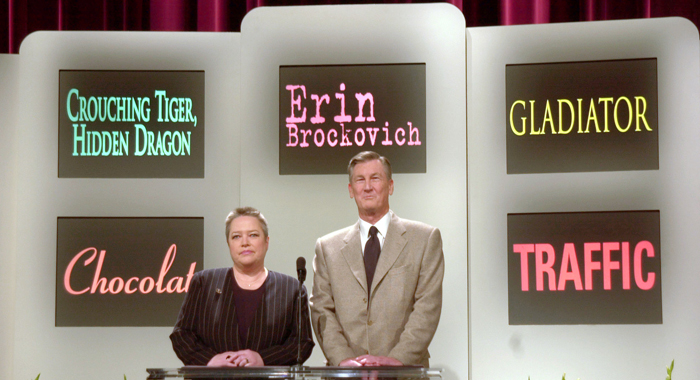
When Michael Douglas stepped out onto the Shrine Auditorium stage with the envelope for Best Motion Picture of the Year in hand, the 73rd Academy Awards had managed to sustain a feeling many an awards evening would have killed for: suspense up until the final moment. It had been a highly competitive Oscar race, with no surefire lock for the top prize, and as Hollywood stepped forward into a mysterious new Millennium, the prevailing sense was that no film had emerged that could put a definitive stamp on such a momentous inflection point. This was partly because, according to film critics at the time, 2000 had been a rather disappointing year for movies.
“A monkey with a dartboard could do nearly as well [at predicting] this year,” wrote The Salt Lake Tribune’s Sean P. Means. “The pundits call this year a ‘wide-open race’ — A polite way to say there was no standout blockbuster, a movie that combined critical acclaim with box-office power.”
“It’s just not a year anybody was able to predict from the beginning,” an anonymous Oscar campaigner confided to the Chicago Tribune. “Who would have thought Gladiator would have been in the mix?”
Some of the films floated for contention by Oscar pundits included Almost Famous, Cameron Crowe’s semi-autobiographical valentine to 1970s rock ’n’ roll journalism; Billy Elliot, a feelgood British export about a young boy torn between his father’s expectations and his blossoming love of dance; and Cast Away, Robert Zemeckis’ survivalist blockbuster starring Tom Hanks as a Fed Ex engineer marooned on a remote island.
On February 13th, 2001, the final lineup was unveiled: the gallic fable Chocolat, the martial arts action-adventure Crouching Tiger, Hidden Dragon, the sword-and-sandals epic Gladiator, the star vehicle docudrama Erin Brockovich, and the hard-hitting crime drama Traffic.
The Florida Times-Union’s Matt Soergel thought it could have gone much worse: “All in all, yesterday’s nominations were a respectable showing for a movie year that, for the first 11 months at least, was truly wretched.”
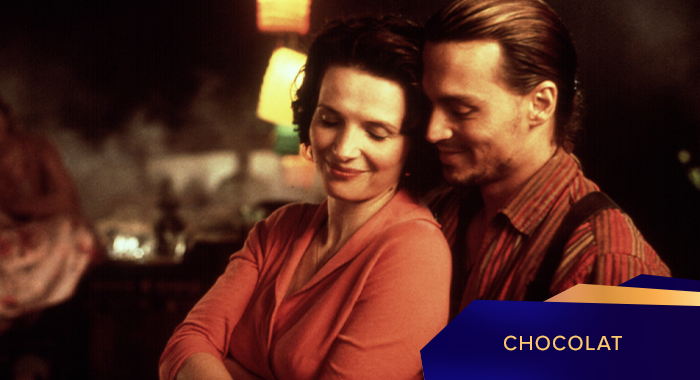
Chocolat
Tomatometer: 64% with 163 reviews
Popcornmeter: 83% with 250,000+ Ratings
Directed by: Lasse Hallström
Starring: Juliette Binoche, Johnny Depp, Alfred Molina, Judi Dench
Despite being a bona fide movie star in her native France since the 1980s, Juliette Binoche was a revelation for English-speaking audiences in the 1996 awards-juggernaut The English Patient. After scoring a surprise Best Supporting Actress Oscar, she could have made herself at home in Hollywood but chose instead to return to French productions for the ensuing four years, leaving her newfound audience hungry for more. When she signed on to star in Lasse Hallström’s adaptation of the bestselling novel Chocolat by Joanne Harris, her return to English-speaking cinema was treated as an event.
Serving up a whimsical take on religious nonconformity with a dash of magical realism, Chocolat told the story of a free-spirited chocolatier and her daughter who set up shop in a repressed French village just in time for Lent, much to the consternation of the neighborhood’s conservatives. Binoche played the candymaker while the ensemble was rounded out by Judi Dench as her curmudgeonly landlady with a heart of gold, Johnny Depp as her drifter love interest, and Alfred Molina as the aristocratic stick-in-the-mud trying to yuck everyone’s yum.
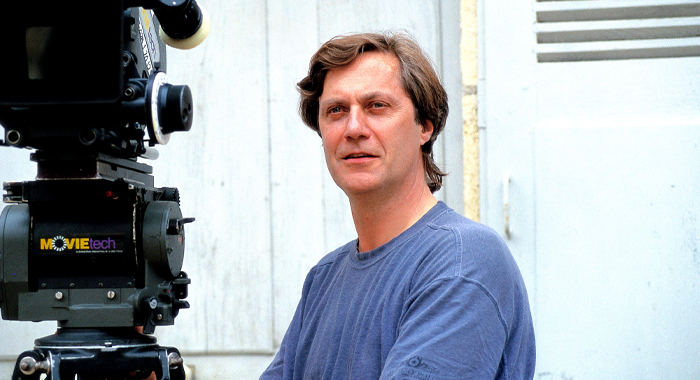
It was, reportedly, a lovely shooting experience. Hallström, renowned for cultivating pleasant sets and riding high on his Oscar-nominated The Cider House Rules the year prior, arranged to have a pot of hot chocolate brewed on location every day to constantly immerse the cast and crew in a cocoa aroma. Even Binoche, who had a reputation for a no-nonsense approach to work, was relaxed and in high spirits. “This is a light piece, a happy piece,” she told Observer (UK) during a set interview, sounding relieved to take a break from her more characteristically emotionally charged roles. “It’s about chocolate, you know, how bad can that be?”
Chocolat began its platform release on December 22nd, arriving just in time for Christmas. Distributed by Miramax and executive produced by the now-disgraced Harvey Weinstein, the release date fit the studio’s M.O. for maximizing exposure during awards season. The fable’s sweetness endeared it to a slight majority of critics while giving the rest a toothache.
Chocolate puns abounded in the review headers – “The French confection,” “Melt-in-your-mouth delicious,” “Twice as sweet as sugar” – but a sizable amount of critics found that the soufflé Hallström had concocted deflated upon closer inspection, the religious and social subtext baked into Harris’ book clashing with the movie’s playful presentation. “Its inclusive, empowering heart is, I suppose, in the right place,” conceded Orlando Sentinel’s Jay Boyar. “But does it really have to be infernally proud of its mush-minded liberalism?”
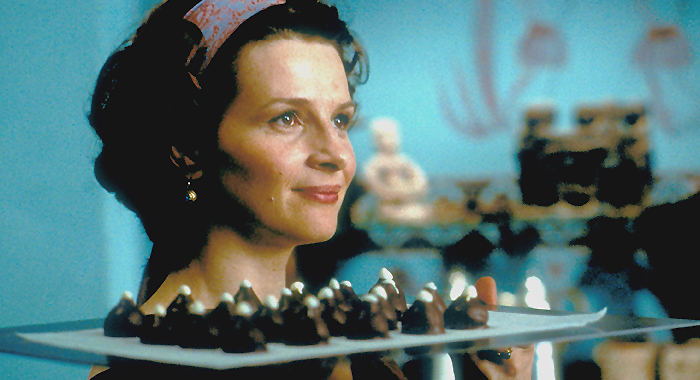
Meanwhile, a minority of critics hailed Chocolat as a flat-out great film. Santa Cruz Sentinel’s Catherine Graham, for instance, declared it a powerful feminist text, celebrating “women and the power arising from the archetypical feminine.” Mostly, though, the general critical consensus was that it was a pleasant enough fable illuminated by Binoche’s much-missed star power.
While Chocolat was aggressively campaigned by Miramax during awards season, with Chicago Tribune’s Mark Caro noting that the Weinsteins were “spending like Dolly Parton at a sequin sale” on the advertisement budget, its Best Picture inclusion came as something of a surprise on nomination morning — and not a happy one for some onlookers. “Dude, Where’s My Car? is more deserving of a Best Picture nomination,” Mark Steyn of The Spectator quipped.
Lacking critical passion but grossing a strong $150 million worldwide, Chocolat had taken the crowd-pleaser slot among the Best Picture nominees. It was never considered a threat for the win, but it didn’t need to be. For Academy voters, Chocolat was dessert.
“You don’t even have to chew it, you can gum it. Or just let it melt in your eyes. Chocolat is middle-class magic realism, comfort food with a Continental label.”
– Bob Campbell, Newark Star-Ledger
Crouching Tiger, Hidden Dragon
Tomatometer: 96% with 216 reviews
Popcornmeter: 86% with 250,000+ Ratings
Directed by: Ang Lee
Starring: Chow Yun-Fat, Michelle Yeoh, Zhang Ziyi, Chang Chen
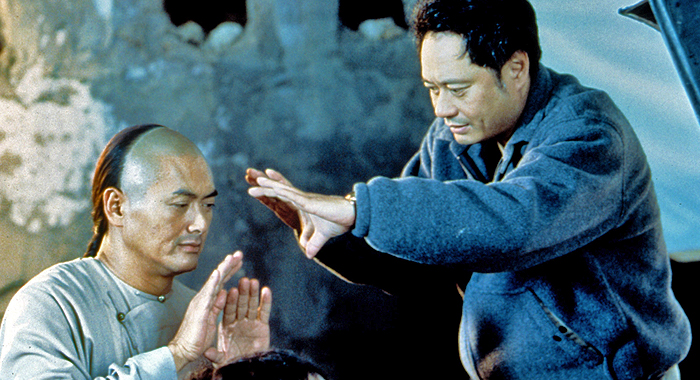
After wrapping his Civil War-set Western Ride with the Devil, Taiwanese director Ang Lee finally felt ready to realize a lifelong dream: translating the wuxia pictures that transfixed him as a child into a prestigious epic. “I think my greed is making a movie just how I want to make it,” he told the Associated Press while explaining why he wanted to gussy up a genre that was widely considered B-movie material.
Lee had steadily been accruing cachet in Hollywood with a series of well-received English-language films, most notably his Oscar-nominated adaptation of Jane Austen’s Sense and Sensibility (1995). When he and his writing partner James Schamus chose a portion of Wang Du Lu’s novel Crouching Tiger, Hidden Dragon for his dream project, Lee spun the tough sell to the moneymen as “Sense and Sensibility with martial arts.”
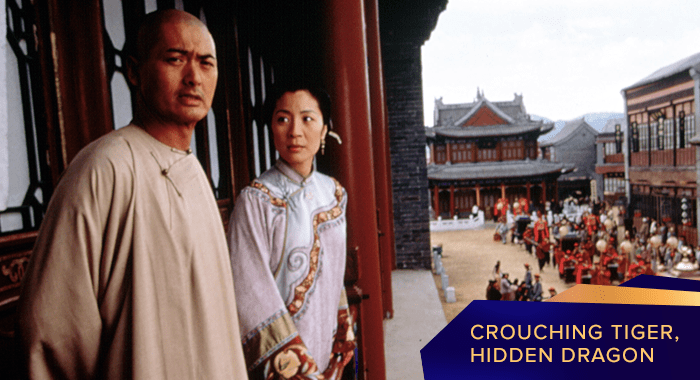
The Mandarin-language picture went into production with a $15 million budget, headlined by action stars Chow Yun-Fat and Michelle Yeoh as two warriors with an unspoken love in 18th-Century China. When a legendary sword is stolen, they investigate the governor’s daughter (Zhang Ziyi), who harbors a secret passion of her own. The balletic fight scenes were masterminded by Yuen Woo-Ping, the legendary choreographer whose reputation reached the U.S. after orchestrating the action in The Matrix just a year prior.
Distributor Sony Pictures Classics steered clear of dropping a subtitled movie into Western theaters without pre-advance hype and opted instead for a film festival route that began at the 53rd Cannes Film Festival in France, where Crouching Tiger, Hidden Dragon received a hero’s welcome. The film weaved its way through ensuing festivals, including the Toronto International Film Festival, where Buffalo News critic Jeff Simon reported the audience breaking out into spontaneous applause the first time they witnessed the characters nimbly float across the air. By the time Crouching Tiger began its platform release in the U.S. on December 8, the critical community was breathlessly urging audiences to get over their phobia of subtitles and rush out to see it.
New York Post’s Jonathan Foreman shared in the ecstatic response, declaring “Ang Lee and James Schamus’ stunning, poetic meeting of East and West is the kind of work that restores your faith in the ability of filmmakers to surprise even the most jaded moviegoer.” Judith Egerton of the Courier-Journal described the experience as “akin to seeing Peter Pan fly for the first time or watching the first light-saber duel in Star Wars.”
Critics were bowled over not only by the elegant action set pieces, but by the sophistication of the narrative’s dueling romances and its feminist subtext. Lee had crafted an action film that simultaneously functioned as an operatic drama.
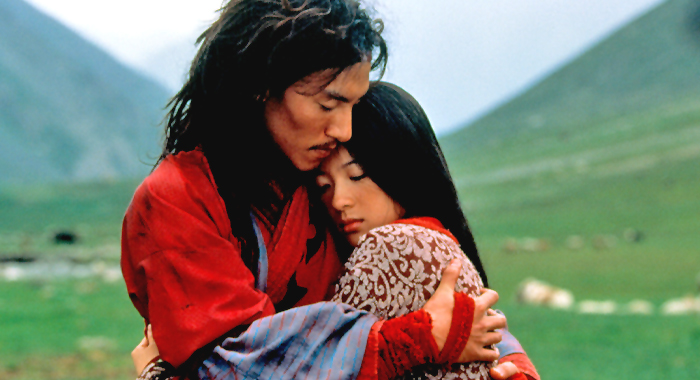
If there was a fly in the ointment, it was the displeased reaction from hardcore fans of the same Hong Kong martial arts movies that had inspired the film. Japan Times’ Mark Schilling reported on the grumbles from Asian cinema communities that Lee’s approach catered to Western audiences without exemplifying the best of the genre. “It does seem that many of the film’s cheerleaders owe their enthusiasm to limited knowledge of both its genre and its region,” concurred Washington City Paper’s Mark Jenkins.
Among U.S. critics, however, Crouching Tiger, Hidden Dragon was the most unanimously acclaimed film of the year, featuring on close to 200 critics’ Top 10 lists and claiming over 50 No. 1 spots. The ambitious hybrid grossed over $200 million worldwide, with more than half of that figure coming from the U.S., and its nomination for Best Picture marked only the seventh time that a foreign-language film had cracked the category.
Even after his gamble paid off, Lee admitted to The Daily Telegraph that his childhood dream still remained elusive. “I think I did transcend myself and the genre to a certain extent, but not as far as in my imagination… because there is gravity in this world.”
“This has been, to put it mildly, a pretty drab year. Still, miracles can happen, and one is suddenly at hand in the improbable form of a martial-arts romance that was shot in China, with Mandarin dialogue, and was directed by Ang Lee. If only for a couple of hours, Crouching Tiger, Hidden Dragon feels like movie paradise regained.”
– Joe Morgenstern, Wall Street Journal
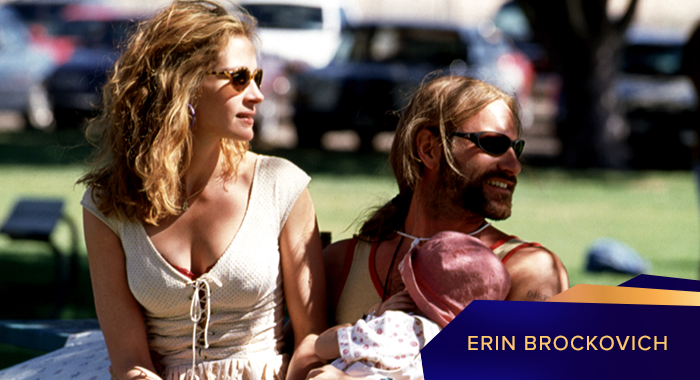
Erin Brockovich
Tomatometer: 87% with 192 reviews
Popcornmeter: 81% with 250,000+ Ratings
Directed by: Steven Soderbergh
Starring: Julia Roberts, Albert Finney, Aaron Eckhart
By the year 2000, Julia Roberts was arguably the biggest star in Hollywood. Commanding $20 million per picture, her track record justified the hefty price tag with beaucoup box office returns after her trio of romantic comedies from the previous three years racked up a cumulative $1 billion. Still, while the mega-hits My Best Friend’s Wedding, Notting Hill, and Runaway Bride had kept her star burning bright, Roberts still had something to prove.
“Just because everybody wants you — which is overstated — well, how thrilling is it when people ask you to do a bunch of crap?” she shared during a press conference. “That’s not a thrill.”
Everyone in the world might have recognized her face, but Roberts was also just a girl, standing in front of a ruthless industry, asking for somebody, anybody, to offer her a worthy dramatic part. It finally arrived when an agent handed her a script by Ever After scribe Susannah Grant telling the true story of Erin Brockovich, a paralegal who doggedly went after a behemoth utility company until it paid out $333 million to a Californian community it had poisoned.
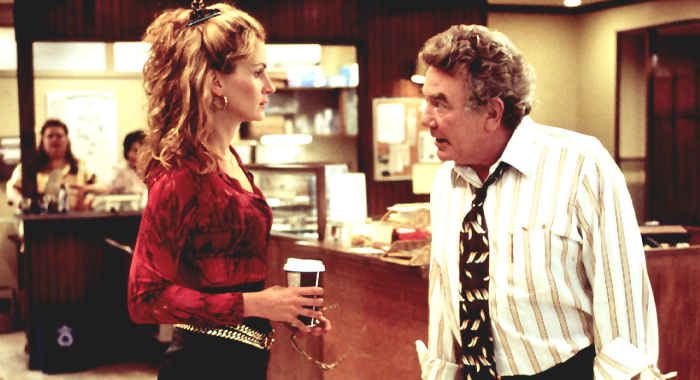
What’s more, Brockovich had an outsized personality to go along with her real-life heroics, with a hardscrabble background along with a penchant for salty language and skimpy outfits. It was the part Roberts had been looking for. Director Steven Soderbergh, known up to that point mostly for chic indies and his lone commercial project Out of Sight, signed on with a keen interest in helping steer Roberts’ star power in a fresh direction.
By the time filming wrapped, Soderbergh was convinced he’d just directed the capstone to Roberts’ career. “When I saw the first cut of the film, I thought that this will be a hard part for her to follow up,” he told reporters.
When Erin Brockovich released on March 17 under Universal Pictures’ distribution, critics could immediately see what Soderbergh meant. “It seems as if Roberts has been working her entire career toward this film,” marveled Bangor Daily News’ Christopher Smith, while The Daily Telegraph’s David Gritten proclaimed her work “an absolute revelation.”
The praise wasn’t reserved only for Roberts, though; Erin Brockovich as a whole was heralded as top-shelf entertainment, receiving favorable comparisons to classic David-vs.-Goliath legal dramas like Norma Rae and Silkwood, with Soderbergh’s direction praised for deftly leveraging Roberts’ star power without overwhelming the rest of the picture.
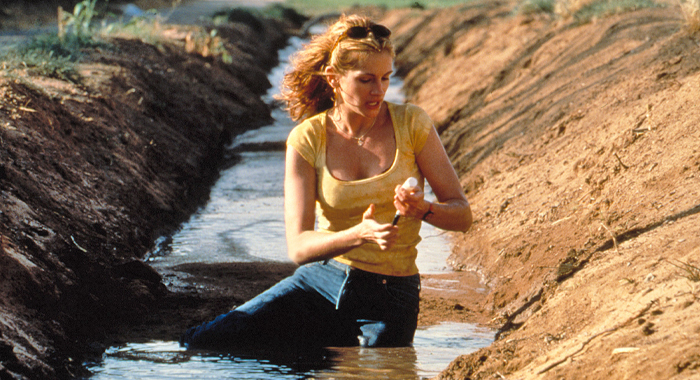
Criticisms of the film were primarily trained on what real-life elements the docudrama chose to focus on: namely, its titular heroine instead of the community that had been impacted by the pollution. “Erin Brockovich has no room for characters who do anything but reflect the glory of its leading lady,” bemoaned Margaret A. McGurk of the Cincinnati Enquirer. Philadelphia Daily News’ Gary Thompson witheringly remarked, “I’m not sure that a movie about horrible suffering (and there is plenty of it) should be so infernally adorable.”
Erin Brockovich was a springtime hit, garnering over $250 million worldwide. Its impact reverberated long enough that it became the presumed frontrunner for the Best Picture Oscar up through the fall season. By the end of the year, it featured on 120 critics’ Top 10 lists. “Sometimes, star power pays,” concluded Tampa Tribune’s Bob Ross.
“The joy and excitement Roberts brings to strong material is as real as kids at a birthday party when the candles blow out. I don’t know if being grateful for a juicy, three-dimensional role contributes to great acting, but it should be a reason she does her best work here.”
– John Griffin, Montreal Gazette
Gladiator
Tomatometer: 80% with 265 reviews
Popcornmeter: 87% with 250,000+ Ratings
Directed by: Ridley Scott
Starring: Russell Crowe, Joaquin Phoenix, Connie Nielsen, Oliver Reed, Derek Jacobi
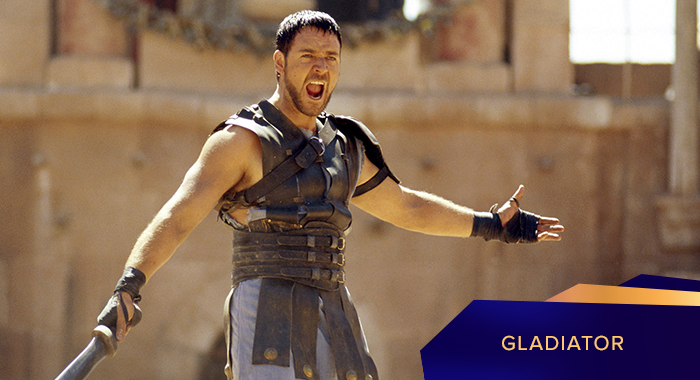
When producers Walter F. Parkes and Douglas Wick approached Ridley Scott to see if he’d be interested in directing the historical action epic they’d been developing at DreamWorks, they had the inspired idea of bringing along a print of Pollice Verso, a 19th-Century painting by Jean-Léon Gérôme. The vivid illustration imagined a gladiator in the Roman Colosseum standing over his felled opponent, looking to the mob for whether or not to grant mercy and being met with downturned thumbs. While Parkes and Wick were giving their pitch to Scott, it gradually became clear that the painting had already done all the work for them. The British director, who had demonstrated a facility with tactile worlds earlier in his career with Alien and Blade Runner but was coming off a cold streak after the box-office and critical disappointments White Squall and G.I. Jane, was instantly seduced by Gérôme’s visual representation of gladiatorial bloodsport.
“We can do that,” he told them, picking up the print to admire it more closely. “We haven’t seen that.”
While that last part may have been a dubious claim in a world where Spartacus was rentable on Blockbuster shelves, it had been close to four decades since audiences had seen a brand new Roman epic on the big screen. Sword-and-sandals pictures thrived in Hollywood during the 1950s with classics such as Quo Vadis? and Ben-Hur, but a whole generation of studios were scared off the genre’s humongous budgets after Joseph L. Mankiewicz’s Cleopatra came within an asp’s breadth of bankrupting 20th Century Fox in 1963. Scott recognized that the advent of digital technology now made the gargantuan sets and teeming crowds feasible for the first time in ages.
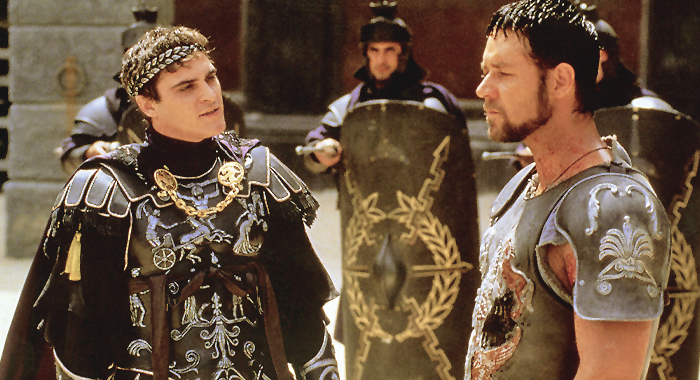
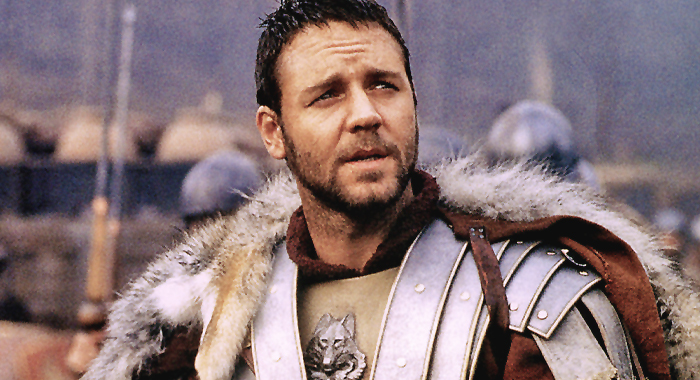
With a screenplay dreamt up by Amistad scripter David Franzoni, Gladiator reimagined a real portion of Roman history as the tale of a noble general betrayed by Emperor Commodus and forced to fight as a slave in the Colosseum. Russell Crowe, a New Zealand-born livewire of an actor who was on the ascent after co-starring in L.A. Confidential (1997) and The Insider (1999), signed on to play the railroaded general, Maximus Decimus Meridius, while indie darling Joaquin Phoenix was cast as the deranged Commodus. Production was greenlit before Scott and the producers were satisfied with the script, necessitating extensive rewrites by John Logan and William Nicholson during shooting.
Despite the haphazard scripting process and the logistical nightmares created by co-star Oliver Reed’s untimely death during production, Gladiator was heralded by most critics as a worthy return to the epics of antiquity upon its release on May 5, 2000, A.D. The eerie resemblance between the Roman mob’s thirst for violence and modern audiences’ appetite for carnage in pro wrestling and crunchy contact sports wasn’t lost on commentators. “The fusion of the ancient and the modern – even to point of some sly echoes of our own sports-mad society – is seamless,” effused Desmond Ryan of the Philadelphia Inquirer. “Gladiator does indeed deliver the glory that was Rome, but it also clinically dissects the assumptions on which it was built.”
The film didn’t win everybody over; a sizable minority found its critique of bloodsport to be disingenuous, its revenge angle simpleminded, and its modern parallels cloying. One vocal skeptic of Gladiator’s strength and honor was the most well-known critic in America, Chicago Sun-Times’ Roger Ebert, whose thumb carried close to as much weight as that of a Roman Emperor from their Colosseum perch. Deriding the film’s muted color palette and fatalism, Ebert lamented “It employs depression as a substitute for personality.”
Even among detractors, however, Crowe’s performance as Maximus was a standout. “Such magnitude demands a heroically proportioned star, and Russell Crowe is the man,” wrote Hartford Courant’s Malcolm Johnson, while London Evening Standard’s Alexander Walker commended the actor for carrying Gladiator’s spectacle “the way Atlas was supposed to carry the globe of the world on his back — in Crowe’s case without stooping.”
While Gladiator may not have gotten Ebert’s endorsement, it handily won the crowd with over $450 million at the global box office. By the end of the year, it featured on over 100 critics’ Top 10 lists, solidifying it as one of the most broadly respected films of 2000.
“As much as the director’s mise-en-scène dazzles, this is the rare Ridley Scott production in which individual characters have relatively secure separate identities. Gladiator, though, is Crowe’s to win or lose — Caesar’s thumb up or thumb down, as it were. And he wins, colossally.”
– Lisa Schwarzbaum, Entertainment Weekly
Traffic
Tomatometer: 93% with 225 reviews
Popcornmeter: 85% with 100,000 Ratings
Directed by: Steven Soderbergh
Starring: Michael Douglas, Benicio Del Toro, Catherine Zeta Jones, Don Cheadle, Luis Guzmán
For director Steven Soderbergh, the 1990s were a time for practice. After his auspicious debut Sex, Lies, and Videotape in 1989, the staunchly indie filmmaker spent the next decade crafting passion projects that mostly flew under the radar.
“I’m sure there were people who thought, what the hell has happened to that guy?” Soderbergh told the Associated Press. “But I was just sort of practicing… I was pushing myself and trying to get better at my job.”
Eventually, the maverick filmmaker realized that his window for mainstream opportunities was shrinking, and so he began to put his practice to good use on studio gigs, starting with the Elmore Leonard adaptation Out of Sight, which then led to Erin Brockovich. The latter vaulted him to a bona fide hitmaker, but he had another passion project up his sleeve in the same year: an adaptation of the British limited series Traffik (1989), which weaved multiple storylines to explore the European drug trade.
While his stock in Hollywood had been steadily climbing, it was tough for Soderbergh to get the movie made. “Let’s face it, drug movies don’t have a storied history when it comes to making money,” he admitted to Los Angeles Daily News. After a false start at 20th Century Fox with Harrison Ford in talks to star, Soderbergh reached into his own pockets to get the ball rolling until USA Films, a consolidation of Gramercy Pictures and October Films that would later go on to become Focus Features, picked up the project.
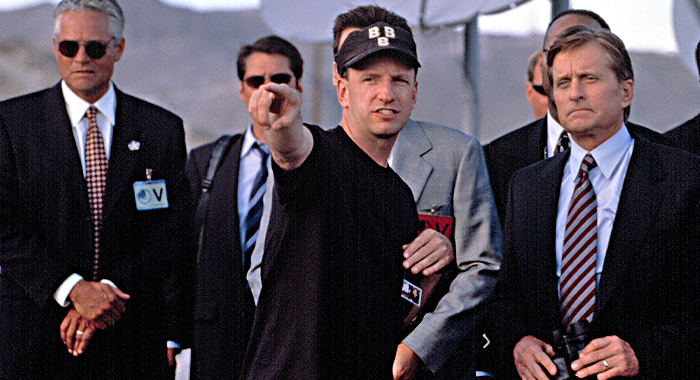
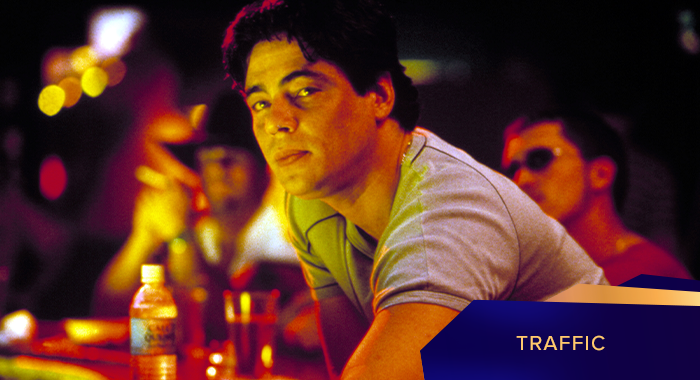
Transposing the original television series into a U.S.-Mexico milieu, the film filled out its cast with Michael Douglas as an American drug czar whose policy convictions are complicated when his daughter (Erika Christensen) is outed as an addict, Benicio Del Toro as a Mexican cop on the frontlines of the Drug War, and Catherine Zeta-Jones as a wealthy housewife whose world is turned upside when her husband is arrested for trafficking. Soderbergh was hands-on with the camera, serving as his own cinematographer and opting to use different color-coded film stocks to differentiate the overlapping locations.
By the time Traffic opened wide in theaters on January 5, 2001, it had already won the New York Film Critics Circle’s Best Film of the Year accolade. Critics were largely bowled over by Soderbergh’s achievement, even more so than his handling of Erin Brockovich just seven months earlier. “Soderbergh has more than fulfilled his early promise,” declared New York Daily News’ Jami Bernard.
After decades of the U.S. government orienting law enforcement policy around stamping out the proliferation of narcotics, Traffic’s sociological dissection of how the Drug War had infected everyday life on both sides of the border resonated with critics who had become skeptical of the approach. “The movie is powerful precisely because it doesn’t preach… The facts make their own argument,” wrote Chicago Sun-Times’ Roger Ebert, while J. Hoberman of Village Voice dubbed it “exemplary Hollywood social realism.”
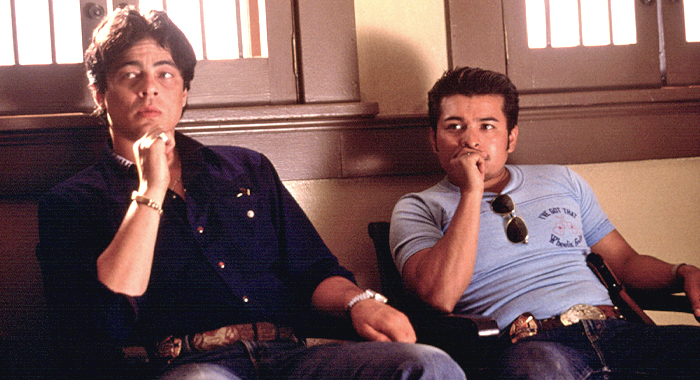
Traffic’s novel-at-the-time structure of intersecting storylines also impressed, with Sydney Morning Herald’s Paul Byrnes marveling at how it managed to cover “supply, demand, addiction, treatment, corruption, enforcement, courts, and policy-making.” Some of the narrative strands were more appreciated than others. While some critics found Christensen’s character’s descent into drug abuse to be rushed and unconvincing, Del Toro’s plotline was often singled out as a highlight. “Del Toro is the film’s true conscience,” wrote Atlanta Journal-Constitution’s Steve Murray. “His melancholy performance is the standout among a strong cast.”
Traffic went on to gross over $120 million at global box-office, vindicating Soderbergh’s gamble on the production. It was featured on over 150 critics’ Top 10 lists, edging out Erin Brockovich’s tally. The director was already busy prepping his next film, the heist remake Ocean’s Eleven, while the accolades poured in. Reflecting on his time spent practicing in the commercial wilderness, he concluded “I feel like now it’s starting to pay off.”
“Traffic is wise enough to avoid obvious proselytizing. Even as it ably dramatizes the pervasiveness of drugs in modern America, the manifest evils and wrenching tragedies they engender, and the futility of our current policies to stop them, it puts the epochal social problem in a bright, shining light for us to see it in a clear-eyed, bracing and sobering new way.”
– Dennis King, Tulsa World
Oscar Evening
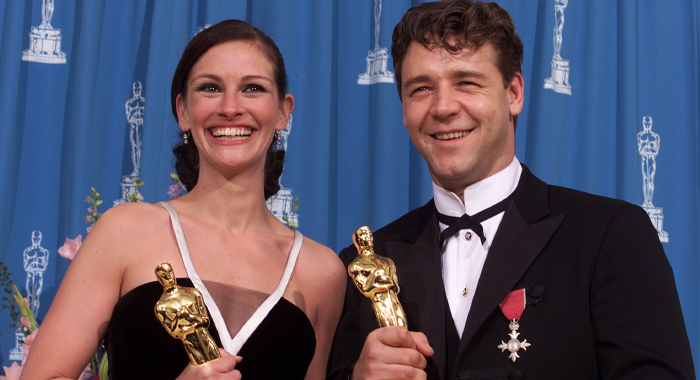
Come Oscar night, March 25th, 2001, the only surefire bet was Roberts taking the prize for Best Actress. Binoche, her competitor in the same category, was even overheard at a party saying the Erin Brockovich star had it in the bag. The precursors otherwise preserved the suspense for the other categories, with Gladiator in a slight statistical lead while Crouching Tiger, Hidden Dragon, which had a fanbase hoping it would break the foreign-language Oscar taboo at its back, and Traffic also picked up crucial trophies.
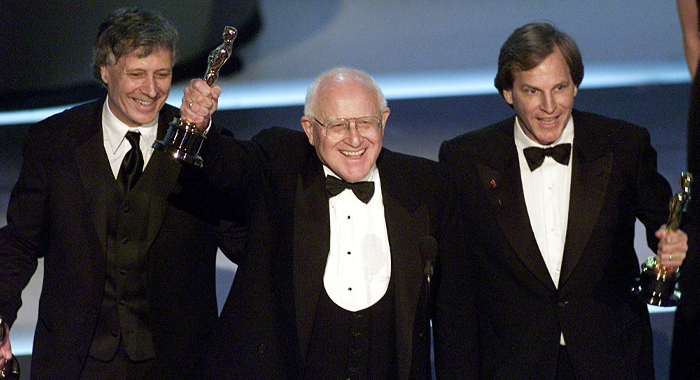
The ceremony, emceed by first-time host Steve Martin, surprisingly tilted in Traffic’s favor when it picked up wins for Soderbergh in directing along with editing, screenplay, and a Supporting Actor prize for Benicio del Toro. Despite the crime drama’s show of strength, Gladiator ultimately claimed the top honor, bringing the evening to a honorable close and notching DreamWorks its second Best Picture Oscar in a row after American Beauty triumphed the year before.
Roberts won her Oscar, kicking off her speech by telling the pit orchestra conductor, “Why don’t you sit, because I may never be here again!” She would co-star in Soderbergh’s next film, Ocean’s Eleven, which minted a new blockbuster franchise for the maverick filmmaker. Both Ridley Scott and Russell Crowe would return for the next year’s ceremony, nominated respectively for directing Black Hawk Down and starring in A Beautiful Mind. Juliette Binoche, having treated her English-speaking fans to Chocolat, returned to French cinema to star in the romantic comedy Jet Lag. Ang Lee, having arguably gotten closer to winning the Best Picture prize with a foreign language film than any filmmaker before him, would advance another glass ceiling just five years later, when he won a directing Oscar for the queer romance Brokeback Mountain.