
Hear Us Out: Memory is the Real Monster in The Vampire Lestat
The early episodes prove that nothing we see, hear, or feel is necessarily the truth, thanks to the unreliable narrator at the center of it all.
One of the things you notice while watching the premiere episode of The Vampire Lestat is how obsessed our lead, Lestat (Sam Reid), is with righting perceived wrongs. Starting with his frantic first reading of the author-fledgling vampire Daniel Malloy’s (Eric Bogosian) book, our Lestat is literally screaming to correct the record. The essential theme of the Interview with the Vampire series, from the minute Louis (Jacob Anderson) steps on screen until the final shots of season 2 and continuing into season 3 (retitled to The Vampire Lestat), is that memory is a monster. Despite how meticulously co-creator and showrunner Rolin Jones demonstrated the damage that can be done when people look into the past, or the lies that emerge when trying to tell the truth, the conversation, commentary, and overall vibes around this season seem to miss that one key aspect. Because hear us out on this one: The Vampire Lestat’s early episodes prove that nothing we see, hear, or feel this season should be taken as gospel.
After viewing episode 1, we are able to look back on the characterizations of the first two seasons of Interview with the Vampire through an entirely new lens. For example, the Louis we see in Lestat’s narrative this season is quite different from the Louis we’ve seen so far. He’s cooler, calmer, more detached. In the opening moments before Daniel Malloy’s book hits the stands, our one true pair are as we would expect them to be: two people who have been through a lot, trying to find common ground after agreeing to stop hurting each other so badly. As they chat on FaceTime and plan a potential “rendezvous”, we see how they might be the only two people who see each other at all. That is why, when Lestat discovers that Louis has, in fact, been telling their stories to others — or even more disturbingly, recounting them inaccurately — it is a betrayal. And the betrayal is acutely felt.

As we jump through the timeline of Lestat’s life with flashes of his past, we assume we are getting a condensed journey through the five stages of grief as he mourns, rages, and bargains with the loss of his anonymity and his own story. Looking at Armand (Assad Zaman), we find a darker, more sinister figure, and Daniel is a garrulous, almost cartoonish version of what the author, with success, would look like. Even as the picture of our lead changes, we as the audience never lose sight of his motivations, no matter how theatrically he communicates them.
Lestat is a character who often withheld his own story unless under the most dire circumstances, so we instinctively understand how he would feel the height of violation at seeing his name, his likeness, and his great love perverted for a commercial endeavor and, worse yet, a commercialistic endeavor, to which he did not have editorial rights — a travesty. Although we’ve never read Daniel’s prose, we have to assume, given the sparse and peacockish nature of his success, that he took supreme editorial license with the story Louis told him. And the license he took made the book a sensation and enraged most of those involved. Anyone with an ounce of capitalism in their veins would understand that the money is definitely in the chase, and allowing Daniel to translate Lestat’s thoughts into a documentary will be even more commercially viable than the acclaimed book. Better still, the book will only grow with every adaptation. Perhaps one of the biggest compliments the show can give to the woman who looms over it all, Anne Rice, is that the Daniel character is essentially a stand-in for the joy and chaotic love of these salacious, drama-filled tales.
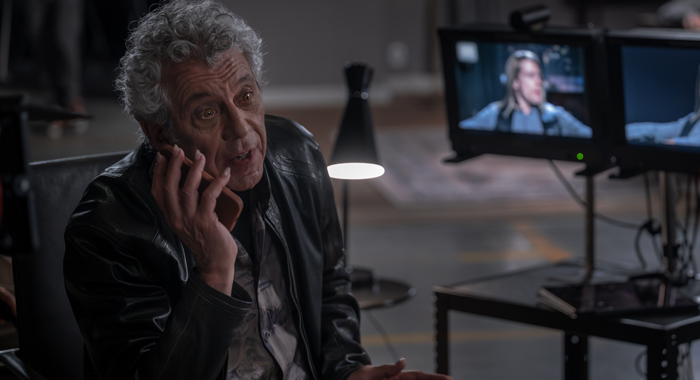
The way Daniel gleefully interprets and willfully misinterprets events for the sake of theatricality is an author vice, a vice we assume the scribe of these stories is similarly affected by. The idea that Rice’s version of events, as we read them, will emerge when everyone in her universe — Armand, Lestat, Akasha (Sheila Atim), and Louis — has had their say is just too delicious not to entertain. In the current discourse, many argue that Lestat is furious that Louis is lying. He certainly plays the part well as the jealous, fed-up ex. But aside from minor details, Lestat’s anger with Louis stems from the betrayal of trust. His fury over the inaccuracy should be directed at Malloy. And although the two of them have somewhat teamed up to tell his side of the story, we, for one, think there might be a bit of revenge coming for our author-vamp from the rockstar. But before we dive too deep into season 3, we think it’s really important that the audience remembers, in the great words of Tatiana from RuPaul’s Drag Race, “What you see isn’t always the truth.” Whether it be what Daniel wrote, what Armand said, what Louis remembers, or what Lestat chooses to forget, we will have a story, but where the truth lies will be a mystery.
That is a truth that will assuredly be the amalgamation of everything we’ve been addicted to thus far, which is why we think this season would be much more enjoyable if people stopped trying to dissect every inch of it when it is being recounted by an unreliable narrator with part-time amnesia. Obsessing over that is probably the lesson that most of the show’s characters are missing, right alongside the audience. Nobody is going to remember what happened in the end. They’re only going to remember how it made them feel. And although many of the characters that Daniel wrote about would be highly interested in punishing him for his prose at this current moment in our tale, they ought to be thanking him, because he freed them from the need to let the stories they’ve been telling themselves be the final word on exactly what happened. By showing how differently these characters interpreted the same sequence of events, it allows each of them to step into the other’s mind, something one would figure would be a lot easier in a show that accepts mind-reading as a pedestrian ability, but alas, it is not.

If you need even more evidence of our theory, look at how Lestat behaves as we approach the final frames. High off the blood of a young groupie and fresh from dispatching a coven of would-be assassins, his diminished state allows the blood-drunk rock star to unlock a compartment of memories. In that instant, we see flashes of every significant person from his life — Louis, Claudia (Delainey Hayles), his mother, Gabrielle (Jennifer Ehle) — and many faces that will haunt his thoughts all season. And as we continue to encounter more significant names in the Anne Rice universe, this will only compound. Because with every new story and every new perspective, we are essentially assembling a complex Venn diagram in which the overlap gives us something close to what really happened, and, in our headcanon, that is what gets us back to Anne Rice herself.
Until then, we get to become dizzily infatuated and absolutely engrossed in whatever narrative is driving the car. Still, it’s important to remember — and we hope you have heard us on this one — that we have an unreliable narrator guiding us toward the truth. Perhaps that is the most exciting thrill and the chaotic joy of riding along with the blood-soaked, sex-drenched rock star poet that is The Vampire Lestat.
The Vampire Lestat is streaming now on AMC+.