
Revisiting the Oscars: How 1976 May Have Had the Greatest Best Picture Lineup of All Time
In anticipation of the upcoming 98th Academy Awards, we reexamine the absolutely stacked Best Picture race of 1976.
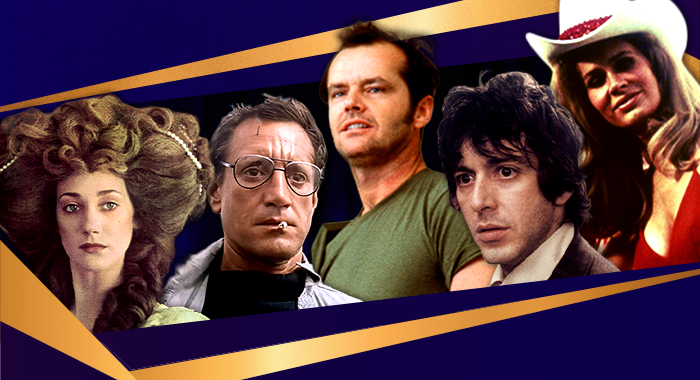
Like every Oscar year, film critics were the Greek chorus of the 1976 awards season without being the ultimate deciders. They didn’t get a vote, but today they get to be heard. This is an analysis of the critical receptions for the 48th Academy Awards’ Best Picture lineup as they were received in their own time, informed by over 300 archival reviews added by the Rotten Tomatoes curation team.
The Race
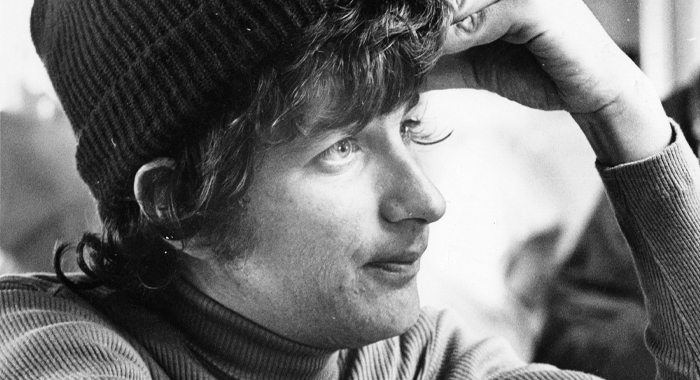
When it came time for the Associated Press’ Bob Thomas to make his predictions for the 48th Academy Awards nominations, he could only shake his head while surveying the films 1975 had to offer. “Is Oscar facing a quality crisis as he approaches his 48th year?” he worried. “It is a slim field indeed.”
Thomas was, of course, talking about a year that would produce one of the most legendary Best Picture lineups of all time. At the time, though, there was a sense that the year had been unremarkable. Steven Spielberg, whose own industry-defining hit Jaws was in the hunt for gold, told Newsday, “The best of the worst are up for awards.”
Trying to guess what diamonds the Academy might pick out of the mound of coal, pundits considered films like the Neil Simon comedy The Sunshine Boys, the Warren Beatty star vehicle Shampoo, the disaster drama The Hindenburg, John Huston’s action-adventure The Man Who Would Be King, or Ken Russell’s The Who-soundtracked musical Tommy.
The eventual slate of Best Picture nominees would instead include Stanley Kubrick’s much-hyped but polarizing Barry Lyndon, Sidney Lumet’s sweltering hostage drama Dog Day Afternoon, the aforementioned Jaws, Robert Altman’s ensemble comedy Nashville, and finally Miloš Forman’s adaptation of One Flew Over the Cuckoo’s Nest.
Nowadays, these films are often cited as arguably the single greatest Best Picture slate ever assembled. For many folks in 1976, they were simply an acceptable enough bunch that would make do until a worthier year rolled along.
Barry Lyndon
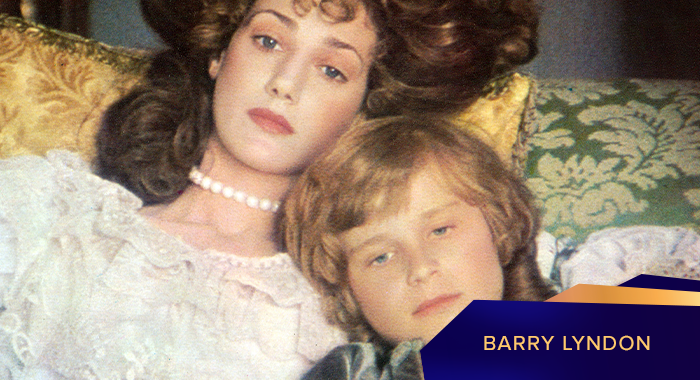
Tomatometer: 78% with 156 reviews
Popcornmeter: 92% with 25,000+ Ratings
Directed by: Stanley Kubrick
Starring: Ryan O’Neal, Marisa Berenson, Leon Vitali, Patrick Magee
By 1975, Stanley Kubrick was enjoying the rarified status of a working filmmaker whose artistic genius was widely treated as a matter of fact. Afforded final cut on all endeavors by his mainstay studio, Warner Bros., the 46-year-old filmmaker had garnered his hallowed reputation by taking on projects that would cow most peers, from his 1964 adaptation of Vladimir Nabokov’s Lolita to the 1968 science-fiction masterpiece 2001: A Space Odyssey, and turning them into visions that defied all conventional expectations.
So it was saying a lot when TIME Magazine’s cover story on the making of Barry Lyndon billed it “Kubrick’s Greatest Gamble.” The director’s choice to adapt William Makepeach Thackeray’s obscure novel The Luck of Barry Lyndon into an expensive period epic had drawn a widespread round of head scratches. For an artist with the freedom to do anything, why this story?
The director dismissed the question: “It’s like trying to say why you fell in love with your wife.” Subsequent reports suggest that the filmmaker might have also been trying to turn lemons into lemonade. After spending years of his life on extensive pre-production for a Napoleon Bonaparte biopic that proved too huge in scope to get financial backing, Kubrick repurposed much of that research for Barry Lyndon, which told a much simpler story while conveniently set during the same historical period.
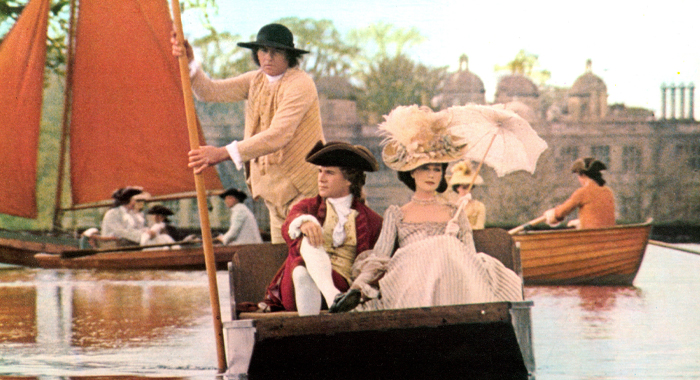
Ryan O’Neal, one of Hollywood’s hottest leading men coming off a string of hits including Love Story and Paper Moon, was cast as Redmond Barry, an Irish rogue who social climbs his way to the height of society before losing it all to hubris. Marisa Berenson, a renowned model cast as Barry’s aristocrat bride, indicated in interviews that surviving the set required a full surrender to Kubrick’s vision, admitting to The Washington Post, “I had no idea what was going on while we were making it.”
While Warner Bros. found the project risky, they trusted in Kubrick’s instincts. He repaid their largesse by taking a hands-on role with the marketing, managing the film’s omnipresent TV advertisement campaign and offering notes for its distribution strategy. When Barry Lyndon finally bowed in theaters on December 18, 1975, the critical reception was a split between awe and borderline contempt. Many felt that Kubrick’s genius had finally curdled into plain old self-indulgence.
“A pretentious, tiresome, fatuous bore, a piece of inflated and contrived elegance that is as desolate as the backside of the moon,” Miami Herald’s John Huddy wrote in a scathing pan. Rolling Stone’s Jon Landau, sharing Huddy’s disgust, called it “a rare glimpse into the chasm between what a director thinks he’s accomplished and what he’s actually accomplished.”
While cinematographer John Alcott’s photography was universally acknowledged as a tremendous achievement — “Every frame exudes muted, self-conscious perfection,” wrote Janet Maslin in the Boston Phoenix — there was a widespread feeling that Kubrick had gone through a lot of trouble to say very little of substance. It was enough to make Los Angeles Times’ Stephen Farber worry whether the master filmmaker had lost his touch completely. “The brilliance of Kubrick’s early work makes the jeweled corpse of Barry Lyndon more depressing,” he wrote. “What has gone wrong?”
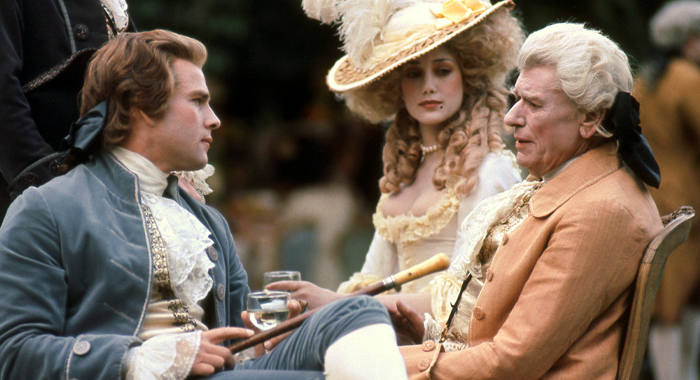
The negative reviews were vociferous enough to draw some direct pushback from critics like Chicago Tribune’s Gene Siskel. Wondering if he and his peers had watched the same movie, he countered, “I found Barry Lyndon to be quite obvious about its intentions and thoroughly successful in achieving them. Kubrick has taken a novel about social class and has turned it into an utterly comfortable story that conveys the stunning emptiness of upper-class life only 200 years past.”
While interpretations differed, admirers were uniformly impressed by how Kubrick had thrown his weight to transform such uncommercial subject matter into a lavish production, with Village Voice’s Andrew Sarris calling it “the most expensive meditation on melancholy ever financed by a Hollywood studio. Every frame in the film is a fresco of sadness.”
Barry Lyndon’s polarized critical reception and its middling box office gross of $20 million made its Best Picture nomination a mild surprise. Kubrick, for his part, confirmed that the film’s obliqueness was his intention, stating, “When you say something directly, it is simply not as potent as it is when you allow people to discover it for themselves.”
“Like the human experiences it depicts, Barry Lyndon has its enigmas and elements language cannot express. Some elements must seep in through the senses and may never find intellectual form.”
– Robert E. Butler, Tulsa World
Dog Day Afternoon
Tomatometer: 94% with 125 reviews
Popcornmeter: 90% with 100,000+ Ratings
Directed by: Sidney Lumet
Starring: Al Pacino, John Cazale, Charles Durning, Chris Sarandon
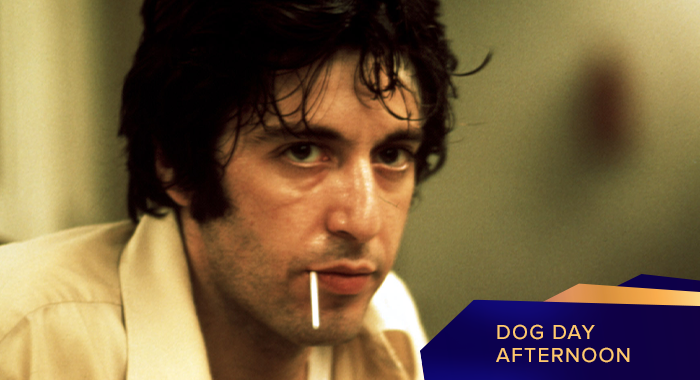
“Dog days,” for those who are wondering, refer to the hottest days of summer, when the thermometer pops and the mood gets so stifling that you feel like you’re about to blow. It was an apt descriptor for the bungled real-life Brooklyn bank robbery that quickly escalated into a hostage situation on August 22, 1972. Warner Bros. swiftly snatched up rights to the story, with Cool Hand Luke co-screenwriter Frank Pierson hired to turn the infamous incident into a clean narrative.
Sidney Lumet, a veteran New York filmmaker who was enjoying a career resurgence after hits Serpico and Murder on the Orient Express, signed on to direct. He’d need all of his years of experience to navigate the picture’s tricky tonal blend of comedy and tragedy. “It’s the toughest picture I’ve ever done,” he admitted to The Ottawa Citizen, finding it difficult to ensure the audience would identify with the two antisocial bank robbers.
One of Lumet’s other challenges was wrangling his leading man, Serpico star Al Pacino, who was cagey about the part of Sonny Wortzik and had to be convinced not to quit during the early stages of filming. “I wouldn’t have done it without Al,” Lumet told The Cincinnati Post. “He’s the only actor I know who could connect with the emotions of Sonny.”
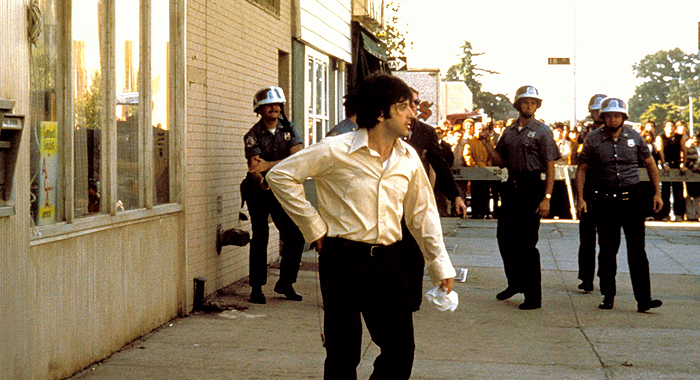
Pacino, coming off three consecutive Oscar nominations, found the part especially exhausting. “Some actors, and I envy them, can turn on and off the needed emotions at will and still give a superior performance,” Pacino explained to the Newark-Star Ledger. “I can’t. I’ve got to be and think and submerge myself into the character. That’s a terrible drain.”
There was also the controversial motivation behind the incident that had elevated it into a national news story: that the bank robber who Sonny was based on had allegedly devised the heist to afford a sexual reassignment surgery for his romantic partner. The subject was mostly taboo in the 1970s mainstream, but Lumet wasn’t interested in gawking at Sonny’s sexuality, stating “We did not want to exploit the sensational angle. We stuck to the truth and didn’t try to top it off in anyway what really happened.”
When Dog Day Afternoon began its platform release on September 21, 1975, it was met with feverish praise. While Lumet maintained that he was definitively not a comedy director, critics marveled at how funny the film was while it played the absurdity of the scenario straight. There was also a sense that Lumet and Pierson had captured how combustible everyone in America felt at the time.
“By turns manically funny, slyly terrifying and strangely provocative, it somehow reaches beyond its format to make startling comment on the rampant panic of contemporary life,” raved the Boston Globe’s Kevin Kelley, while Gary Arnold of The Washington Post wrote, “Pierson has given Lumet a golden opportunity to direct from strength, combining his vivid feeling for big-city settings, characters and tensions with an equally vivid sense of theatricality.”
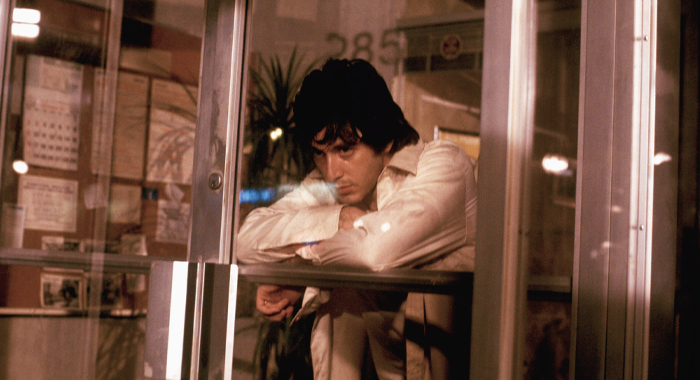
Then there was Pacino’s performance, which won ecstatic plaudits. Ted Mahar of The Oregonian marveled at how “an almost telepathic relationship seems to exist between Pacino and the camera; as few other performers can, he seems to give the impression he is letting you read his mind.”
Complaints from the minority of detractors included the film’s extended length, with Dane Lanken of the Montreal Gazette quipping, “The people who made the movie liked it too much.” The Flint Journal’s Ed Hayman also found the film hypocritical in its critique of tabloid sensationalism, asserting that Lumet had created “an example of the very thing he warns against — a report that is more concerned with spectacle and tasteless jokes than with understanding.”
The prevailing sentiment, however, was that Lumet had crafted a gem that was tough to pin down neatly into a single category largely because it echoed the contradictions of real life, with Tampa Bay Times’ Dorothy Smiljanich concluding, “The movie is as close as a fictional film can be to reality.”
“Dog Day is so eccentric and original a work that it does not categorize easily: frequently very funny, it is not quite a comedy; increasingly suspenseful, it is far from being a caper movie; frequently affecting, it is still pretty cool-eyed and ironic. But from start to end it is engrossing and unpredictable.”
– Charles Champlin, Los Angeles Times
Jaws
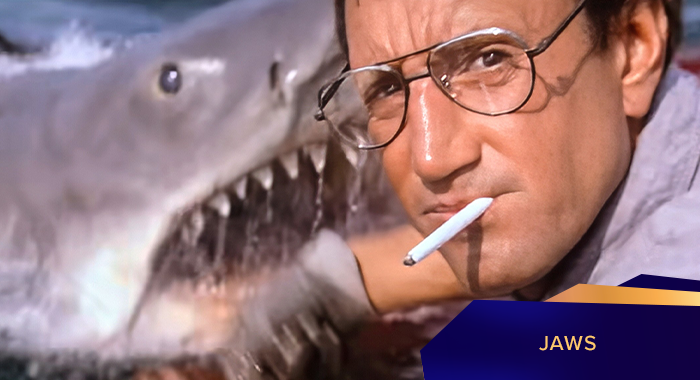
Tomatometer: 97% with 178 reviews
Popcornmeter: 91% with 250,000+ Ratings
Directed by: Steven Spielberg
Starring: Roy Scheider, Robert Shaw, Richard Dreyfuss, Lorraine Gary, Murray Hamilton
Peter Benchley’s bloody beach read Jaws, the tale of an overgrown great white shark terrorizing a sleepy coastal town, was primed to be a Hollywood blockbuster before it was even published as a book. When the pitch for Benchley’s manuscript reached producers Richard D. Zanuck and David Brown, a pair of Hollywood free agents who’d met during their previous ill-fated tenures at 20th Century Fox, they instantly knew they’d found perfect chum for box office returns.
“We read it in one night, and we both had the identical feeling,” Brown told New York Daily News. “It’s a wonderful movie. It’s unique. We’ve just got to get it.” They won the rights after a fierce bidding war and proceeded to give the book the Hollywood treatment, turning Benchley into a celebrity with promotional tours while commissioning a striking paperback cover — a giant shark rising from the ocean depths to gobble up an unsuspecting swimmer — with the intention of using the same design for the forthcoming movie poster.
The book was a phenomenal bestseller, giving Zanuck and Brown’s proposed film adaptation the momentum of a tidal wave. To direct their surefire blockbuster, they tapped 27-year-old Steven Spielberg, a wunderkind from television who’d just directed his theatrical feature debut, The Sugarland Express.
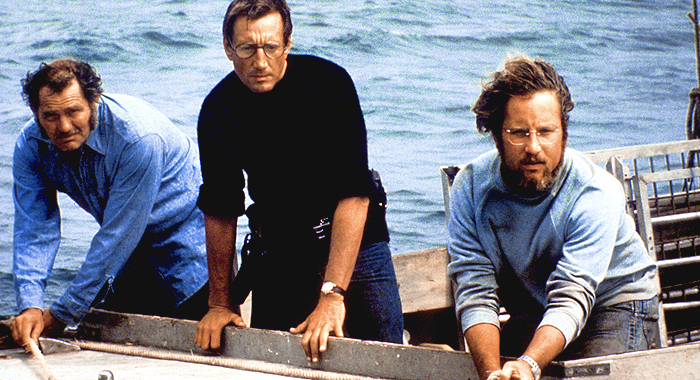
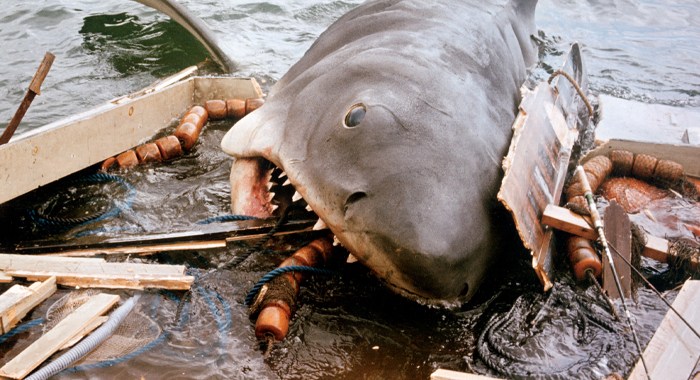
What Zanuck and Brown hadn’t fully considered in their rush to get Jaws to the big screen was how technically demanding the shoot would be. With the animatronic shark (affectionately named Bruce) frequently breaking down and the third act’s setting in the open sea proving to be a logistical nightmare, the project turned into a crucible for young Spielberg. While the production woes became legendary, the producers defended the choice of having such a youthful filmmaker captain the ship.
“We could have gotten a so-called ‘safe’ director, one that would have gotten us off the island on schedule, but we preferred to go with Spielberg, who added so many fine little touches, little facets of character, and who wanted to make a good film, not just an action movie,” Zanuck said.
Despite all the skeptical coverage leading up to Jaws’ release on June 20, 1975, the reception was almost unanimously glowing. Even critics who had grown to loathe the oversaturated disaster movie genre were bowled over by the film’s sophistication. Most of all, it scared the hell out of them.
“The film plays with the audience like toy sailboats in an unfathomable sea,” wrote Austin American-Statesman’s Steve Hogner. A traumatized Colin Bennett of The Age (Australia) warned readers, “I would not give my right arm to see it again; in fact wild sea-horses could not drag me back.”
While stars Roy Scheider, Robert Shaw, and Richard Dreyfuss got their flowers — San Francisco Chronicle’s John L. Wasserman calling the cast “quietly spectacular” — Spielberg’s direction was the revelation. “The shark may be a killer, but ultimately the spookiest fish in the whole proceedings is Spielberg, a masterful sadist,” wrote Minneapolis Star-Tribune’s Will Jones.
Spielberg’s skill at manipulating the audience was so apparent, in fact, that some critics wondered why he had devoted his gift to what was ostensibly a B-movie. “It’s impossible to tell whether this is where his talent stops,” mused Globe and Mail’s Martin Knelman. “Until he tries something with more respectable intentions, we won’t know whether he has been slumming.”
Zanuck and Brown got their hit: Jaws grossed over $260 million at the box office, making it the most successful film in Hollywood history up to that point. An equally huge haul of Oscar nominations was expected to cap the film’s triumph. Instead, come nomination morning, Jaws came up short with only four, with no acting nominations and a shocking snub for Best Director.
Spielberg, whose stunned live reaction became immortalized in a home movie, was convinced that the Academy was rejecting Jaws’ financial success and not its artistic achievement. “If we had earned only $45 million we would have gotten 11 nominations,” he told Newsday shortly after. “Jaws was too successful; it is being dismissed as a freak.”
While Jaws had culturally dominated 1975 and received near-unanimous critical praise, there had been a backhanded compliment implicit in many of the plaudits, crystallized by Knelman’s description of the picture as “absolutely top-drawer trash.” In his Oscar predictions, Associated Press’ Bob Thomas acknowledged the film’s overwhelming popularity but concluded, “Even Universal Studios press agents do not proclaim Jaws a work of art.”
“The teeth of Jaws is director Steven Spielberg, who, at 27, has directed only one previous theatrical feature, The Sugarland Express. He is a master; not only at terror, which is high accomplishment in itself, but in touch and tempo, intuitive knowledge of how far to push, in balancing comedy, black comedy and horror and, within all this, giving us characters who are also human beings.”
– John L. Wasserman, San Francisco Chronicle
Nashville
Tomatometer: 89% with 136 reviews
Popcornmeter: 83% with 10,000+ Ratings
Directed by: Robert Altman
Starring: Keith Carradine, Lily Tomlin, Karen Black, David Arkin
Robert Altman had something he wanted to say about America. The maverick director, who had become a household name with his bawdy Korean War comedy M*A*S*H in 1970, followed by a series of critically admired commercial flops, was curious what it was about American society that had created the era’s epidemic of political assassinations. From that germ of an idea grew Nashville. “In many ways, it was an essay on political assassination,” he told The Tennessean in an interview at the time.
For Altman, the southern city was the perfect location for his treatise on modern American malaise. “Nashville to me is like Hollywood was 40 years ago,” he explained. “It’s not even just a place — it’s a state of mind, just in the way Hollywood was. It’s the [place] where the kids get off the buses and hope to make their fortunes.”
The story would follow a diverse array of musicians seeking fame and fortune in Nashville, their narratives overlapping until finally coming together in the film’s climactic murder of a presidential candidate. Developing the project at United Artists, Altman was persistently dissatisfied with the script and enlisted Thieves Like Us screenwriter Joan Tewkesbury to give it a polish. Tewkesbury opted to start from scratch and embedded herself in Nashville, where she found an affection for the locals that the original draft lacked.
“After researching, spending several weeks in Nashville, I had to go back and tell Bob that we were wrong about the people there,” Tewkesbury told The Philadelphia Inquirer. “They may not be perfect, but they are sincere. I was impressed by that.”
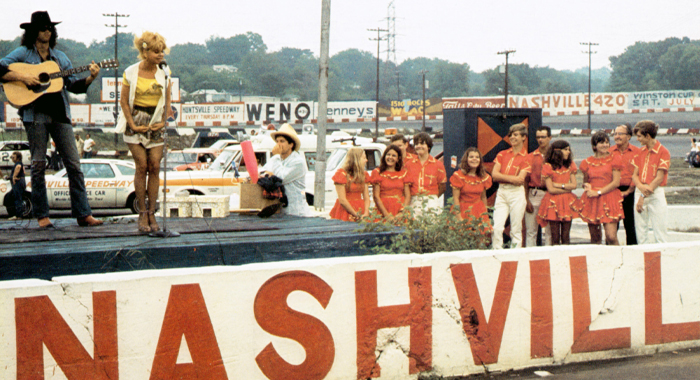
While Altman was pleased with Tewkesbury’s redo of the screenplay, United Artists balked at the new direction and dropped the project. Fittingly, the musically-inclined film was put back on track by concert promoter Jerry Weintraub’s financial backing, and it was subsequently picked up by Paramount Pictures.
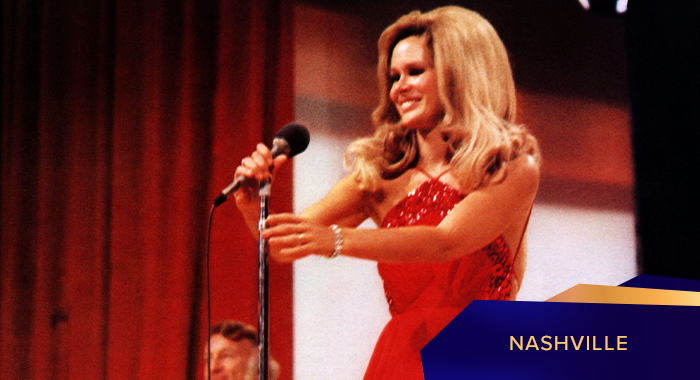
The eclectic cast included a mix of fresh and weathered faces like Keith Carradine, Lily Tomlin, Karen Black, Barbara Harris, Ned Beatty, and professional singers like Ronee Blakley, with much of the ensemble writing their own songs for the film’s soundtrack. The production went smoothly, with Altman deeming it “boring” in a good way. Having carefully structured the shoot to allow for loose improvisation, the cast and crew collectively fell in love with the process.
“Near the end Bob said ‘why don’t we just keep shooting Nashville for the rest of our lives?’ and everybody said ‘yeah,’” cast member Allan Nicholls shared with the Montreal Gazette. “It was that kind of thing.”
All good things, even a film shoot, must come to an end, but Nashville’s critical reputation preceded it long before its release when The New Yorker’s Pauline Kael preemptively gave it a rhapsodic review months in advance. “[United Artists]’ decision will probably rack up as a classic boner, because this picture is going to take off into the stratosphere,” Kael raved, adding “Nashville is a radical, evolutionary leap.” The debatable journalistic ethics of Kael’s review rankled the critical community, but her sentiment proved to be a bellwether when Nashville finally hit theaters on July 2, 1975. By and large, critics were left giddy by Altman’s achievement.
“Robert Altman’s Nashville is the damndest thing you ever saw and then some,” proclaimed Steve Hogner of the Austin American-Statesman. “It is to American film what William Faulkner’s The Sound and the Fury is to American literature — an epic definitive statement of the natural undercurrents shaping this nation.”
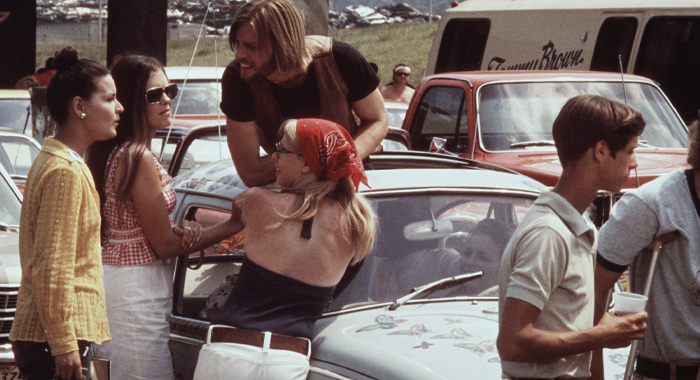
The claim that Altman had crafted The Great American Novel in cinematic form was echoed by many, with New York Magazine’s Judith Crist suggesting it “should be required viewing before we consider ‘celebration’ of a bicentennial,” referencing America’s impending 200th birthday in 1976.
While those who loved Nashville were effusive in their adoration, the film drew a number of skeptics who were put off by its cynicism. Toronto Star’s Clyde Gilmour dismissed it as “a hollow, irresponsible and vicious ‘I hate America’ diatribe,” while New York Daily News’ Rex Reed admonished it for providing “a viewpoint that is at once as fake and superficial as Hollywood itself, with its blank sunshine and heartless smiles.”
Reed’s critique that the film didn’t mirror the reality of the real Nashville was a sentiment shared by many southerners. The film drew a fair amount of accusations that Altman was putting down the good people of Music City.
“It simply isn’t true,” Altman said in response. “If I put down anything it was me and my impression of what I consider America is today and doesn’t need to be.”
“An enigmatic film that is part melancholy and part faith. Its people stumble and bend, but seldom fall and never break. Altman says: We’re not as bad as we think we are, nor are we as mighty as we once dreamed of being.”
– John Huddy, Miami Herald
One Flew Over the Cuckoo’s Nest
Tomatometer: 92% with 140 reviews
Popcornmeter: 96% with 250,000+ Ratings
Directed by: Milos Forman
Starring: Jack Nicholson, Louise Fletcher, Brad Dourif, Will Sampson, Christopher Lloyd, Danny DeVito
By the time Ken Kesey’s countercultural 1962 novel One Flew Over the Cuckoo’s Nest was finally adapted into a film, its cultural zeitgeist had become passé. A surrealist work that planted the reader inside the perspective of a schizophrenic Native American, Chief Bromden, as he witnesses a fellow patient’s failed rebellion at a mental hospital, the book exemplified a revolutionary spirit that thrived throughout the 1960s but had withered into exhaustion by 1975.
If Hollywood star Kirk Douglas had had his way, the movie would have arrived much sooner. Starring in a Broadway stage adaptation of Cuckoo’s Nest and scooping up the film rights in 1963, Douglas floated the project to a little-known Czechoslovakian filmmaker named Miloš Forman before spending the rest of the decade mired in ownership disputes. Forman, in the meantime, steadily built up an international reputation with his Czech comedies Loves of a Blonde and The Firemen’s Ball.
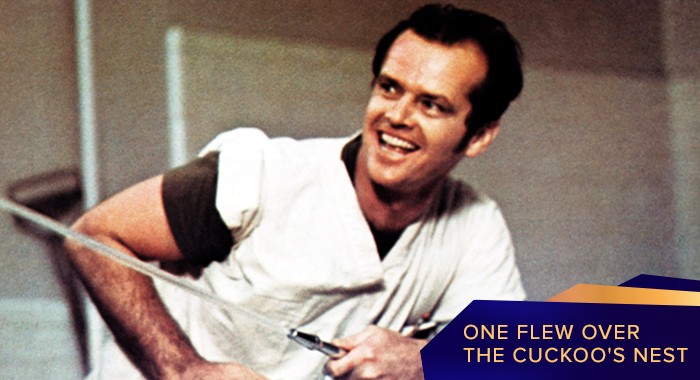
Eventually, Douglas passed producing duties for the film to his son, future Oscar-winner Michael Douglas, and the project found its way back to Forman. By the time Cuckoo’s Nest was finally ready to be made, there was no question who would play Randle P. McMurphy, the mental hospital’s resident hellion. Jack Nicholson, fresh off two consecutive Oscar nods for The Last Detail and Chinatown, was ideal casting to crack the incorrigible nut.
“[Jack Nicholson]’s not an actor,” Forman told the St. Louis Post-Dispatch at the time. “He’s a miracle.”
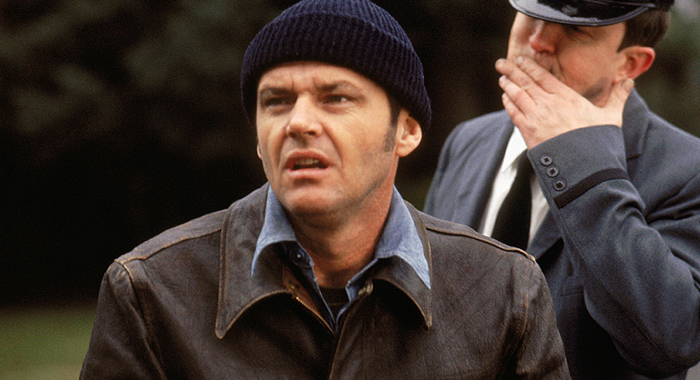
While Kesey’s book was rooted in Chief Bromden’s subjectivity, the filmmakers were more interested in emphasizing McMurphy’s emotional journey while presenting the hospital setting at a more objective remove. Forman, who spent three weeks living at an Oregon mental facility for research, felt “the film must first of all be real, then it must be entertaining and then a comedy.”
Nicholson, describing McMurphy as “a marvelous character,” saw the film as a study in people rather than an institutional critique. “I never thought the strength of Cuckoo’s Nest was in its milieu,” he told The Windsor Star. “It’s a story of an individual who, if he was more sophisticated, would realize where his actions were taking him.”
Forman was also intent on softening Nurse Ratched, the hospital’s dictatorial figurehead, concluding, “The fanaticism of the righteous is much more convincing than a black and white villain.” Louise Fletcher, who had just returned to acting after a decade-long hiatus, was cast as the well-meaning scourge, while the rest of the cast was rounded out with an eclectic ensemble of theater and comedy actors, along with first-time performer Will Sampson as Chief Bromden. “We used many inmates in the film, and a lot of them kept looking at us sort of like we belonged,” Nicholson joked. “It makes you wonder a little along the way.”
Arriving in U.S. theaters on November 21, 1975, Cuckoo’s Nest received a terrific critical response, the chief takeaway being Nicholson’s perfect casting. “No one but Jack Nicholson could have played McMurphy,” wrote Ronald E. Butler of Tulsa World. “The two are one, and it is a grand performance, supercharged with vigor and nuance as it should be.” London Evening Standard’s Alexander Walker ruled, “In Jack Nicholson’s performance, this year’s acting ‘Oscar’ is already spoken for.’”
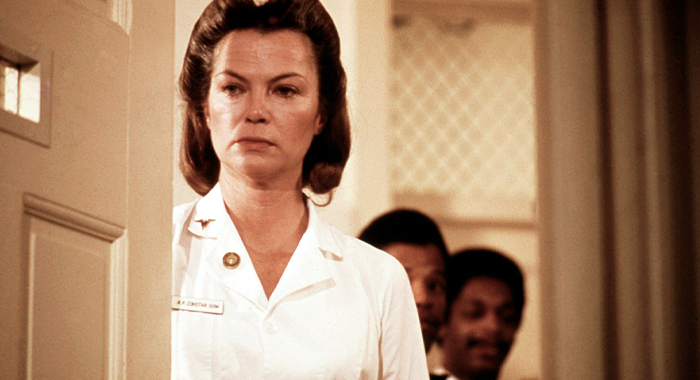
Nicholson didn’t hog all the kudos, though; Fletcher and the rest of the cast received stupendous praise as well, with Fort Worth Star-Telegram’s Elston Brooks summing up their collective effort as “ensemble acting at its best.” Forman, meanwhile, was commended for rising to the daunting task of making a comedy out of very bleak material, the result described by The Philadelphia Inquirer’s Desmond Ryan as a “movie of numbing power with a raw humor that induces laughter made shrill by an undercurrent of despair.”
Some didn’t find it all that amusing. Newsday’s John Cashman slammed the film’s playful presentation of mental illness, ruefully concluding, “Sick persons are not funny.” The Toronto Star’s Clyde Gilmour, meanwhile, wondered, “What will be the next thigh-slapper from Hollywood? Terminal cancer?”
Some critics were also miffed by how Forman’s treatment diverged from Kesey’s book. “Kesey’s story was hardly designed to be naturalistic, and Forman’s streamlining isn’t the way to make it work,” wrote Boston Phoenix’s Janet Maslin. “As it stands, Forman has merely reduced the story without successfully revising it.” Splitting the difference, Newsweek’s Jack Kroll wrote in his positive review that simplifying the adaptation resulted in “a well-made film that flares at times into incandescence but lacks ultimately the novel’s passion, insight and complexity.”
Grossing over $100 million at the domestic box office, One Flew Over the Cuckoo’s Nest was a massive hit, second only to Jaws for the year.
“The rebellion of the late 60s wasn’t all that wonderful, but it opened some minds and eyes, and the book, the play, and now this glorious film, lay it in our laps. It’s a tribute to filmmaking at its finest.”
– Patrick Taggart, Austin American-Statesman
Oscar Evening
The 1976 awards season was not a particularly suspenseful race. As the night of reckoning neared, One Flew Over the Cuckoo’s Nest firmed up as the runaway frontrunner for the big prize. When the Austin American-Statesman held a prediction contest for its local readership, 55% of respondents predicted Cuckoo’s Nest as the victor, with Jaws in a distant second with 28% of the vote. A similar poll by the Hamilton Journal News showed 49% of Ohioans betting on Cuckoo’s Nest while Jaws trailed at 23%.
The frontrunner status made Forman, who had gone home empty-handed twice before for the Best Foreign Language Film category, only more nervous. “Everybody is telling me I’m going to win,” he confided in the Sunday Independent (Ireland) on the day of the ceremony. “But there’s a tiny little space in my mind that is filled with doubts.”
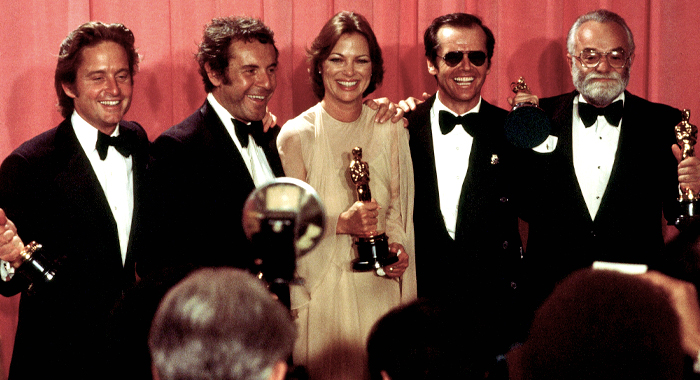
He needn’t have worried. One Flew Over the Cuckoo’s Nest cleaned up on March 29th at the Dorothy Chandler Pavilion, pulling off a royal flush with Oscars for Picture, Directing, Actor, Actress, and Screenplay — the first film to do so since It Happened One Night 41 years prior.
The evening still managed to spread the wealth among its spoil of riches, with Frank Pierson collecting a screenwriting award for Dog Day Afternoon, Keith Carradine claiming Best Original Song for his Nashville single “I’m Easy,” Barry Lyndon cleaning up in techs for Cinematography, Art Direction, Costume Design, and Adapted Score, and finally Jaws scooping up trophies for Editing, Sound, and John Williams’ Original Music.
It was Nicholson’s night, though, with the late-blooming star soaking up his crowning moment in Hollywod. Accepting his award, he thanked his agent, who “about 10 years ago advised me that I had no business being an actor.”