
The Star and Creators of Anna Pigeon on Why We Need a Badass Park Ranger Right Now
Showrunner Morwyn Brebner, director Lea Thompson, and star Tracy Spiridakos talk about keeping the spirit of the books, park service authenticity, and more.
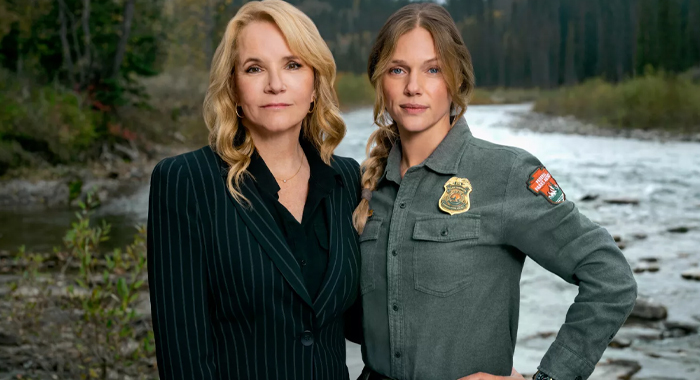
Anna Pigeon is the park ranger-meets-Nancy Drew series you didn’t know you wanted and that book fans have been craving. Nevada Barr’s long-running book series has been adapted into a procedural crime series. Created by Morwyn Brebner, produced by Lea Thompson, and starring Tracy Spiridakos as Anna Pigeon, the series follows a former city slicker who became a park ranger after a devastating event that completely changed her ethos and life. Hiding from her feelings and running from her personal demons in the vast expanse of a national park, Pigeon sets herself to solving crimes on the park’s grounds.
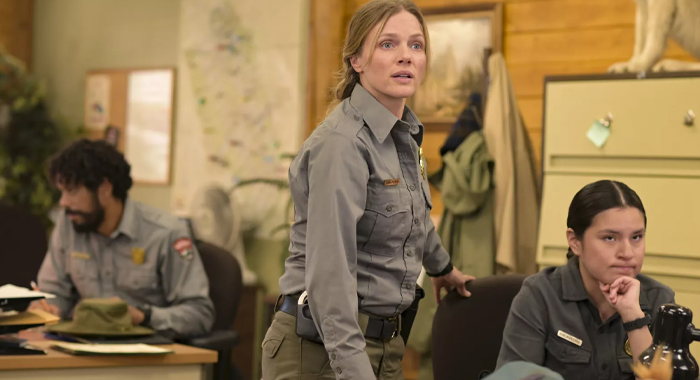
We recently sat down with Spiridakos, showrunner and executive producer Brebner, and director and executive producer Thompson at the Austin Television Festival for a panel previewing the new show. Hot off the show’s premiere episode, critics are also weighing in, with Thelma Adams of The Wrap writing, “The show [features] a pleasing rhythm, modest plot puzzles, and a jaunty heroine brought to life by the charismatic Spiridakos.”
Read on for our chat with the cast and filmmakers of Anna Piegon.
Jacqueline Coley for Rotten Tomatoes: Lea, as EP of this one, how did you find this story? How did you get involved with it?
Lea Thompson: A DP friend of mine told me about these stories, which were owned by somebody else at the time. He said I should get involved. So I waited until I could get the rights, and I got them about 10 or 12 years ago, maybe more. Once I read the books, I loved them and felt like this was something people would love to watch, not only in America but in Europe, Canada, all over the world. I know how much people love the national parks; I live by a glacier myself. And I loved the character so much. She’s flawed, she’s interesting, she’s sexy. Everyone wants to be her friend, or be her, and men want to know her. It was a great story, so I kept trying to sell it. Then I met Morwyn, who was the perfect person to write it, and we had one actress in mind for Anna Pigeon. Just one. And we got so lucky that she said yes.
RT: Morwyn, this is the story of a park ranger, and it’s very procedural, with twists and turns. It reminded me of Picket Fences or Crossing Jordan — a small town where the craziest things happen, and it turns out that’s basically everyday park life. The books were written in a different era, and modern parks face different political and environmental realities. How did you keep the heart of the books while adapting them for modern audiences?
Morwyn Brebner: That’s such a good question. The show became more and more topical as we were shooting it. The parks are among the last truly wild spaces we have; they’re big, there’s peril and danger there, and people go in without knowing what they’re getting into. Park rangers are the only ones who can help in that situation, which is inherently dramatic. Bad things happen in parks. Over the years, while we were hoping to get picked up, I’d send myself links to strange stories out of national parks: a man falls off a cliff, a buried man, things like that. I started seeing the parks as a microcosm of the world at its most elemental level. Anna Pigeon walks in alone and says, “I’m going to solve your problem; I’m going to help you.” That push and pull between being self-reliant and needing other people is something I think people are really dealing with right now.
Picket Fences is a good comparison because there’s a real warmth to the community of people who work in the parks; they’re there to do good; some are running from things, and a lot of them are running to nature. Anna is tough but also vulnerable, funny, and finds the best in things. Those qualities — community, resilience, the redemption nature offers — feel very present in the world right now. It’s strange how once you write something, it starts showing up. There’s an enormous green fireball in the show, and now there are fireballs everywhere in real life. The parks are in the zeitgeist, and they really need protecting right now.
Growing up, my elementary school took us to nature once a year. I’d get hay fever, and my head would swell up, but it was my one encounter with awe in nature. What we’re all trying to do, and what Lea did so well directing the pilot and setting the visual tone, is bring some of that awe to the audience along with this badass character.
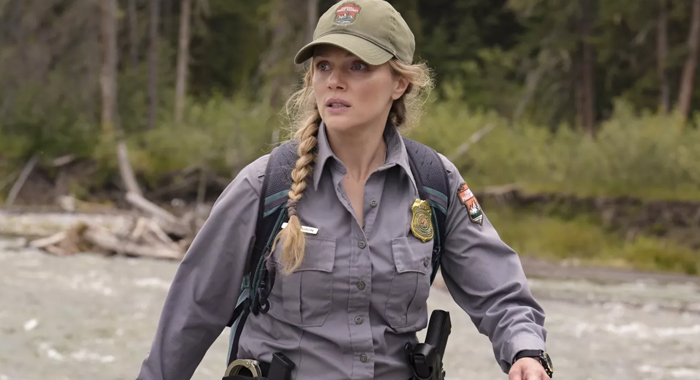
RT: Tracy, one thing that’s interesting about you playing Anna Pigeon is that actors, even on soundstages, appreciate the control of a soundstage: no random goat yelling in the background, no sudden downpour. But it looks like you all shot this outside, actually outside. This has to be a departure for you; a lot of your past work, like Chicago PD, was shot indoors. What was it like acting out in nature?
Tracy Spiridakos: I loved it. Every day we’d show up to set and all be like, “How is this real life?” It was spectacular. I have a ton of photos I can’t share yet; we don’t want to give anything away before it airs. We shot in Canada, and I used to go to Banff and the Canadian Rockies on road trips with my brothers and friends growing up, so it felt familiar. It was stunning and so much fun. I learned to horseback ride, climb trees, and work with animals.
RT: This is an interpretation of the books, but it’s a very popular series, and Nevada Barr surely wants to see it presented well, as do her fans. Tracy, what were the quintessential parts of Anna that you read in the books and wanted to make sure came through in your performance?
Spiridakos: I wasn’t familiar with the books until I got involved. I read the pilot first and completely fell in love with the writing. I did read a book before we started shooting, but Morwyn did such an excellent job adapting the character that I never felt I had to bring anything in on my own; I fully trusted the writing. Even with new characters added, Morwyn built it all seamlessly within that world. I also had the guidance of Lea, who had read all the books and helped guide me through what that world looks like. We did it together.
Thompson: Nevada will be really happy to hear that. She trusted us right away. We met her on one of the first days we were shooting; she happened to be in the neighborhood, and we all went to dinner. She was thrilled; when she saw Frederick, she loved it. She was excited and game for everything. I’d had the option on the book for so long, asking her for an extension every year, so I feel very grateful. I owe her a great debt for giving me this opportunity. And Morwyn did an amazing job, including creating some new characters.
RT: Morwyn, you had to be judicious about what to keep, what to kill, and what to combine. What was your guidepost for those decisions?
Brebner: Someone once told me that doing an adaptation is like squeezing the juice out of an orange; you get the essence and hope it’s not a lemon. So I looked for what was essential in the books and in where Anna is at the start of the series. We also brought in elements from another book called The Rope, an Anna origin story, and folded that into the present timeline. Nevada’s writing makes Anna so badass and cool; there’s a wish in the show that you’d both want to be rescued by Anna and want to be Anna, as Lea said. I used that as a guiding signpost, staying true to Glacier, where we set it, and true to who would actually be in that park. It’s a journey of respecting the books by essentializing them for the new medium. Nevada was incredibly generous and supportive of that, and had a lot of faith in Lea and in Tracy once she knew Tracy would play Anna.
Thompson: I believe so strongly that we need this kind of character right now, a woman who’s interesting, powerful, smart, funny, sexy, and out to protect nature and Mother Earth.
RT: USA Network has this legacy of “blue sky television,” shows like Suits and Royal Pains, where there’s drama and intrigue but also comfort in the characters. It’s hard to define, but there’s clearly some magic to it. Even though an episode might start with a murder, I still felt warm by the end. Is that something you think about consciously?
Brebner: We do. We all do. It was a real conscious decision across every aspect. The ranger station, an actual cabin our production designer turned into a beautiful set, was a place that felt good to be in. All the people in the park feel like a family you want to be around. We do have literal blue skies too; Lea shot beautiful vistas, so it’s a literal blue sky show as well. It comes from a sense of love between the characters, and that was a very deliberate choice.
Spiridakos: Anna has some hope in her too. In each episode, no matter what’s happening, we root for Anna. She’s not really someone who wants people in her world; she’s very much on her own, but you see her making friends and letting people in, and you want that warmth for her. The hope is that it makes everyone watching feel like spending time with loved ones and getting out into nature. It’s meant to feel generally hopeful.
RT: Lea, what were the challenges of directing a show so physically demanding, with actors working outside where it’s not a prop, it’s actual dirt? How did that complicate things, and how did you deal with it?
Thompson: Going back to a movie I made, Red Dawn, I love Westerns. There’s something visceral about them, and I do think we’re in danger of losing that with AI. As a director, I wanted this to feel really visceral and real. We decided on this location early on: cabins outside with no soundstage. We don’t have a lot of money, so that was expensive, but we chose to shoot it that way for authenticity. We were lucky to have an actress who wasn’t fussing with lip gloss constantly; I was obsessed with no “TV hair.” I wanted sun flares, no green screen, real eagles flying by, real animals. It feels more real as an actor when you can feel the dirt, the rain, the sun on your face.
But it was difficult, especially with daylight. In summer we’d have 15 hours of light, but in winter, during the finale, I only had about seven or seven and a half hours. There was an episode near the end where the sun was dropping fast; I called cut, and then it was suddenly pitch dark. We didn’t have a full night in summer, or a full day in winter, so we had to work around it. But everyone was game to fight that fight, and you need that. It’s more visceral; I don’t want an actor to fake wind if real wind is available. The park itself is a character in the show.
RT: And because of the nature of the books, which I haven’t read either but researched a bit, they’re episodic: This happened at this time, that happened at that time. Tracy, you’ve worked on a lot of procedurals. For a cop show, it’s the crime of the week; for a medical show, it’s the disease of the week. For a park show, it could be almost anything. But what’s the “park service” equivalent for accuracy? Is there a specific way you use the radio, or get out of the vehicle, that makes it feel “park ranger” authentic?
Spiridakos: I don’t want to give too much away, but there were things I had to learn. As a police officer character, you’re trained to clear a house or a room with a gun; you know where to look. Park rangers go through similar training, but their day-to-day focus is different, more on first aid and handling situations like an avalanche. Coming from playing a cop, I had to be aware of not leaning too heavily on that instinct, since a ranger’s training, while it includes those skills, focuses more on other things. I’m not trying to take anything away from real park rangers’ training, but the focus is different, and I had to be conscious of that.
Brebner: We actually had an amazing park ranger consultant who told us stories across the spectrum, some harrowing, some very funny. And a little romance once in a while.
Anna Piegon is currently releasing new episodes weekly on USA Network.