
16 Special Presentations and Guest Appearances to Check Out at the 2026 TCM Classic Film Festival
From early Hollywood classics and Westerns to counter-culture action flicks and blood-soaked '80s satire, here's what to look for at this year's festival.
Turner Classic Movies has been carrying the torch for movie lovers ever since it first flickered onto television screens in 1994. Running back cinema history with no commercial interruption, the Warner Bros. Discovery-owned cable channel serves as a firm reminder that great movies never have an expiration date.
This year marks the institution’s 16th TCM Classic Film Festival, hosted in theaters across Los Angeles’ Hollywood Boulevard. From Thursday, April 30 to Sunday, May 3, TCM is screening more than 80 classic movies with the overarching theme of “The World Comes to Hollywood,” focusing on the cinematic contributions made by those who flocked to Hollywood from distant shores. Here are 16 highlights from the festival program that feature special presentations or notable guest appearances, along with Tomatometers all recently updated with contemporaneous reviews by the Rotten Tomatoes curation team to best reflect how they were received in their own time.
Thursday, April 30
 98%
Modern Times
98%
Modern Times
98%
Modern Times

Screening: Thursday, April 30 at 5:30pm at Chinese Multiplex House 4, with special guest Tony Shalhoub
In several ways, Charlie Chaplin’s Modern Times was, in the parlance of our own modern times, a big flex on the Hollywood system. It was a testament to the silent film icon’s popularity at the box office that he could return to theaters after a five-year absence following his previous film, City Lights, and be met as if he never left. What’s more, Chaplin refused to conform to the dominance of talkies and kept his iconic Tramp character silent, only allowing the compromise of sound effects to intrude on his pantomime.
“I have never felt that I should speak so long as I remained the screen character with which I have been so long identified,” Chaplin told Screen Radio & Daily at the time. “Now I know that until I throw away my baggy trousers and my cane, I shall not talk in a picture.” Modern Times received universal acclaim. While trouble brewed in Europe, critics hailed Chaplin’s old-fashioned throwback as a tonic for a world that was spinning out of control.
Chaplin himself dismissed any political intention in his satire of the capitalist machine, asserting, “It seemed to me a good subject with which to have a little fun, and that was my only idea in dealing with it.” In the same breath, he admitted to hearing that the Soviet film commission reported back to Moscow that he had made “propaganda on behalf of Communism.” Modern Times would prove to be Chaplin’s last appearance as The Tramp, and, true to his word, his last film to go without dialogue. Actor Tony Shalhoub will be a special guest at the TCM screening, which will be projected in 35mm.
“When we are feeling that the world has become too hard and too horrible, a chaos of present din and a menace of destruction, Charlie is our crumb of comfort, his flimsy cane our staff of life.” – Ivor Brown, Observer (UK), February 16, 1936
 22%
Grease 2
22%
Grease 2
22%
Grease 2
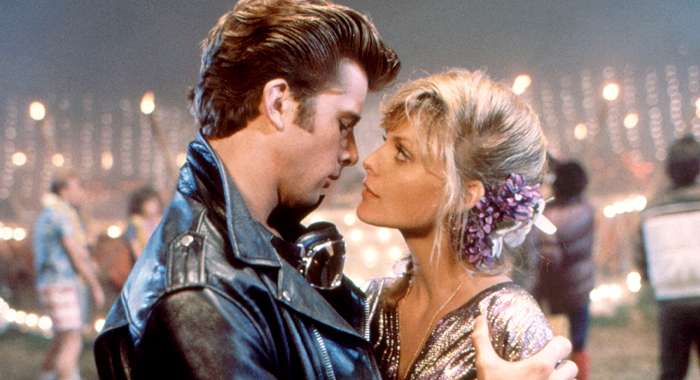
Screening: Thursday, April 30 at 7:30pm poolside at The Hollywood Roosevelt Hotel, with co-stars Maxwell Caulfield, Lorna Luft, Christopher McDonald, and Adrian Zmed in attendance
Riding on the success of 1978’s Grease, this contentious sequel has spent the last several decades being unfairly reviled. Starring Maxwell Caulfield and Michelle Pfeiffer in a role-reversal romance, Grease 2 attempts to make lightning strike twice, to frayed effect. What the film lacks in originality, it makes up for in its choreography by first-time director and returning choreographer Patricia Birch. Though critics wished for something new, something more meaningful, and catchier tunes, Grease 2 has managed to develop a cult following for charting its own musical path. Without the presence of John Travolta and Olivia Newton-John, Grease 2 allows its fresh faces to carry the story through, curiously subverting the expectations of a direct sequel and acting more as a continuation of the world. With all its jiving, rocking, belting, and cool kicking, Grease 2 may not be the exact word, but it has its own groove and feeling. Caulfield and co-stars Lorna Luft, Christopher McDonald, and Adrian Zmed will be in attendance.
“Where the songs, arrangements, and choreography in G-1 tended to look and sound alike, this film has gaits and dynamics.” – Jeff Milar, Houston Chronicle, June 12, 1982
 73%
Blonde Venus
73%
Blonde Venus
73%
Blonde Venus
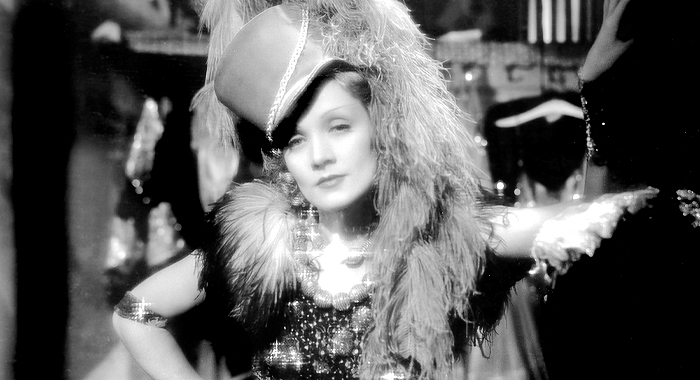
Screening: Thursday, April 30 at 9:15pm at Chinese Multiplex House 4, with special guest Nicholas Josef von Sternberg
After a turbulent creative back-and-forth between director Josef von Sternberg, Marlene Dietrich, and Paramount Studios, Blonde Venus could have easily become a very different film. What started out as a simple script dispute, led to a two-week creative standoff between the three parties. Eventually, Sternberg and Dietrich returned to complete production, shaping the final version into a gripping tale about a woman navigating love, survival, and societal judgement. It does raise the question, however, of what the alternate version might have looked like.
Regardless of the outcome, the film’s 1932 premiere drew critical attention, with reviewers and audiences captivated by Dietrich’s magnetic performance and Sternberg’s visual daring. The film pushed boundaries with its adult themes and moral ambiguity, marking it as one of the most provocative and talked about films of early 1930s Hollywood. Blonde Venus cemented Dietrich’s status as a screen legend and proved that cinema could be glamorous, emotional, and boldly fearless all at once. Von Sternberg’s son, Nicholas Josef von Sternberg, will be in attendance as a special guest.
“Directed by Josef von Sternberg, [Marlene Dietrich] is offered in her first role as an American woman, a warm, loving, humanly-moved personality, through which Dietrich exemplifies an artistry more brilliant than in anything she has yet given the screen.” – Republic Staff, Arizona Republic, September 25, 1932
93%
Days of Heaven
93%
Days of Heaven
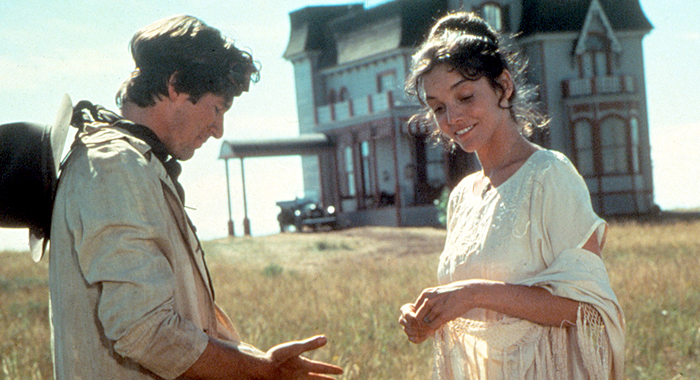
Screening: Thursday, April 30 at 9:30pm at the Egyptian Theatre, with co-star Brooke Adams in attendance
When Terrence Malick’s long-awaited sophomore feature, Days of Heaven, was finally ready to be unveiled at the 31st Cannes Film Festival, the editing process had taken so long that its fresh-faced star — Richard Gere — had already booked, filmed, and made a name for himself with another film in the interim, Looking for Mr. Goodbar. Lamenting to the New York Daily News that audiences would have had a very different introduction to him if Days of Heaven had premiered first, Gere described the mysterious film as “people trying to find some sunshine and some peace in their lives.”
While the finished product did feature Gere and co-star Brooke Adams as runaway lovers scratching out a future for themselves in early 20th century Texas, it was the sunshine that made the biggest impression on audiences and critics. Directors of photography Néstor Almendros and Haskell Wexler’s painterly depiction of golden hour was so striking that the film was immediately hailed as a watershed visual accomplishment, with News & Observer’s Bill Morrison commenting that it was “as though the French impressionists had exchanged canvas for celluloid.”
According to Adams, Malick’s completed vision was very different than what she and her co-stars had originally signed up for. “Terry wrote a script and then couldn’t bear to hear his words,” she told the New York Daily News at the time. “He really did three films. He wrote one, did another and edited a third version.” Adams will be attending the TCM screening as a special guest.
“Days of Heaven does not function as we expect movies to function. There may be an outline of a story and a set of characters, there may even be a beginning and an end, but all of this is illusive and dreamlike, as if you could reach out and poke your finger through the vapor-like structure created by the director.” – John Huddy, Miami Herald, December 20, 1978
Friday, May 1
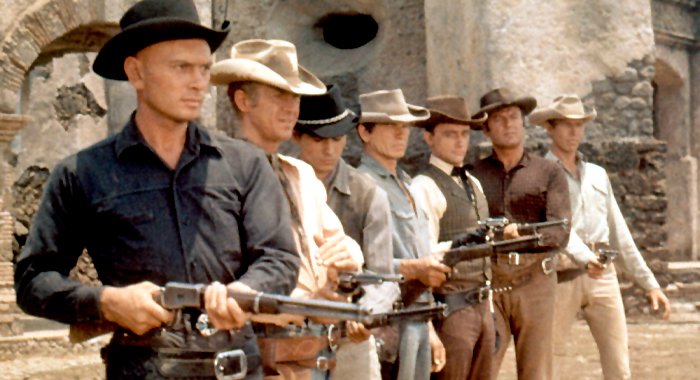
Screening: Friday, May 1 at 9:00am at Chinese Multiplex House 1, with special guest William Joyce
Watching Eli Wallach in The Magnificent Seven, it would be hard to believe that the shiny, gold-plated teeth he sported were anything but the real thing. A speculated handful of 24-carat gold, to be exact. Not only did Wallach’s gold-rimmed teeth add to the film’s authenticity, so did the fact that it was shot primarily on location in Morelos, Mexico, which was also home to Mexican Revolutionary leader Emiliano Zapata. With this sense of realism firmly in place, the film has stood the test of time, becoming one of the most well-known Westerns of its decade. The Magnificent Seven is a Western that crackles with tension, courage, and cinematic bravado.
With Yul Brynner leading the cast under the direction of John Sturges’ brilliant direction, it’s no wonder that, upon its release, critics praised the ensemble’s chemistry and Sturges’ skillful staging, setting it apart from its celebrated source material, Japanese auteur Akira Kurosawa’s 1954 masterpiece Seven Samurai. They noted the film’s ability to thrill without sacrificing character depth. The Magnificent Seven helped set a new standard for Westerns, combining high-stakes action with enduring storytelling, and its impact has resonated through decades of remakes, adaptations, and pop culture references. It remains a landmark of the genre, a story of courage, loyalty, and legend. Writer and illustrator William Joyce will be in attendance as a special guest.
“Sturges is no Kurosawa, but he makes Seven into the cinematic equivalent of a catchy cover tune that loses some of the original’s depth, but adds a snap all its own.” – Keith Phipps, AV Club, January 11, 2006
Screening: Friday, May 1 at 10:00am at the El Capitan Theatre, with special guests Mario Cantone and Andreas Deja
It’s curious (and curiouser) that Alice in Wonderland was arguably animation titan Walt Disney’s biggest passion project of his career and, inarguably, his biggest personal disappointment. Before the cartoonist had ever doodled Mickey Mouse, he cut his teeth as a filmmaker making a series of shorts based on Lewis Carroll’s heroine. By the time he went into production on a full-length animated feature adapting the book, it was widely reported that it was the film he had most wanted to make for decades. It was also considered one of his steepest challenges yet, with the added pressures of turning a critically adored literary masterpiece into family entertainment and developing an animation style that wouldn’t be too derivative or dismissive of artist John Tenniel’s iconic book illustrations.
When Disney’s Alice finally arrived in theaters, it received generally warm reviews with some grumblings accusing the children’s entertainer of flattening Carroll’s complex work into a silly spectacle. The picture failed to break even at the box office in its initial run and became Disney’s least favorite of his cartoon children, the filmmaker reportedly complaining it had “no heart.” After his death, Alice was finally re-released to much greater success in 1974, where its psychedelic imagery was welcomed by college-aged audiences. Disney animation veteran Andreas Deja and stand-up comedian Mario Cantone will be attending the TCM screening as special guests.
“The Disney film may not please the purists, to whom every word in Alice is part of the sacred tablet. But it represents the best (and most honest) work he has done since Snow White — which is to say, the most creative and imaginative work the American screen has known.” – Sydney J. Harris, Ottawa Citizen, July 12, 1951
88%
Ace in the Hole
88%
Ace in the Hole
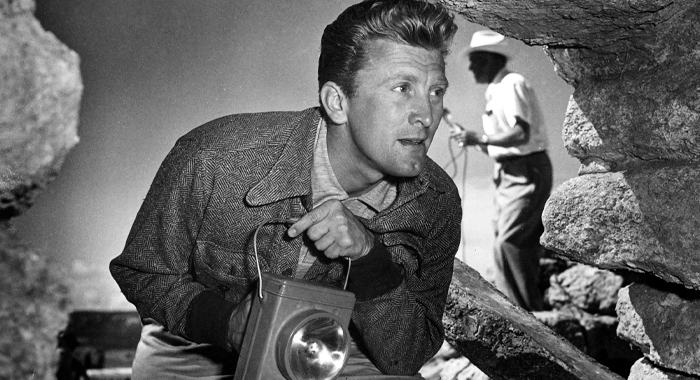
Screening: Friday, May 1 at 6:00pm at Chinese Multiplex House 1, with special guest Josh Mankiewicz
Billy Wilder’s scabrous journalism satire Ace in the Hole caused such a commotion upon its release in 1951 that leading actor Kirk Douglas felt compelled to pen a syndicated op-ed beseeching the American public to give the picture a chance. While the movie star had already performed a heel turn in the boxing romance The Champion just a few years prior, it still hadn’t been enough to prepare audiences for the diabolical lengths he would go to as Ace’s Chuck Tatum, an unscrupulous reporter who exploits a trapped man’s plight all in the name of a juicy story. The film got such a scandalized reception at the box office that Paramount Pictures would retitle it The Big Carnival for a re-release just a couple months later.
Ace in the Hole garnered a begrudgingly impressed reception from critics, most of whom had to hand it to the picture’s acidic boldness even when its cynicism was aimed squarely at their newsroom peers. Douglas, for his part, cited the movie’s ability to provoke as a virtue. “You may hate me as Chuck Tatum… or cheer me,” he wrote. “But I don’t think you’ll be indifferent.” Dateline NBC correspondent Josh Mankiewicz will be attending the TCM screening as a special guest.
“Perhaps one of Hollywood’s greatest sins is its general reluctance to take a chance on stepping on anyone’s toes. The result is an endless flow on sugar-coated pills that conform, not to actual life, but to the Hollywood idea of what life should be like to keep the public happy. Once in a long, long time, though, a rebellious movie turns up — a movie like Ace in the Hole.” – John McDowell, Newark Star-Ledger, July 26, 1951
62%
Vanishing Point
62%
Vanishing Point
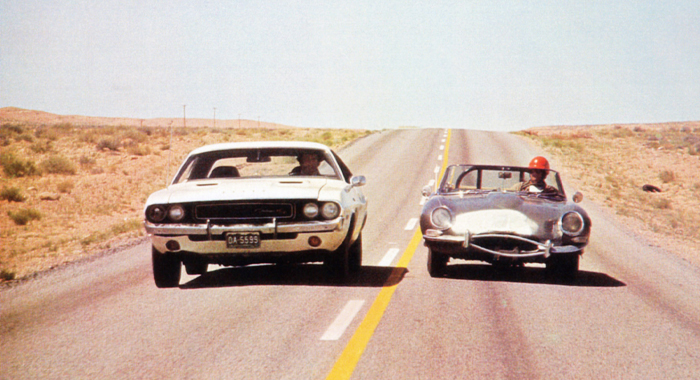
Screening: Friday, April 30 at 12:00am at Chinese Multiplex House 6, with special guest Edgar Wright
A fever dream of a chase film, Vanishing Point introduces a new type of American outlaw for the end of the free love era. Vanishing Point unfurls as a stimulant-fueled, nearly nightmarish story of a desperate man in desperate times on the run from the law and maybe even society itself. Offering perhaps a few too many similar thematic digressions on the American spirit as explored in 1969’s Easy Rider, Vanishing Point ultimately received a mixed reception from critics upon its release in March of 1971. Though they couldn’t deny the visual impact of the film’s extended chase sequences, many critics felt it failed to package its explorations of law, order, freedom, and destiny into a coherent narrative.
But with its legacy now cemented as a cult slice of vehicular mayhem thanks to its inspiration on Quentin Tarantino’s Death Proof — in which one character calls it “one of the best American movies ever made” — Vanishing Point stands as a uniquely existential and relentless chase film with few, if any, peers. Remade as a network TV movie starring Viggo Mortensen, an updated Vanishing Point attempted to bring the original’s story to the brave new world of 1997, but compared to the original’s thematic indulgences, the few critics that managed to see it simply felt that it barely attempted to say anything at all. Filmmaker Edgar Wright will attend the screening as a special guest.
“[Barry] Newman does a good job in portraying this man possessed by the death wish and, although the movie is sloppily edited and directed and the story often cluttered with superfluous characters, the sheer power of relentless speed has an almost hypnotic effect.” – Harvey Taylor, Detroit Free Press, June 9, 1971
Saturday, May 2
Screening: Saturday, May 2 at 8:45am at TCL Chinese Theatre IMAX, with special guest George Stevens Jr.
Originally adapted from the 1925 novel An American Tragedy, A Place in the Sun saw director George Stevens reshaping the material into a modern portrait of desire and consequence. His classic moral tale follows George Eastman (Montgomery Clift), a young man torn between ambition and responsibility, who becomes involved with Alice (Shelley Winters), a working-class woman who becomes pregnant, while also falling in love with wealthy socialite Angele (Elizabeth Taylor). As George is pulled between two conflicting worlds, Stevens’ adaption explores the devastating cost of desire and class aspiration.
Upon the film’s release, critics praised Clift’s nuanced performance and Stevens’ precise direction, highlighting the film’s tragic intensity. The story’s exploration of ambition, love, and social constraints resonated strongly with audiences and earned multiple Academy Award nominations, solidifying its reputation as a high point of 1950s Hollywood drama. American Film Institute founder and writer-director-producer George Stevens Jr., the son of director George Stevens, will be in attendance as a special guest.
“The emotional entanglements of the three young people prove tragic, but they are true emotions, and their poignancy has a compelling, deeply moving quality. This story of love and frustration goes straight to the heart.” – Jane Corby, Brooklyn Daily Eagle, August 29, 1951
96%
Camille
96%
Camille
Screening: Saturday, May 2 at 9:15am at Chinese Multiplex House 6, with special guests Diane Baker and Tara McNamara
By 1936, Alexander Dumas’ novel The Lady of the Camellias was close to 100 years old, already had four film adaptations, and was considered tired material by the masses. It told a classic, tragic story, no doubt, about two people falling in love in a time that prevents them from being happy. What could not have been anticipated was George Cukor reinvigorating the played-out story with style, grace, and all the magnetic talent Greta Garbo had to offer. Camille lives and breathes by Garbo’s human and touching performance, which surprised audiences. This is a picture that elevates the source material through the dedication and high precision of its director, writers, cast, and production designers. Accompanied by luxurious sets, sumptuous period costumes, and a strong supporting cast, Camille has withstood the test of time as a marvelous interpretation of Dumas’ creation. Actress and producer Diane Baker and film journalist Tara McNamara will be in attendance as special guests.
“So for a sentimental relic, the book by Dumas, there evolves a picture which is likely to prove to be Garbo’s best vehicle in several years.” – Clark Wales, Detroit Free Press, December 27, 1936
Screening: Saturday, May 2 at at 9:15am at Chinese Multiplex House 1, with special guest Joe Dante
The Rocky Horror Picture Show tells us that;“Michael Rennie was ill the day the earth stood still, but he told us where we stand,” and how right it was. In exploring the anxieties of global security through contact with otherworldly visitors, The Day the Earth Stood Still is a science-fiction moral marvel, simmering with hope for peaceful existence among us all. Written and directed by Robert Wise and starring Michael Rennie, Patricia Neal, and Sam Jaffe, this film solidified science-fiction as a legitimate, less silly genre within filmmaking. Taking in the out-of-this-world sets, dazzling special effects, and the humanist message imparted by Wise’s script, Earth remains a prescient, timeless, and thought-provoking picture that truly moves the audience with its fictional dilemma. Filmmaker Joe Dante will attend the screening as a special guest.
“Well directed by Robert Wise, sensibly played by Michael Rennie, Patricia Neal, Billy Gray, Sam Jaffe and Hugh Marlow, The Day the Earth Stood Still is more believable than most of these shiver science shockers.” – Mildred Martin, The Philadelphia Enquirer, September 29, 1951
Screening: Saturday, May 2 at 11:45am at Chinese Multiplex House 1, with special guest Jonah Goldberg
Lonesome Rhodes, a rough rogue whose television ascension helps him amass elite power, fame, and fortune, becomes a cautionary tale against the worship of demagogic figures. Written as a searing satire by Budd Schulberg and directed with intentional hyperbole by Elia Kazan, A Face in the Crowd continues to speak consciously to the current zeitgeist, just as it did upon its release in 1951. This specific critique of TV culture at the time could be seen as foreshadowing the all-consuming power of TV personalities, albeit packaged here in a wildly entertaining format. In his feature film debut, Andy Griffith makes and breaks this film in all respects. Critics found his maniacal performance to be raw, bombastic, and real. While the supporting cast stands at the edges of Griffith’s performance, it is Patricia Neal who manages to stand toe-to-to with his larger-than-life — larger-than-the-screen — personality. Whether a first watch or a rewatch, the performances demand awe and the moral questions posed linger long after it’s over. Journalist, author, and political commentator Jonah Goldberg will be in attendance as a special guest.
“It shows how one man can become a nationwide influence, a power, first i the commercial field of product-plugging and then in politics as a kingmaker. It warns the American people of the perils of being influenced, of falling under the spell of a demagogic personality.” – Helen Bower, Detroit Free Press, May 30, 1957
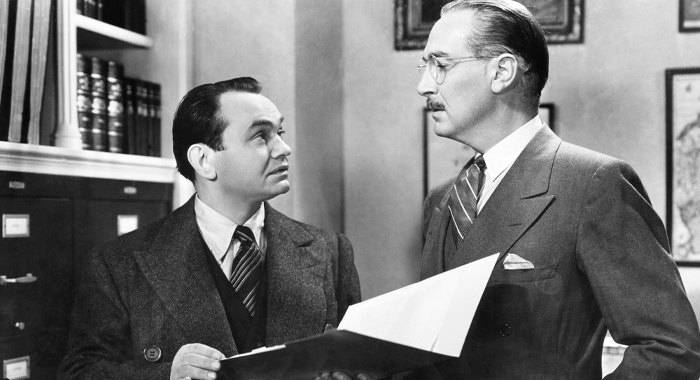
Screening: Saturday, May 2 at 3:30pm at Chinese Multiplex House 6, with special guest Annette Insdorf
In the late 1930s, as the US recovered from its greatest existential threat, The Great Depression, another existential threat had emerged with wide-reaching influence: the Nazi party. With sympathizers of the movement proliferating in the US through the formation the German American Bund in 1936, the Nazi threat was clear and present. And it would be the shocking real-life FBI cases of spy rings related to that organization that would prompt Warner Bros. Pictures to produce Confessions of a Nazi Spy. Inspired in part by the Rumrich spy case, the first major case of international espionage in the US, Confessions would be Anatole Litvak’s fourth directorial effort for Warner and his second with actor Edward G. Robinson. On its release in May of 1939, critics championed the film as a socially conscious, truth-affirming piece of patriotic filmmaking.
And while some critics took issue with what they felt were the film’s occasional dips into outright propaganda, the majority attested to both its entertainment value and its social value as an eye-opening expose of America’s greatest threat. Despite sparse screen time, Robinson’s tough, gritty performance as FBI agent Ed Renard was especially highlighted by critics as lending a strong air of verisimilitude to the film. This keen sense of realism and adherence to the facts wouldn’t please everyone, however, with president of the German American Bund, Fritz Kuhn, unsuccessfully attempting to sue Warner Bros. for millions in libel damages. Kuhn claimed that the studio had spied on his organization to create the film’s story. The bund leader would later be arrested and jailed shortly after the film’s release and deported to Germany some years later. Film historian Annette Insdorf will attend the screening as a special guest.
“The director has carefully avoided the usual melodramatic touches of fictitious spy pictures, with the result that it is entirely convincing and much more dramatically effective.” – Ronald D. Scofield, Sacramento Bee, May 29, 1939
84%
RoboCop
84%
RoboCop
Screening: Saturday, May 2 at 9:45pm at the Egyptian Theatre, with special guests Kurtwood Smith and Paul McCrane
The big winners of 1987’s summer box office were sequels and big screen adaptations like Beverly Hills Cop II and The Untouchables, but the two original movies that audiences flocked to both happened to be unique sci-fi action mashups: Predator and RoboCop. While Predator’s box office success wasn’t quite equal to its mixed critical reception, RoboCop was immediately hailed by critics as a near transcendent, fiercely smart evolution in the ‘80s action movie cycle. To them, its ventures into gore-leaden, over-the-top violence were in perfect balance with its knowing satire, near mythical resurrection story, and Paul Verhoeven’s kinetic direction.
This balance of dark wit and bone-crushing thrills proved to be a tricky thing to recapture, with RoboCop 2 finding itself critically lambasted as a mean-spirited holding pattern of its predecessor. A watered down approach to the series’ tone would find another critical failure with RoboCop 3 and moderate, though vastly tempered, critical praise with the syndicated series RoboCop. Later attempts to recapture some semblance of the original film’s grim mix of satire and ultraviolence — the miniseries RoboCop: Prime Directives and the 2014 reboot RoboCop — would be viewed by critics as admirable, but wholly uneven experiments. Co-stars Kurtwood Smith and Paul McCrane will be in attendance as special guests.
“Robocop scrapes the bucket of gore but rises above the comic-book mentality with solid acting and action. There is even an epic quality to the character of Robocop.” – John Robinson, Santa Cruz Sentinel, July 24, 1987
Sunday, May 3
Screening: Sunday, May 3 at 9:00am at TCL Chinese Theatre IMAX, with special guests Christopher Barnes, Erin Blunt, Gary Cavagnaro, Scott Firestone, Jackie Earle Haley, Alfred Lutter, Brett Marx, David Pollock, and David Stambaugh
Before Rocky would redefine the sports movie with its release some eight months later, The Bad News Bears would tell its own critically lauded tale of underdogs — albeit much shorter, more foul-mouthed ones — in the spring of 1976. Directed by Michael Ritchie, who had delivered similar satirical treatises on the unique American psychology of winning with The Candidate and Smile, The Bad News Bears was widely noted by critics for its ribald but knowing insights into youth baseball and its raw, salt-of-the-earth characters. Stacked with a roster of richly characterized pipsqueak baseballers, Bears found much critical praise for delivering a refreshingly crass but authentic portrait of youth after an oversaturation of safe and cutesy children’s movies by Disney in the 1970s.
The Bad News Bears showed the world that the kids of the ‘70s may not be alright, but they sure had plenty of spunk. Further attempts at the bat for the series would be seen as lacking Ritchie’s deft directorial touch. With The Bad News Bears in Breaking Training, The Bad News Bears Go to Japan, the TV series The Bad News Bears, and the Richard Linklater-directed remake Bad News Bears, critics would find the series becoming the very thing they felt the original steered clear of being: mawkish, witless, and hopelessly inauthentic. Attending the screening will be several of the original child stars, including Christopher Barnes, Erin Blunt, Gary Cavagnaro, Scott Firestone, Jackie Earle Haley, Alfred Lutter, Brett Marx, David Pollock, and David Stambaugh.
“Bad News Bears is not only achingly funny, good-hearted, skillfully schmaltzy and relentlessly entertaining, it’s also one of the most perceptive and revelatory films about male American childhood I’ve ever seen.” – Jeff Millar, Houston Chronicle, April 9, 1976
Screening: Sunday, May 3 at 4:00pm at TCL Chinese Theatre IMAX, with special guest Adam Shankman
Breakfast at Tiffany’s was originally intended to be filmed in Hollywood, but director Blake Edwards ultimately made the sound decision to film it in New York. This choice helped define the film’s atmosphere, centering Audrey Hepburn as Holly Golightly within a vibrant world of freedom and spontaneity. Not only does Holly’s story radiate with glamour and charm, but it also shimmers with its hypnotic musicality. Henry Mancini’s “Moon River” provides a beautifully understated backdrop to the film’s elegance and emotional tone. In a letter penned to Mancini in 1961, Hepburn wrote, “Everything we cannot say with words or show with action you have expressed for us. You have done this with so much imagination, fun and beauty.”
When the film premiered in 1961, critics were captivated by Hepburn’s magnetic presence and the film’s playful yet bittersweet energy. While some noted its lighter social commentary and occasionally dated elements, audiences fell in love with Holly’s character, and the film quickly became an icon of 1960s Hollywood glamour. Breakfast at Tiffany’s remains a touchstone for fashion, romance, and the enduring magic of a single unforgettable performance. Filmmaker Adam Shankman will be in attendance as a special guest.
“Miss Hepburn sparklingly personifies all the Hollies of the world, each of whom has certain personality traits in common, facets which the lovely actress superbly makes her own.” – Ben Kubasik, Newsday, October 6, 1961
The TCM Classic Film Festival runs from April 30 – May 3, 2026.
Archival curation for this feature was led by Robert Fowler, Dom Pembleton, Andrew Allen, and Darla Chavez.